Liber Abaci Brings New Arithmetic to Merchants
A mathematical book explained Hindu-Arabic numerals through practical commercial problems.
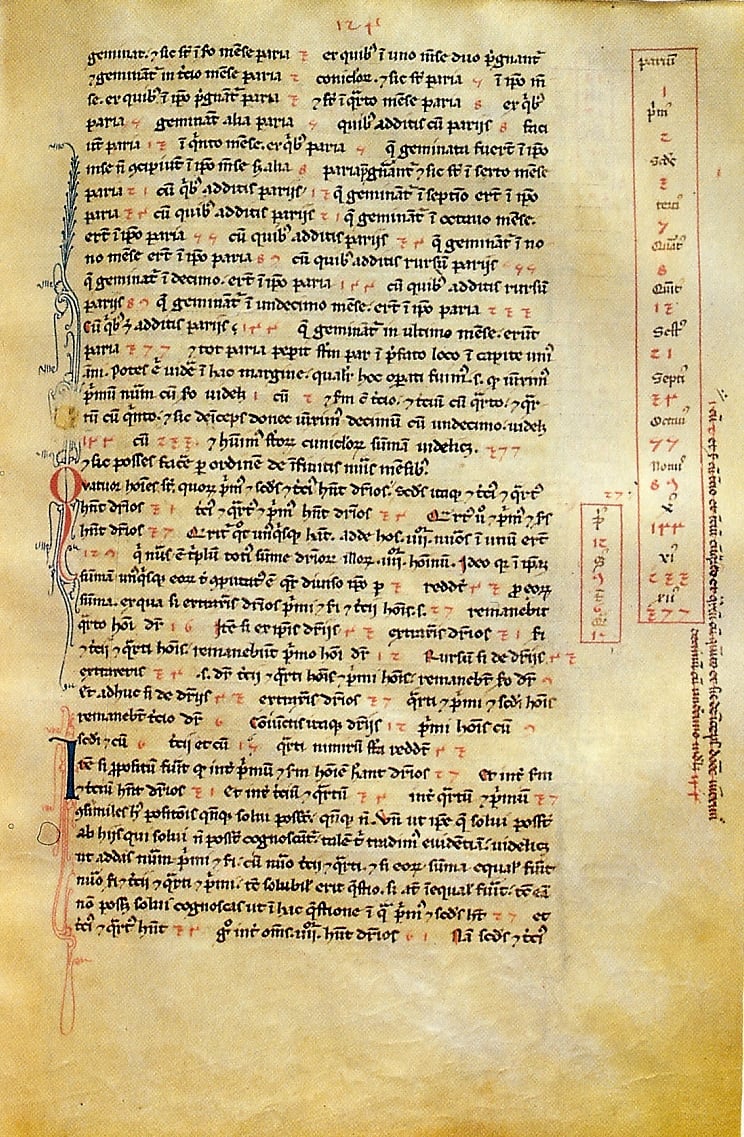
In 1202, Leonardo of Pisa, the mathematician later remembered as Fibonacci, completed the Latin treatise Liber Abaci. Although the title translates literally to The Book of Calculation, modern scholars such as Laurence Sigler observe that it was not an instruction manual for the mechanical abacus. In medieval Italy, the term referred broadly to arithmetic, and Fibonacci's volume was among the earliest Western texts to champion base-10 positional notation and glyphs resembling modern numerals, presenting computation without physical counters.
Leonardo encountered this numerical system during his youth in Bugia, where his father served as an official in the customs house for Pisan traders. Recognizing the value of mathematical training for commerce, his father arranged for his instruction in what Leonardo termed the method of the Indians. His travels across Egypt, Syria, Greece, Sicily, and Provence convinced him of the immense practical advantages of Indian reckoning over traditional European methods based on Roman numerals and older reckoning devices.

Keep reading in Yester
Coming soon to the App Store