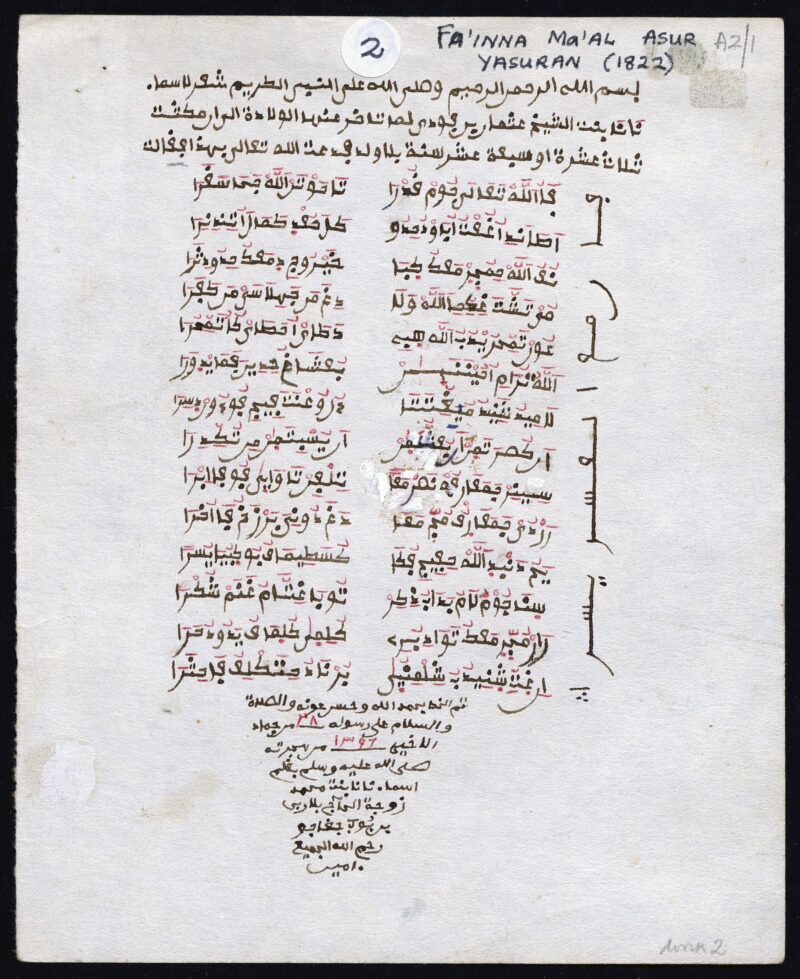
Nana Asma’u Builds Networks of Women’s Learning
Teaching, poetry and scholarship helped spread education in nineteenth-century Sokoto.
Nana Asma'u was born in 1793 in the settlement of Degel, shortly before the outbreak of the conflicts that led to the foundation of the Sokoto Caliphate. She was the daughter of the scholar and leader Usman dan Fodio, whose religious reform efforts sparked the Fulani War between 1804 and 1808. Growing up amidst these military and political transformations, Asma'u witnessed the early upheaval of the new empire and later reported on battles she had witnessed in her written works.
Trained rigorously in Qur'anic interpretation and traditional Islamic scholarship, Asma'u became fluent in Arabic, Fula, Hausa, and Tamacheq. She was a Sufi of the Qadiriyya order, whose community regarded denying women the chance to develop their talents through education as contrary to God's will. Alongside female relatives such as her sisters Maryam and Fatima, Asma'u assumed a prominent intellectual and social role within the state. When her half-brother Muhammed Bello became the second Sultan, she served as his trusted counsellor, maintaining correspondence with regional officials and foreign scholars while advocating for community ethics.

Keep reading in Yester
Coming soon to the App Store
Keep following the story
Sources
- Nana Asma'u, Muslim Woman Scholar: Excerpts from One Woman's Jihad by Beverly B. Mack and Jean Boyd (Women in World History, Roy Rosenzweig Center for History and New Media, George Mason University)
- General History of Africa VI: Africa in the Nineteenth Century until the 1880s (UNESCO, via Internet Archive)
- Nana Asmaʼu
Image: Nana Asma'u (1793–1864)