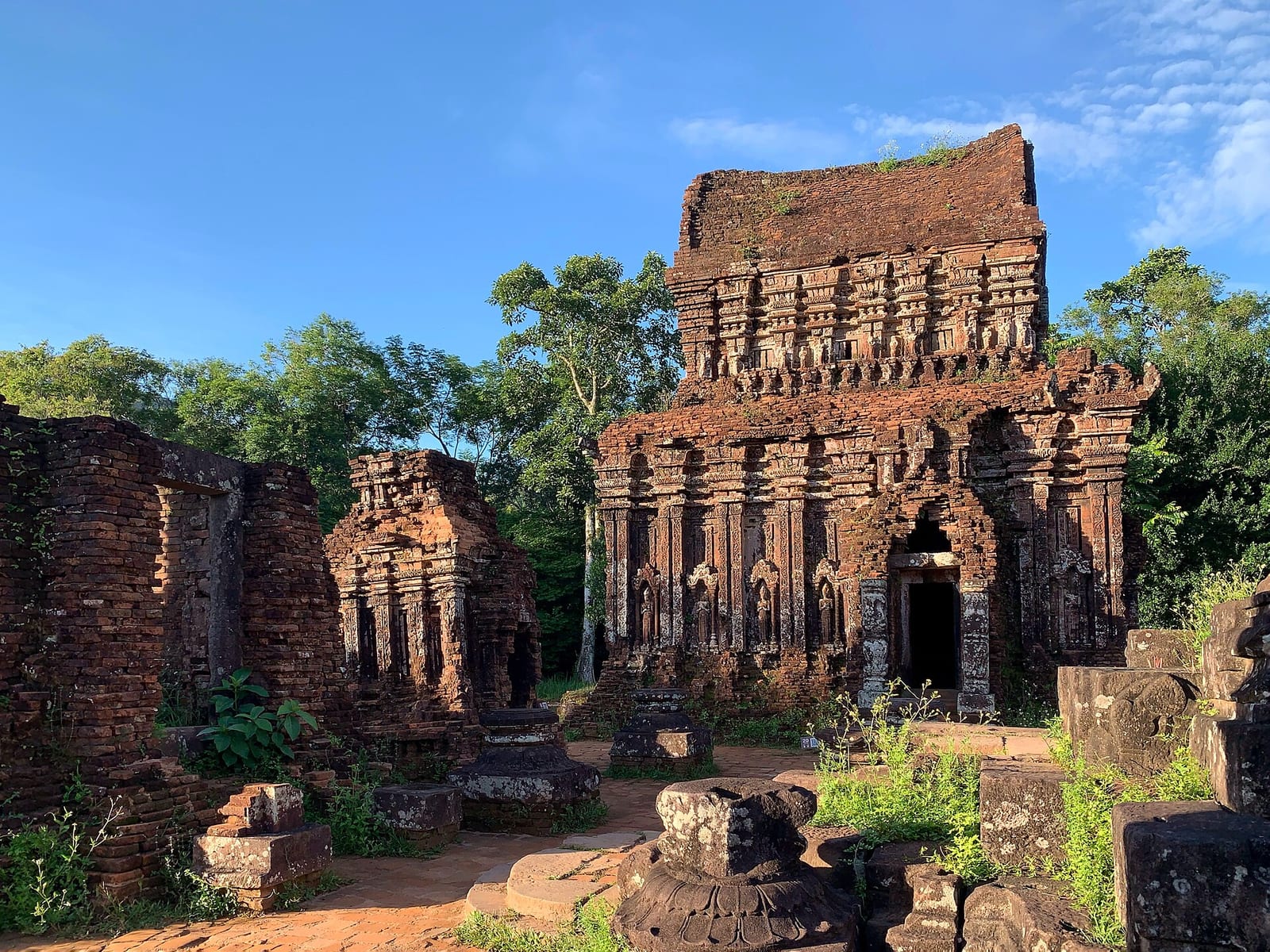
Mỹ Sơn Preserves the Sacred Architecture of Champa
Temple remains record a regional civilization shaped by local rulers and wider religious exchange.
In a two-kilometer valley ringed by mountain ranges in central Vietnam, the brick enclosures and sanctuaries of Mỹ Sơn preserve the religious heart of the historical kingdom of Champa. Built primarily between the fourth and thirteenth centuries, the complex formed a ceremonial center for Cham monarchs and served as a burial site for royalty and leaders. Dedicated principally to Shiva under titles such as Bhadreshvara, the compound lay within reach of the ancient political hubs of Simhapura and Indrapura, anchoring sacred rituals through centuries of shifting dynastic authority.
The earliest documented phase began under King Bhadravarman I, who reigned from 380 to 413 and dedicated the valley to Shiva through the erection of an inscribed stone stele and a timber hall sheltering a lingam. That initial structure burnt down in the sixth century, prompting King Sambhuvarman to rebuild during his reign from 572 to 629. His reconstructed sanctuary, later labeled A1 by archaeologists, honored the divinity as Sambhu-Bhadresvara. Even after Chinese forces sacked the Cham capital in 605, Sambhuvarman preserved the sanctuary, restored stability, and maintained tributary relations with the northern court.

Keep reading in Yester
Coming soon to the App Store
Keep following the story
Sources
Image: Chainwit.