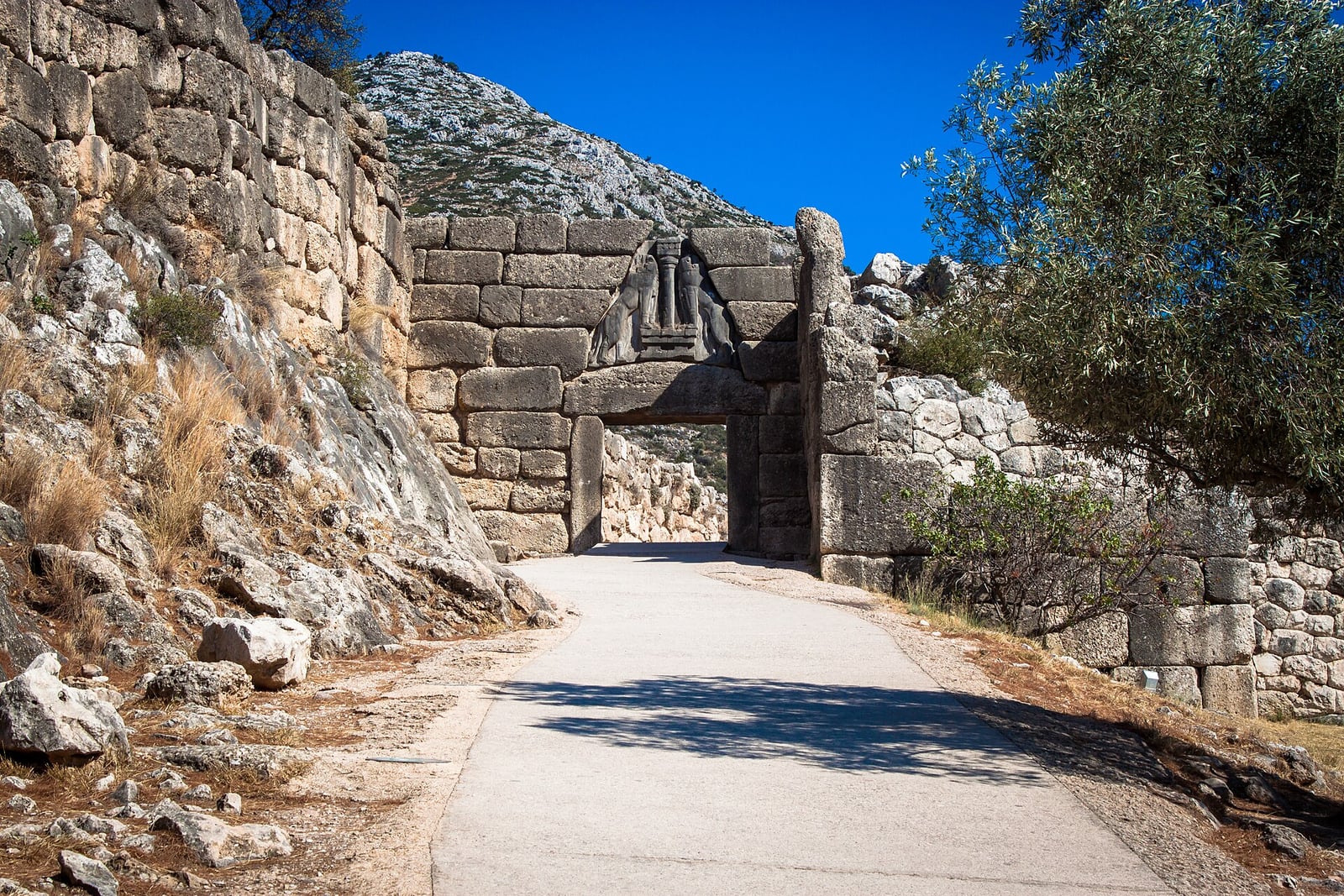
Mycenae Raises the Lion Gate
The citadel of legendary Agamemnon was entered through a gate topped by carved lions.
Perched on an acropolis hill rising 274 metres above sea level in the north-eastern Peloponnese, Mycenae commanded the Argive plain and guarded key transit routes toward the Isthmus of Corinth. Although traces of settlement at the location reach back to the Early Neolithic era, the community expanded into a dominant regional power during the Late Bronze Age. By roughly 1350 BCE, monumental fortifications arose around the summit, constructed from limestone blocks so enormous that classical Greeks later attributed the masonry to mythical giants known as the Cyclopes.
Around 1250 BCE, during the ceramic period classified by archaeologists as Late Helladic IIIB, planners dramatically extended the defensive perimeter along the western slope. This expansion brought an ancestral royal burial ground, now termed Grave Circle A, inside the fortified precinct. To serve as the primary entry through the newly fortified circuit, builders raised the monument known today as the Lion Gate, where a stepped ramp directed visitors past the venerable shaft graves and upward toward the palace complex on the peak.

Keep reading in Yester
Coming soon to the App Store
Keep following the story
Sources
- Archaeological Sites of Mycenae and Tiryns (UNESCO World Heritage Centre)
- Mycenae: Institutions (Mycenae Excavations, Archaeological Society at Athens)
- The magic of Mycenae (Current World Archaeology)
- City of Mycenae (EBSCO Research Starters)
- Diodorus Siculus, Library of History, Book XI (LacusCurtius, University of Chicago)
- Mycenae
Image: Andy Hay from UK