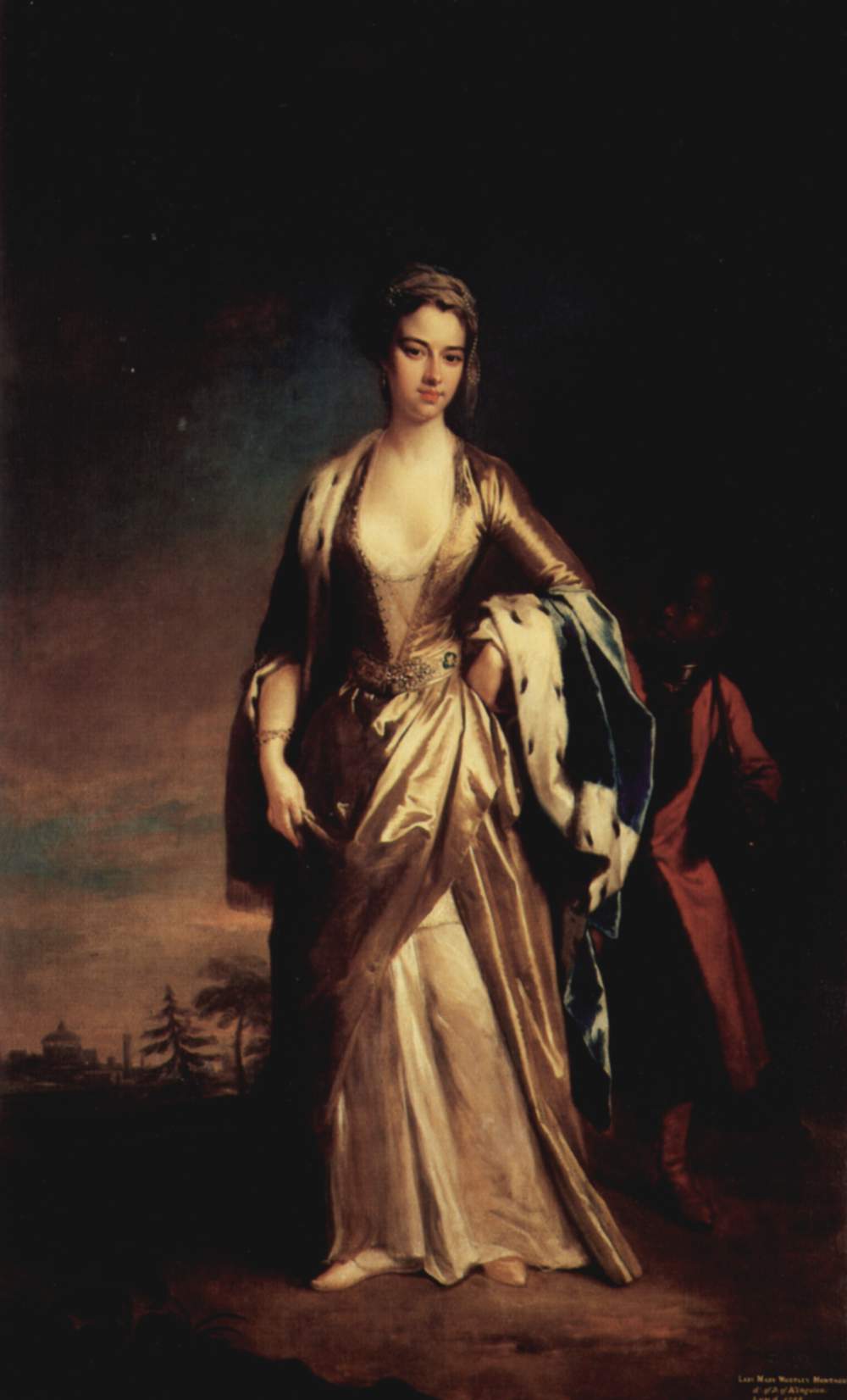
Lady Mary Wortley Montagu Promotes Smallpox Inoculation
A practice she saw in Constantinople entered British medicine.
In 1717, while residing in the Ottoman Empire, Lady Mary Wortley Montagu witnessed a regional medical custom designed to confer protection against smallpox. Her husband, Edward Wortley Montagu, had been dispatched to Constantinople as the British ambassador to the Ottoman court. Having suffered from smallpox herself in 1715, which left her facial features scarred, and having lost her brother to the infection, Lady Mary took an immediate interest in the method. Ottoman women practiced variolation, which she referred to as engrafting, by transferring live matter from a mild smallpox vesicle into scratched incisions on an uninfected recipient's arm or leg, routinely inducing a milder infection and subsequent immunity.
Convinced of the value of this preventive treatment, Lady Mary resolved to shield her family from the lethal disease. In March 1718, she arranged for embassy surgeon Charles Maitland to inoculate her young son, Edward. Writing to correspondents in Britain, she reported that local practitioners safely administered variolation each autumn to thousands without fatal outcomes. Her accounts praised the hospitality and domestic practices of Ottoman women, whose segregated social circles provided her with firsthand access to traditions generally hidden from Western male observers.

Keep reading in Yester
Coming soon to the App Store
Keep following the story
Sources
- Lady Mary Wortley Montagu (1689-1762): Smallpox Vaccination in Turkey (Internet Modern History Sourcebook, Fordham University)
- Edward Jenner and the history of smallpox and vaccination (Proceedings of Baylor University Medical Center, via PubMed Central)
- How Mary Wortley Montagu's bold experiment led to smallpox vaccine, 75 years before Jenner (The Guardian)
- Lady Mary Wortley Montagu (Eighteenth-Century Poetry Archive)
- Lady Mary Wortley Montagu
Image: Jonathan Richardson the younger