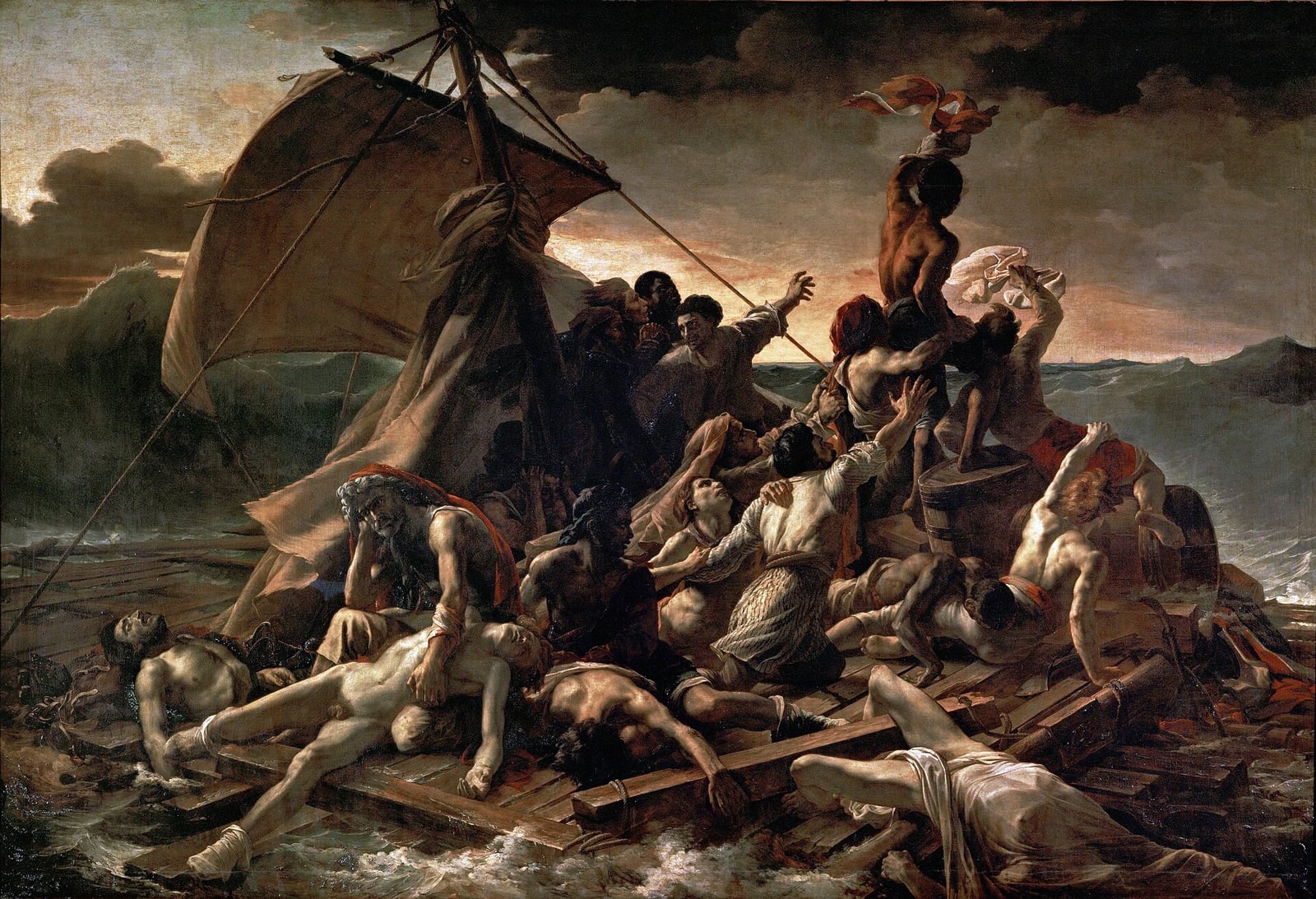
Géricault Turns a Shipwreck Scandal into a Painting
A huge canvas made survivors of a naval disaster into an accusation against the government.
On 2 July 1816, the French naval frigate Meduse ran aground on the Arguin sandbank off the coast of present-day Mauritania. The vessel was carrying a new governor to Senegal, which Britain was handing back to France after the Napoleonic Wars. Its commander, Viscount Hugues Duroy de Chaumareys, was a Bourbon loyalist who had not navigated for roughly two decades, having secured his post through political preferment rather than operational readiness. When the ship could not be refloated, most of the roughly 400 people aboard took to the boats, and 17 men chose to stay with the wreck. Another 147 people, 146 men and one woman, were herded onto an improvised wooden raft about 20 meters long. Although initial plans called for the boats to tow the platform, the towlines were quickly cast off.
For thirteen days, the abandoned platform drifted without effective steering. Thirst, starvation, exposure, violent mutinies, and cannibalism decimated those aboard; by the fourth day only 67 people were still alive. When the French brig Argus came across the raft by chance on July 17, only fifteen survivors remained alive. Public outrage erupted once accounts spread across Europe, transforming the nautical disaster into a political crisis for the newly restored Bourbon administration. Théodore Géricault, an ambitious young French artist, recognized that the disaster provided the material to establish his artistic reputation, deciding to execute a colossal, uncommissioned canvas based on the event.

Keep reading in Yester
Coming soon to the App Store
Keep following the story

Sources
- Narrative of a Voyage to Senegal in 1816, Savigny and Corréard (Project Gutenberg)
- The Raft of the Medusa (Royal Museums Greenwich)
- Explaining the Raft of The Medusa (TheCollector)
- Le radeau de la Méduse, INV 4884 (Musée du Louvre, Collections)
- Romanticism, topicality, sensuality (Musée du Louvre)
- Joseph: A Celebrated Haitian Model in 19th-Century Paris (Getty)
- The Raft of the Medusa
Image: Théodore Géricault