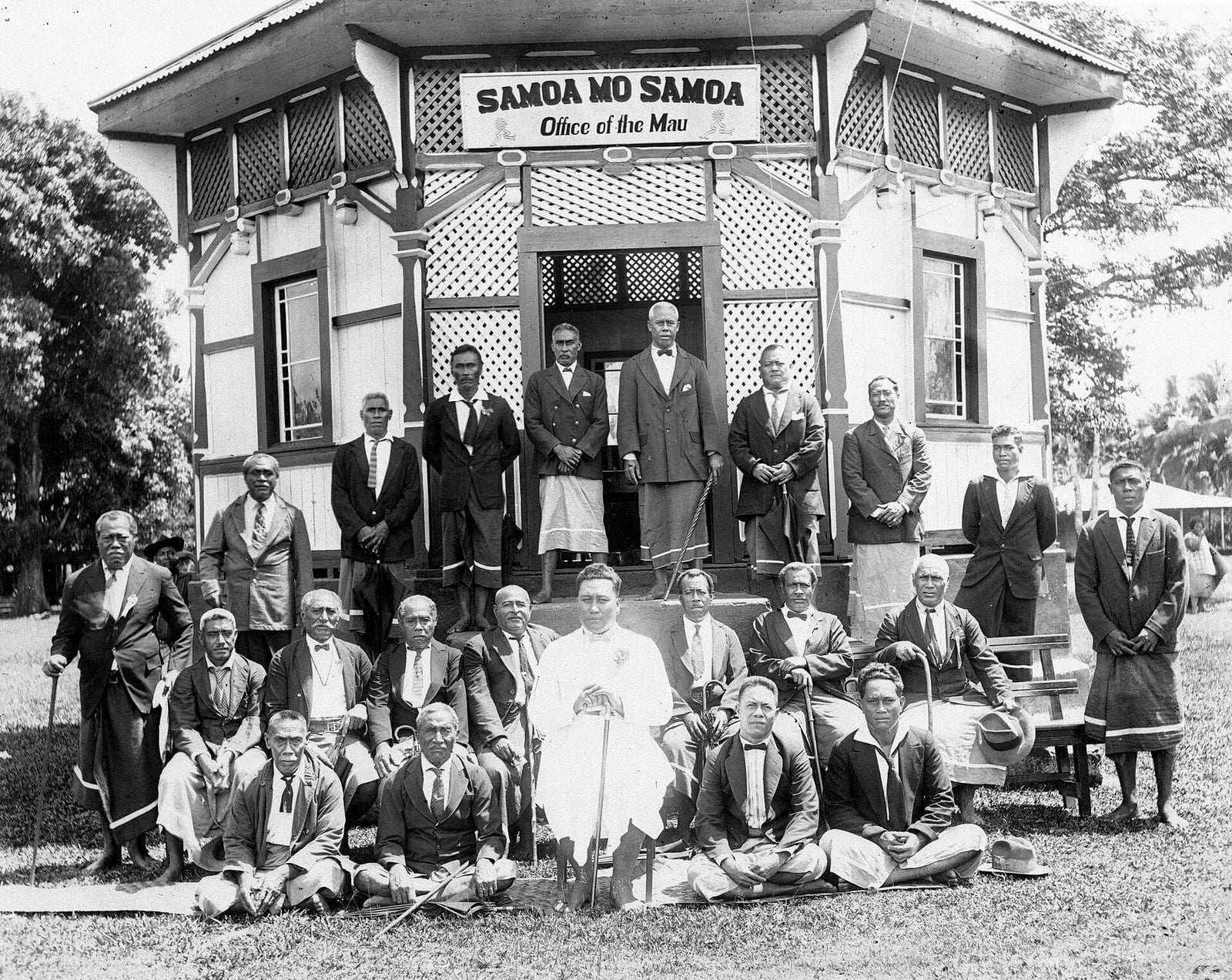
The Mau Movement Marches for Samoan Self-Rule
A nonviolent protest met deadly force on Black Saturday.
On 28 December 1929, hundreds of Samoans gathered in the coastal town of Apia to welcome Alfred Smyth, a community leader returning from two years of political exile. The demonstration was organized by the Mau, a widespread nonviolent movement seeking self-rule under the motto Samoa mo Samoa, meaning Samoa for the Samoans. Participants marched in their distinctive uniform of navy blue lavalavas bordered with white stripes, an emblem the New Zealand colonial authorities had outlawed. As the parade passed through the streets, military police attempted to arrest a marcher, sparking a confrontation that ended when police fired into the crowd.
The demonstration descended into bloodshed later remembered as Black Saturday. When stone throwing broke out, Tupua Tamasese Lealofi III, a paramount chief and prominent Mau leader, stepped between the crowd and the police lines, turning his back to the officers while calling for nonviolence. He was shot from behind, and several bystanders who ran forward to shield or assist him were struck down by gunfire. Police also fired a Lewis machine gun from the balcony of the police station. By evening, eight Samoans were dead and three more died later of their wounds, alongside dozens injured. One New Zealand constable was clubbed to death by protesters during the melee.

Keep reading in Yester
Coming soon to the App Store
Keep following the story
Sources
- How NZ took influenza to Samoa, killing a fifth of its population (RNZ)
- The 1918 Influenza Pandemic in Samoa and the Wider Pacific (DigitalNZ, National Library of New Zealand)
- Samoans 'bled' for independence: Tanuvasa (Samoa Observer)
- Western Samoa Gains Independence from New Zealand (EBSCO Research Starters)
- Samoa, The World Factbook (CIA, via Unbound Medicine mirror)
- Mau movement
Image: Alfred John Tattersall