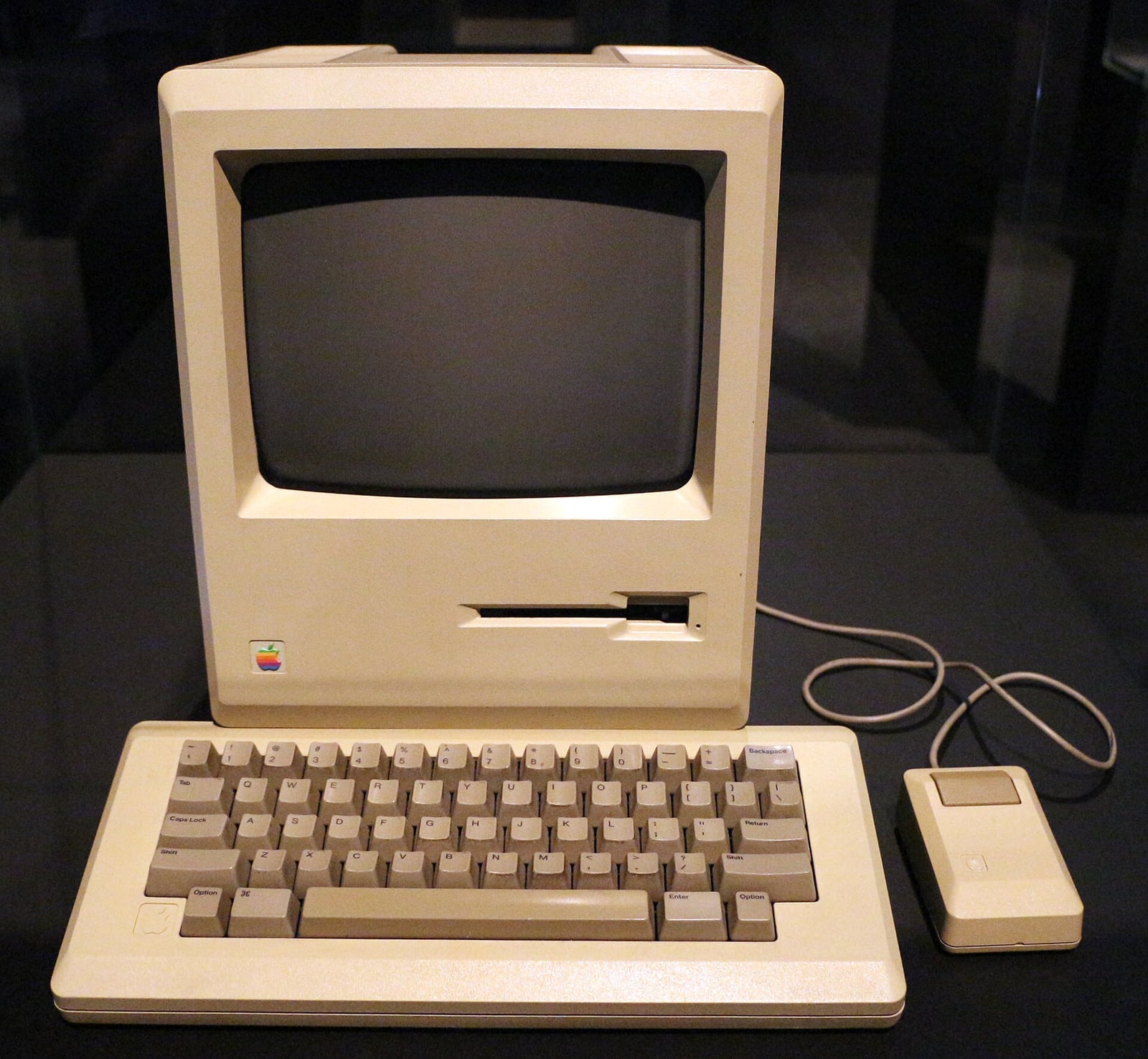
Apple Introduces the Macintosh
A computer with a mouse and on-screen windows brought graphical interfaces to a wide market.
In 1979, Apple began planning new personal computers to follow the Apple II. Jef Raskin initiated the Macintosh project as an affordable, consumer-oriented machine, originally intended to run a text-based interface. Around the same time, Apple engineers visited Xerox PARC to study advanced experimental systems utilizing graphical user interfaces. While Apple's high-end Lisa project incorporated these concepts, Macintosh team member Bud Tribble urged hardware designer Burrell Smith to adapt Lisa's Motorola 68000 processor for the lower-cost machine. By late 1980, Smith succeeded in building a compact board running the chip. Steve Jobs soon focused his attention on the project, leading to Raskin's departure in 1981, and guided the machine toward a design centered on a graphical interface.
Apple manufactured the computer at a factory in Fremont, California, packaging the system into a beige desktop enclosure with a built-in handle. The physical unit contained a nine-inch monochrome cathode-ray tube screen displaying 512 by 342 pixels, along with a single 400-kilobyte 3.5-inch floppy disk drive. To make operation quiet, Jobs insisted on omitting an internal cooling fan, relying instead on convective airflow, a design choice later blamed for hardware reliability issues. The hardware ran on an 8-megahertz Motorola 68000 processor sharing 128 kilobytes of system memory with the video display logic, supported by 64 kilobytes of read-only memory holding core routines.

Keep reading in Yester
Coming soon to the App Store
Keep following the story
Sources
- Apple Macintosh Microcomputer (Smithsonian National Museum of American History)
- Apple Macintosh 512K Microcomputer (Smithsonian National Museum of American History)
- Apple Macintosh 128K (Centre for Computing History)
- Jobs, Raskin, and the Macintosh: What the Record Shows (Raskin Center for Humane Interfaces)
- Macintosh 128K
Image: Sailko