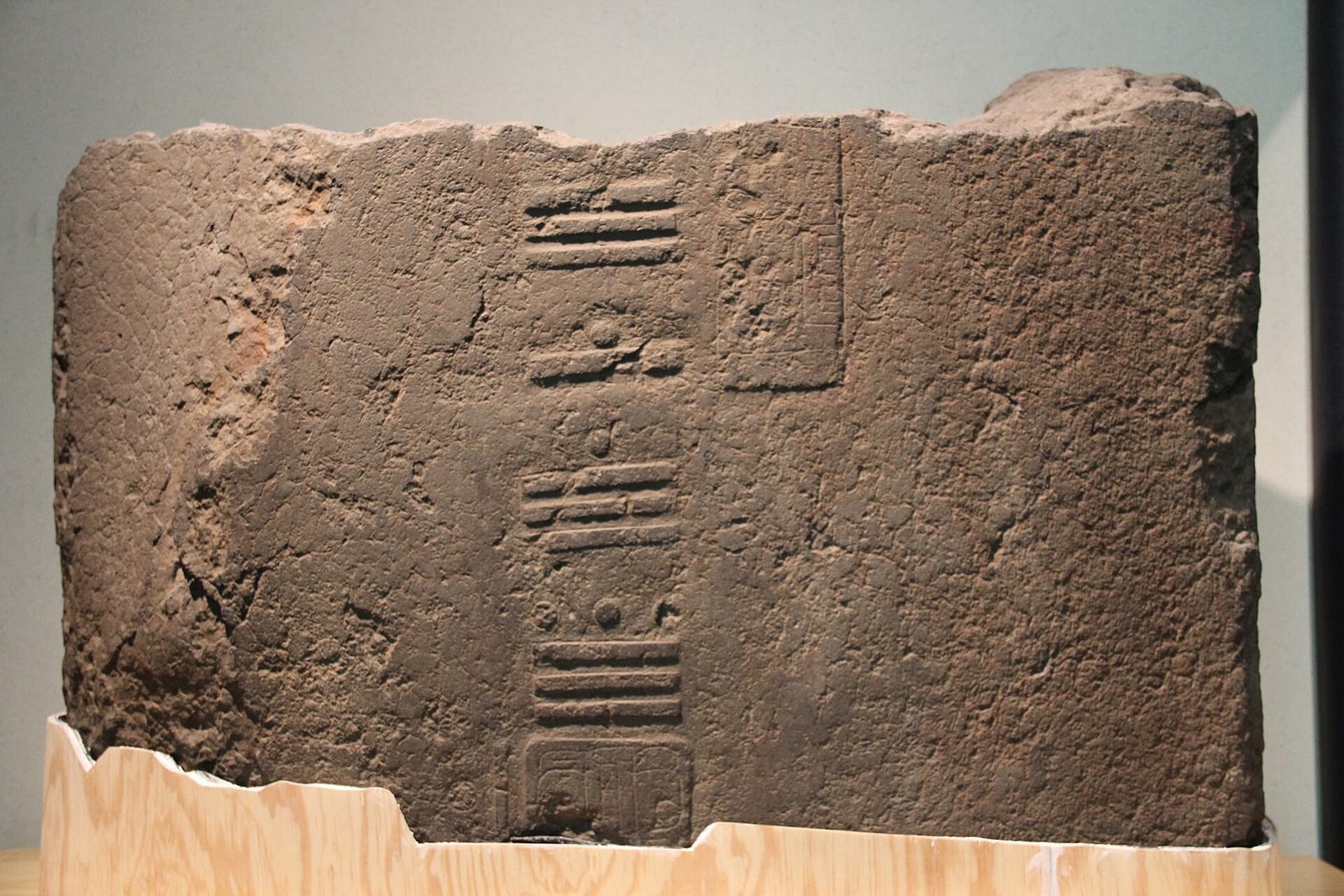
The Oldest Known Long Count Date Is Carved in Chiapas
A stela records a day in December 36 BCE, counted from a mythical starting point.
In Mesoamerican chronometry, standard cycles like the 260-day tzolk'in and the 365-day haab' tracked civil and ritual schedules within recurring fifty-two-year intervals known as Calendar Rounds. To record historical events across centuries without ambiguity, ancient societies developed the Long Count calendar. This non-repeating system tabulated elapsed days from a distant cosmological starting point, identified by the widely accepted Goodman-Martinez-Thompson correlation as August 11, 3114 BCE in the proleptic Gregorian calendar. Unlike a strict base-twenty count, the tally functioned as a modified vigesimal system, setting its second positional unit to roll over at eighteen so that a third-order unit spanned 360 days.
The earliest preserved contemporaneous Long Count inscription appears on Stela 2 at the archaeological site of Chiapa de Corzo in Chiapas, Mexico. The carved monument registers a date calculated to 36 BCE, making it the oldest undisputed Long Count date found on a physical monument. Another contender, Stela 2 from Takalik Abaj in Guatemala, preserves an eroded inscription that could span anywhere between 236 BCE and 19 BCE, but its worn numerals render the exact reading uncertain. Meanwhile, painted mural fragments from San Bartolo in Guatemala, dated to between 300 and 200 BCE, record the day 7 Deer in the 260-day calendar, the earliest securely dated Maya calendar notation, though not a Long Count date, so Stela 2 at Chiapa de Corzo retains its status as the oldest confirmed contemporaneous Long Count text.

Keep reading in Yester
Coming soon to the App Store
Keep following the story
Sources
Image: Gary Todd