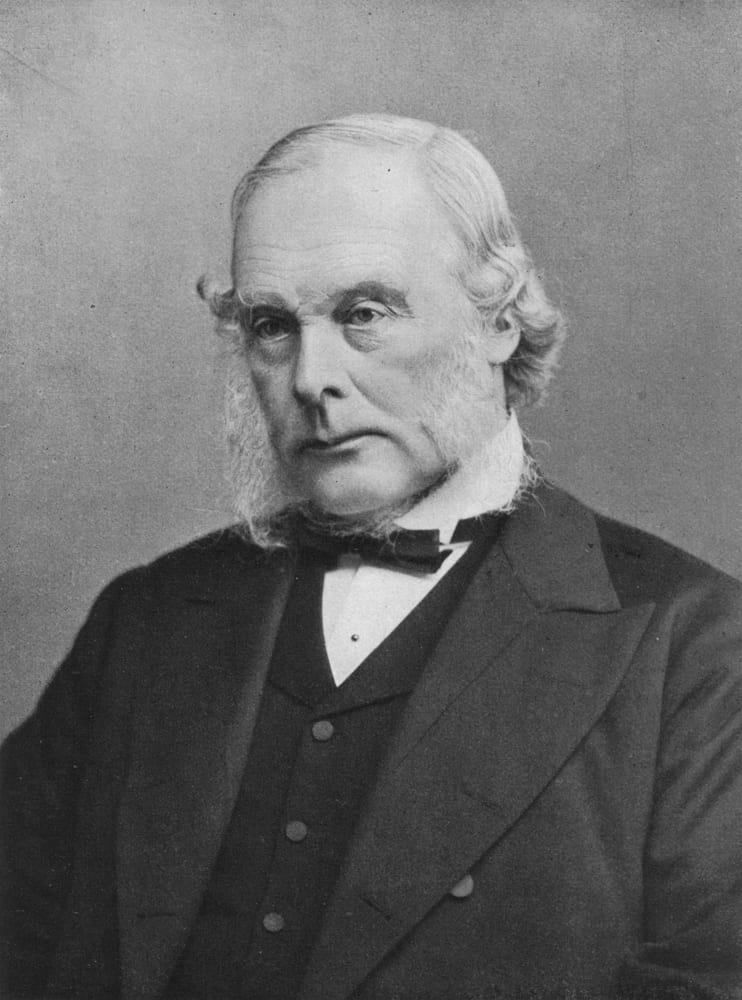
Lister Makes Antisepsis a Surgical Practice
Experiments with antiseptic treatment changed how surgeons approached wound infection.
During his clinical appointments at University College Hospital in the early 1850s, Joseph Lister encountered the deadly consequences of post-operative blood poisoning. Outbreaks of hospital gangrene, pyaemia, and erysipelas frequently swept through surgical wards, where surgeons often interpreted the spread of disease through miasma theory, attributing it to noxious foul air produced by the wounds themselves. Lister, observing that cleaned and debrided injuries occasionally recovered, began to suspect that a specific agent within the wound rather than ambient atmospheric vapours drove putrefaction, though at the time he lacked a theoretical framework to identify the mysterious bodies he observed through his microscope.
Lister's perspective shifted fundamentally upon examining Louis Pasteur's work on fermentation and the germ theory. Connecting wound decay to the action of microorganisms, Lister reasoned that destroying microscopic germs before they could multiply in exposed tissue would stop infection from taking hold. As a surgeon at the Glasgow Royal Infirmary, he introduced carbolic acid, a chemical known today as phenol, to test this hypothesis. His system required using the chemical to sterilise surgical instruments, sutures, patients' skins, operating wards, and the hands of surgeons.

Keep reading in Yester
Coming soon to the App Store
Keep following the story
Sources
- The Case of James Greenlees (Royal College of Physicians and Surgeons of Glasgow, Heritage)
- Joseph Lister: Antiseptic Principle of the Practice of Surgery, 1867 (Internet History Sourcebooks, Fordham University)
- Farmer to industrialist: Lister's antisepsis and the making of modern surgery in Germany (Notes and Records of the Royal Society, via PMC)
- From the Base of the Cecum to the Throne of England: King Edward VII's Appendix (Washington University in St. Louis, peer-reviewed article record)
- From Barbers and Butchers to Modern Surgeons (Science History Institute, Distillations)
- Joseph Lister
Image: Unknown author Unknown author