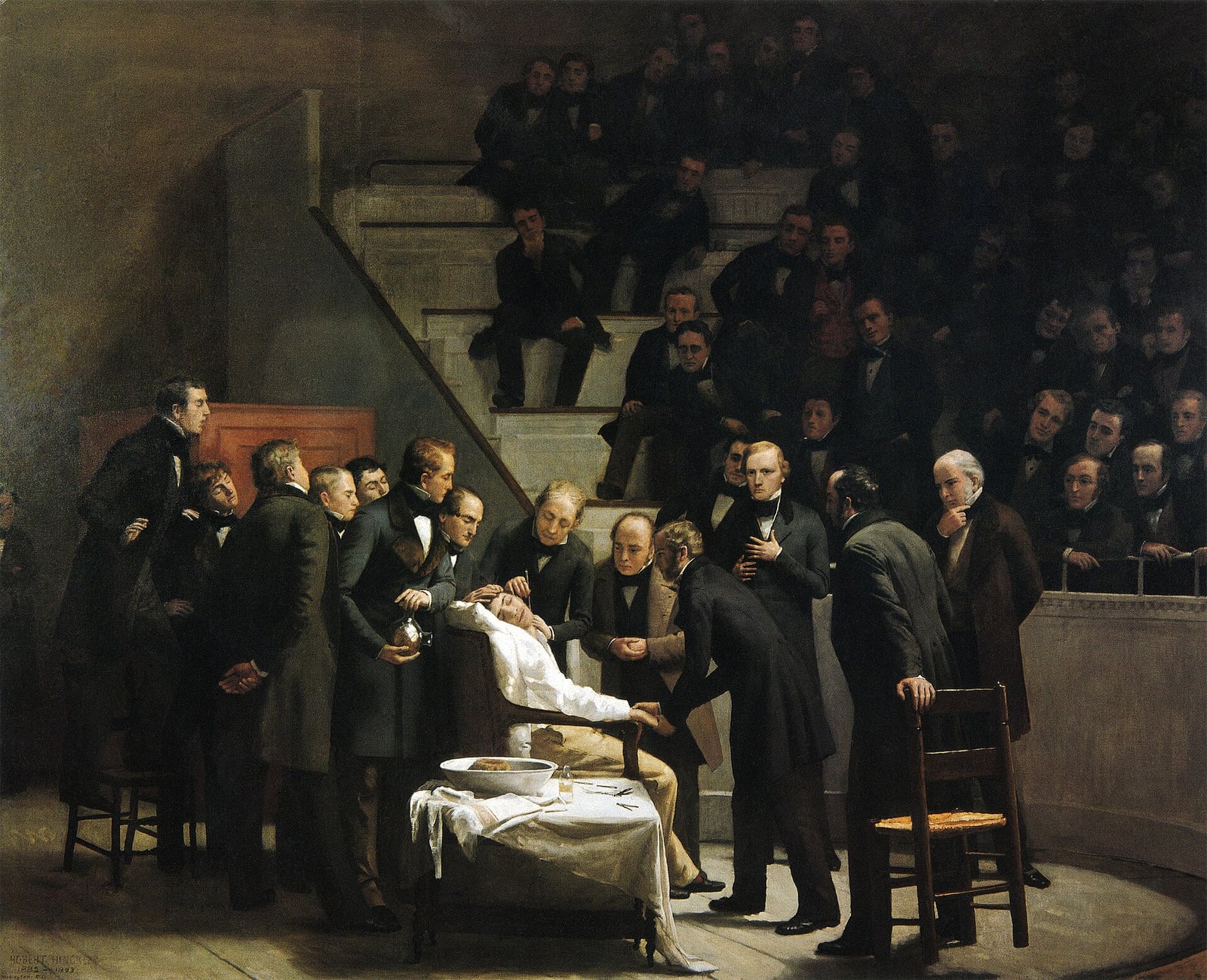
A Public Operation Demonstrates Ether Anesthesia
Surgery without pain moved from rumor to demonstration in a Boston amphitheater.
On October 16, 1846, inside the operating amphitheater of the Massachusetts General Hospital in Boston, the American dentist William T. G. Morton administered inhaled sulfuric ether to a patient named Edward Gilbert Abbott. Surgeon John Collins Warren then proceeded to excise a tumor from the man's neck without causing surgical pain. This public presentation followed Morton's successful, painless extraction of a tooth on September 30, 1846, about two weeks earlier. Henry Jacob Bigelow, a Boston surgeon who read a newspaper report regarding the dental procedure, helped organize the October exhibition, which transformed whispered experiments into a widely acknowledged medical breakthrough.
Morton had learned dentistry from Hartford practitioner Horace Wells, and the two briefly worked as partners. After turning to the study of medicine at Harvard, Morton attended chemistry lectures given by Charles T. Jackson, who is credited with putting him on the trail of ether. Morton departed Harvard without finishing his degree, but he carried forward an ambition to apply chemical vapors to alleviate the severe physical torment traditionally associated with surgery. Following the successful Boston demonstration, the hospital venue earned lasting renown as the Ether Dome.

Keep reading in Yester
Coming soon to the App Store
Keep following the story
Sources
Image: Robert Cutler Hinckley