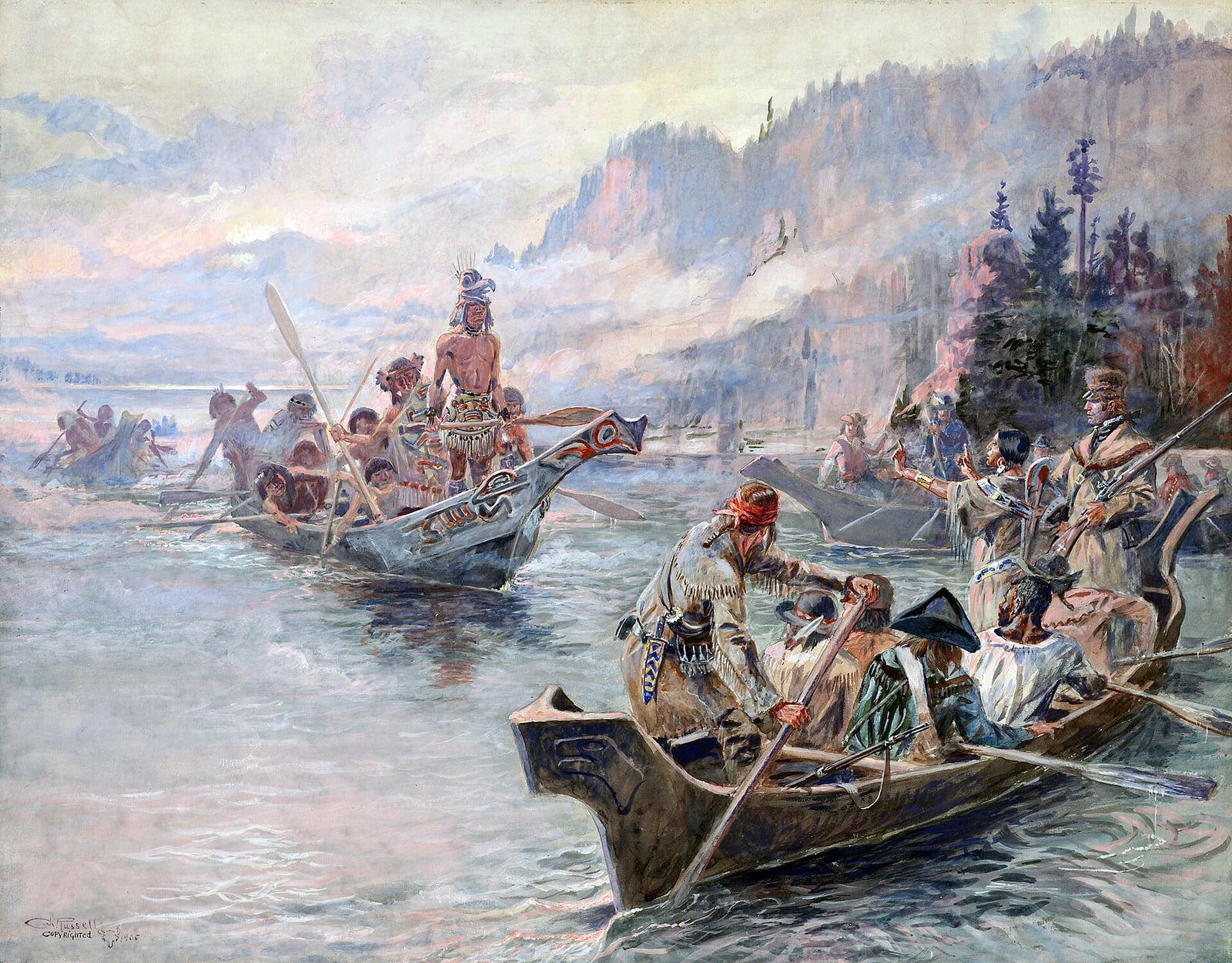
Lewis and Clark Set Out Across the American West
An expedition depended on Native nations and guides, including Sacagawea.
On May 14, 1804, a detachment of over thirty men under Second Lieutenant William Clark departed Camp Dubois on the eastern bank of the Mississippi River, navigating up the Missouri River to join Captain Meriwether Lewis in St. Charles, Missouri. Commissioned by President Thomas Jefferson following the 1803 Louisiana Purchase, the military and civilian party known as the Corps of Discovery was charged with traversing the continent to the Pacific Ocean. Jefferson sought a direct water route for commerce, an inventory of western geography and natural resources, and the formal assertion of United States sovereignty over indigenous territories before European empires could expand their own footholds.
The journey relied heavily on diplomacy and trade with sovereign indigenous populations. Carrying silver peace medals, gift bundles, and advanced weaponry, the Corps aimed to impress Native leaders while securing safe passage. Relations varied sharply across different territories. Near the confluence of the Missouri and Bad rivers in September 1804, a tense dispute over tribute with Lakota leaders nearly triggered an armed confrontation until chief Black Buffalo intervened to defuse the standoff. Farther north, the expedition established winter quarters at Fort Mandan, where they maintained stable trade with the Mandan nation and hired French-Canadian fur trapper Toussaint Charbonneau as an interpreter.

Keep reading in Yester
Coming soon to the App Store
Keep following the story
Sources
- York (NPS)
- Soldier Pay (Lewis and Clark Fort Mandan Foundation, lewis-clark.org)
- Congressional compensation (Lewis and Clark Trust)
- May 14, 1804 (Journals of the Lewis and Clark Expedition, University of Nebraska-Lincoln)
- February 11, 1805 (Journals of the Lewis and Clark Expedition, University of Nebraska-Lincoln)
- September 23, 1806 (Journals of the Lewis and Clark Expedition, University of Nebraska-Lincoln)
- The Vote at Station Camp (National Park Service)
- Two Medicine Fight Site (National Park Service)
Image: Charles Marion Russell