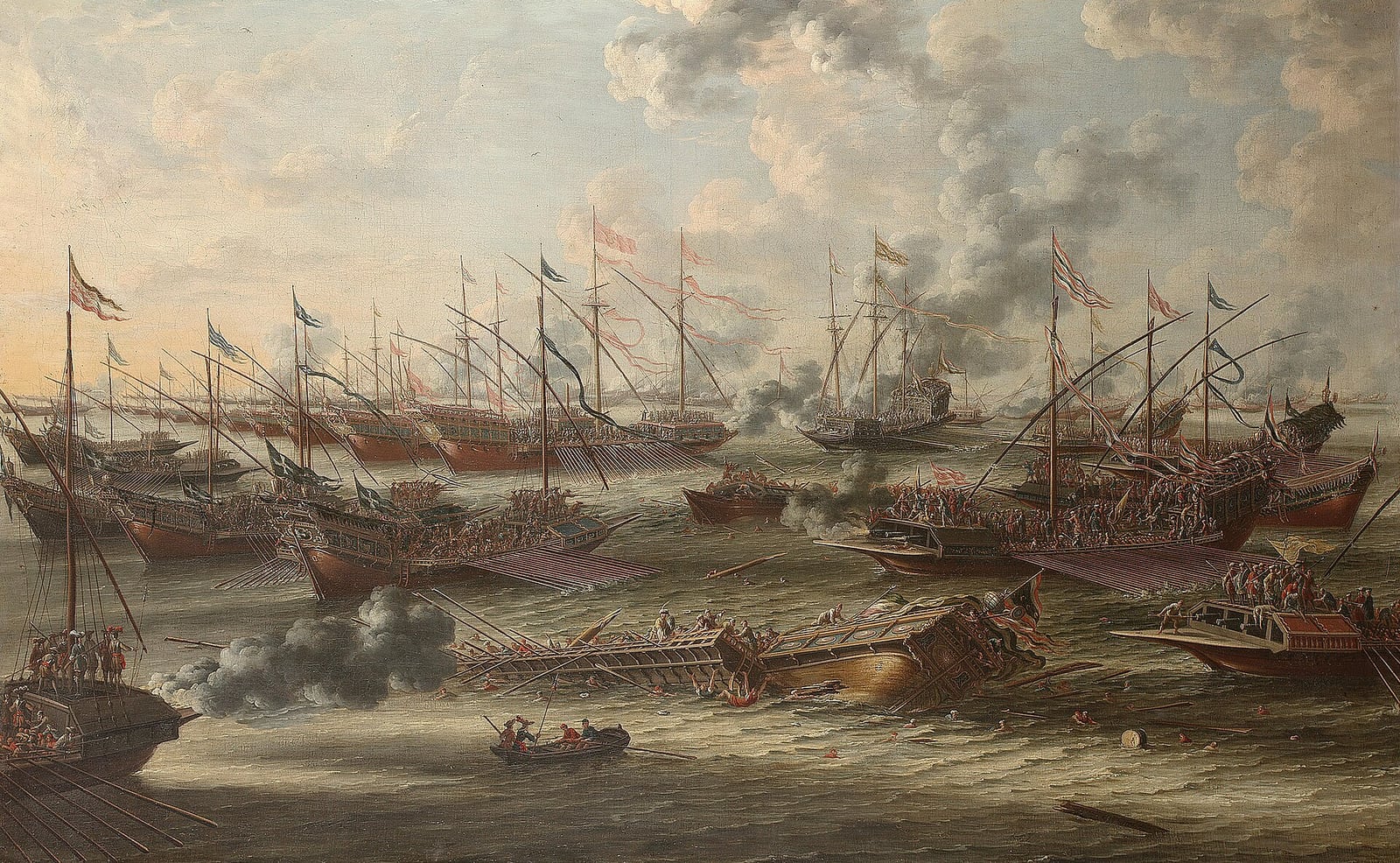
The Holy League Defeats the Ottoman Fleet at Lepanto
A huge galley battle became a symbol of Mediterranean rivalry.
On the morning of 7 October 1571, two massive galley fleets deployed in the Gulf of Patras off western Greece. The Holy League, an alliance organized by Pope Pius V that brought together the Spanish Empire, the Republic of Venice, the Papal States, Genoa, and several smaller Catholic powers, had assembled over two hundred galleys and six Venetian galleasses. Facing them was the Ottoman navy, commanded by Ali Pasha, which sailed out from its station at Lepanto with over two hundred war galleys and dozens of galliots. Both sides sought control of the Mediterranean sealanes following the Ottoman capture of Venetian positions in Cyprus earlier that year.
The clash was essentially an infantry combat fought on floating wooden platforms, marking the last major naval encounter in Western history conducted almost entirely with oared warships. The Holy League vessels carried thousands of veteran Spanish, Italian, and German infantry, supported by a substantial advantage in artillery and firearms such as muskets and arquebuses. By contrast, the Ottoman fleet relied heavily on composite bowmen and suffered from shortages in its elite janissary forces, while its oarsmen were largely enslaved Christian captives; the Christian galleys, for their part, were rowed by Muslim captives, convicts, and hired men.

Keep reading in Yester
Coming soon to the App Store
Keep following the story
Sources
Image: Laureys a Castro