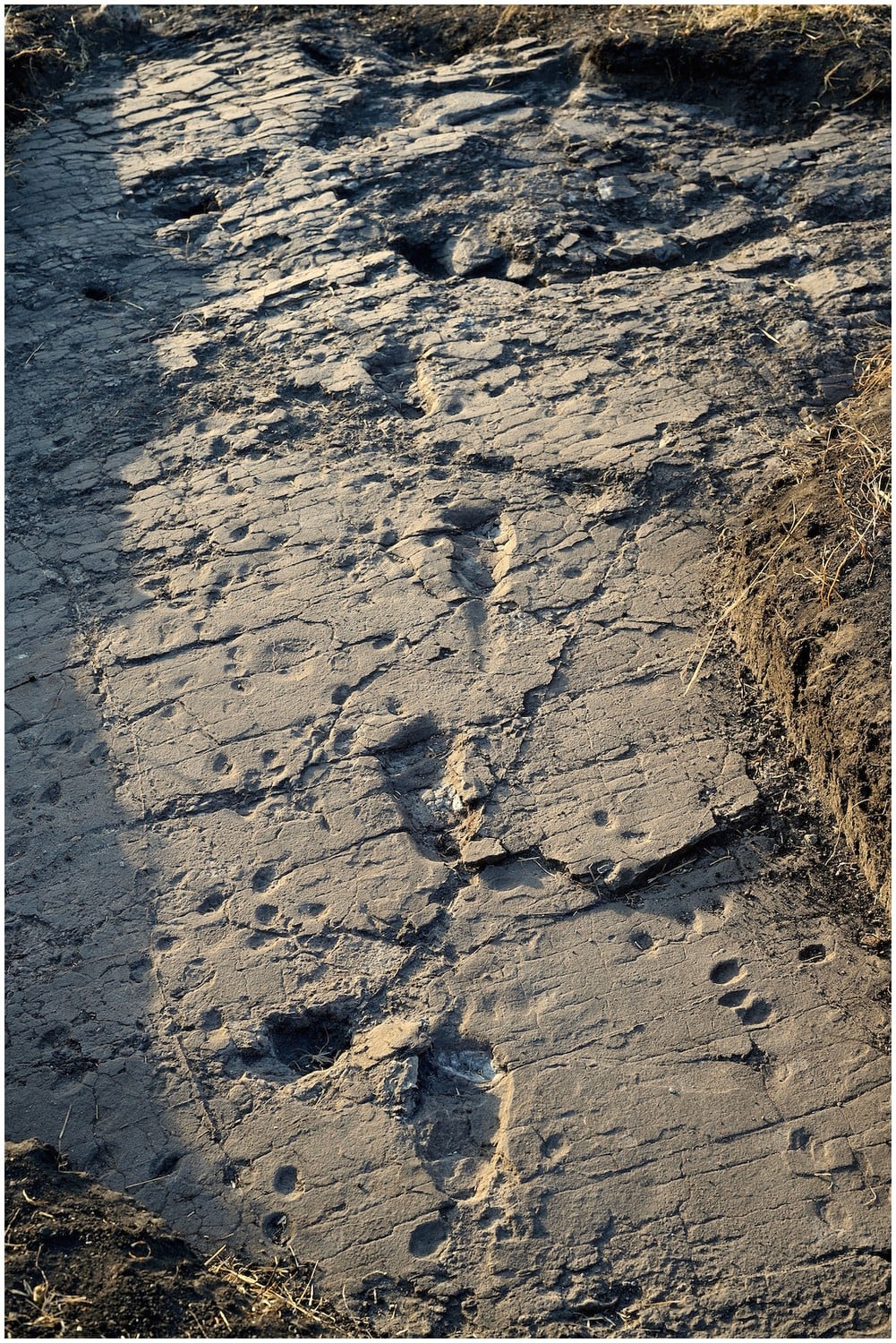
Mary Leakey’s Team Finds 3.7-Million-Year-Old Footprints
Volcanic ash in Tanzania preserved tracks of early humans walking upright.
In 1976, members of paleoanthropologist Mary Leakey's field team came across fossilized animal tracks preserved in hardened volcanic ash at Laetoli, a prehistoric site in northern Tanzania located forty-five kilometers south of Olduvai Gorge. The location had drawn scientific interest since 1935, when a local resident named Sanimu persuaded Louis Leakey to inspect the area, yielding early fossil collections. Excavations led by Mary Leakey in 1978 and 1979 exposed a continuous trackway of early hominin impressions about twenty-seven meters long. Potassium-argon dating and stratigraphical analysis placed the layer, part of the Upper Laetolil Beds, between 3.6 and 3.8 million years old, establishing the prints as the oldest direct evidence of hominin bipedalism identified up to that time.
The tracks at the primary locality, known as Site G, preserve the path of three individuals traveling in the same direction. One individual stepped directly into the depressions left by another, creating superimposed marks that complicate detailed reconstruction. The ash itself was originally believed to have erupted from the nearby Sadiman volcano, though later geological testing has contested that specific origin. Soon after the ash fell, light rain consolidated the layer into a durable tuff, capturing not only hominin strides but also clear impressions of raindrops and the tracks of over twenty animal species, including rhinos, baboons, and extinct relatives of elephants.

Keep reading in Yester
Coming soon to the App Store
Keep following the story
Sources
- Laetoli Footprint Trails (Smithsonian National Museum of Natural History, Human Origins Program)
- Project Origins, Hominid Trackway at Laetoli (Getty Conservation Institute)
- New footprints from Laetoli (Tanzania) provide evidence for marked body size variation in early hominins (Masao et al., eLife 2016, via PubMed Central)
- Laetoli
Image: Fidelis T Masao and colleagues