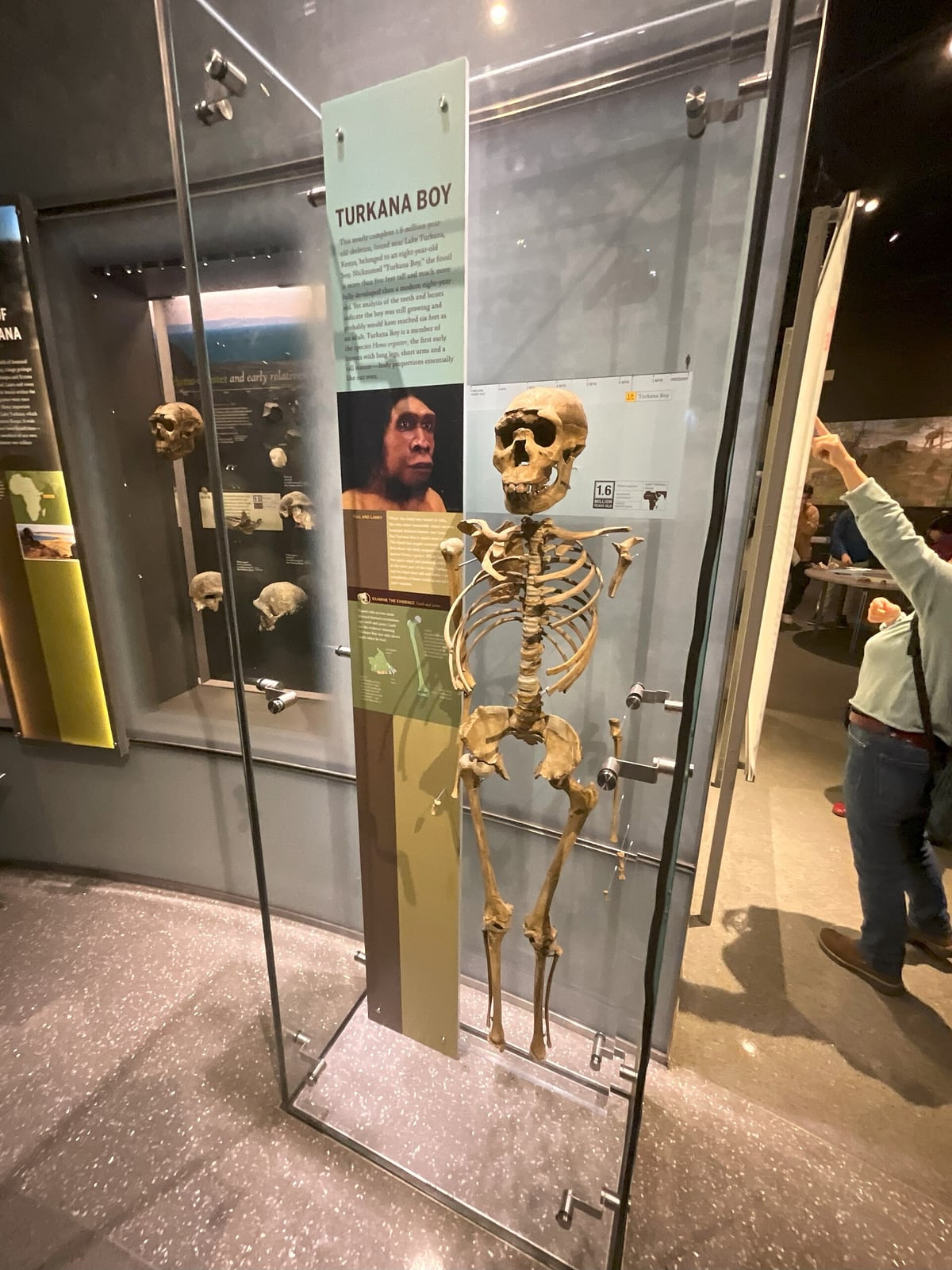
Turkana Boy Reveals an Early Human Skeleton
A remarkably complete skeleton of Homo erectus was found near Lake Turkana.
In 1984, fossil hunter Kamoya Kimeu located a small skull fragment on the bank of the Nariokotome River, situated near Lake Turkana in northern Kenya. Subsequent excavations uncovered a remarkably intact hominin skeleton cataloged as KNM-WT 15000, commonly referred to as Turkana Boy or Nariokotome Boy. Dating to between 1.5 and 1.6 million years ago, the remains make up the most complete Homo erectus skeleton ever found, offering researchers an unprecedented view of the anatomy of Homo erectus, a taxon that some authorities alternatively designate as Homo ergaster.
Evaluating the youth's biological age and adult potential proved challenging for paleoanthropologists. Initial estimates of age at death ranged broadly from 7 to 11 years. In 1993, Alan Walker and Richard Leakey assessed the individual at roughly 11 to 12 years old based on bone maturity patterns, arguing that dental stages often suggest a younger age than chronological reality. Conversely, researcher Christopher Dean estimated an age of eight years in 2009. These discrepancies stem from whether developmental rates are compared against modern humans, who experience an extended adolescent growth spurt, or against chimpanzees. Recent fossil evidence indicates that early hominins likely lacked the modern human maturation trajectory, directly altering projections of the youth's eventual adult stature.

Keep reading in Yester
Coming soon to the App Store
Keep following the story

Sources
- KNM-WT 15000 (Smithsonian National Museum of Natural History, Human Origins Program)
- The Life and Times of Turkana Boy (Turkana Basin Institute)
- Turkana Boy: Kenya's eternal ambassador (National Museums of Kenya)
- Best-Preserved Human Ancestor Didn't Have Bone Disorder (Live Science)
- How do we know how they died? (Australian Museum)
- Turkana Boy
Image: Vicpeters