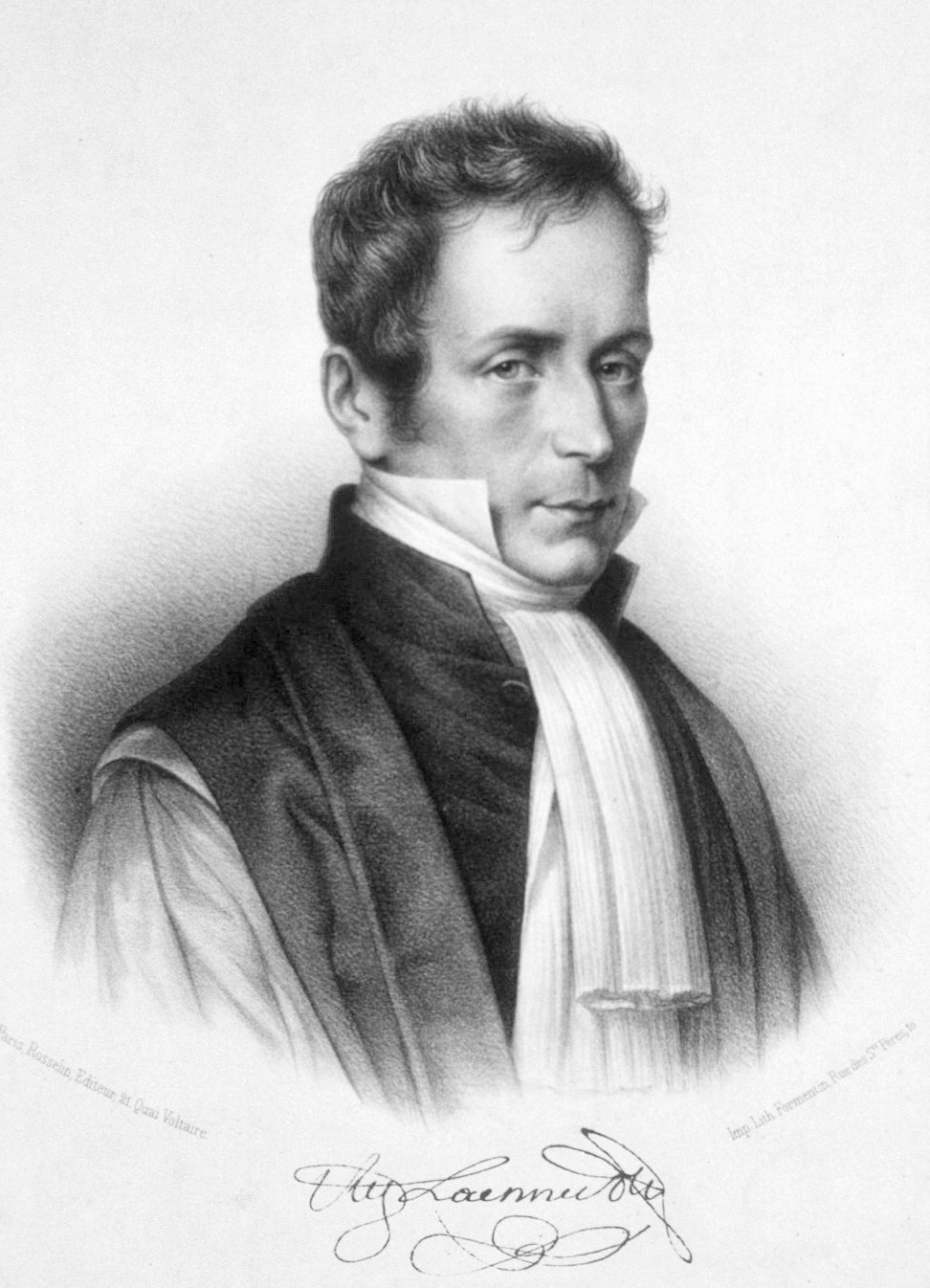
Laennec Invents the Stethoscope
A rolled sheet of paper led to a new way of listening to the body.
In 1816, while treating patients at the Hôpital Necker in Paris, the French physician René Laennec faced a recurring clinical dilemma. When examining a young woman who showed symptoms of heart disease, traditional examination techniques proved inadequate. Percussion and placing a hand on the chest yielded little information, while placing an ear directly against the patient was considered inappropriate due to her age and sex, as well as being hindered by her body habitus. Drawing on an acoustic principle regarding how solid objects transmit vibrations, Laennec rolled a quire of paper into a tight cylinder and placed one end against her chest and the other to his ear.
The simple makeshift tube allowed Laennec to perceive the internal motion of the heart with unexpected clarity. Prior to this innovation, clinical examination relied heavily on direct auscultation, which required the practitioner to press an ear directly to the patient's body. Recognizing the practical superiority of indirect listening, Laennec experimented with tubes of different designs. He settled on a hollow wooden cylinder twenty-five centimeters long and three and a half centimeters in diameter, fitted with a plug for listening to the heart and made in parts that could be taken apart for carrying.

Keep reading in Yester
Coming soon to the App Store
Keep following the story
Sources
Image: Unknown author Unknown author