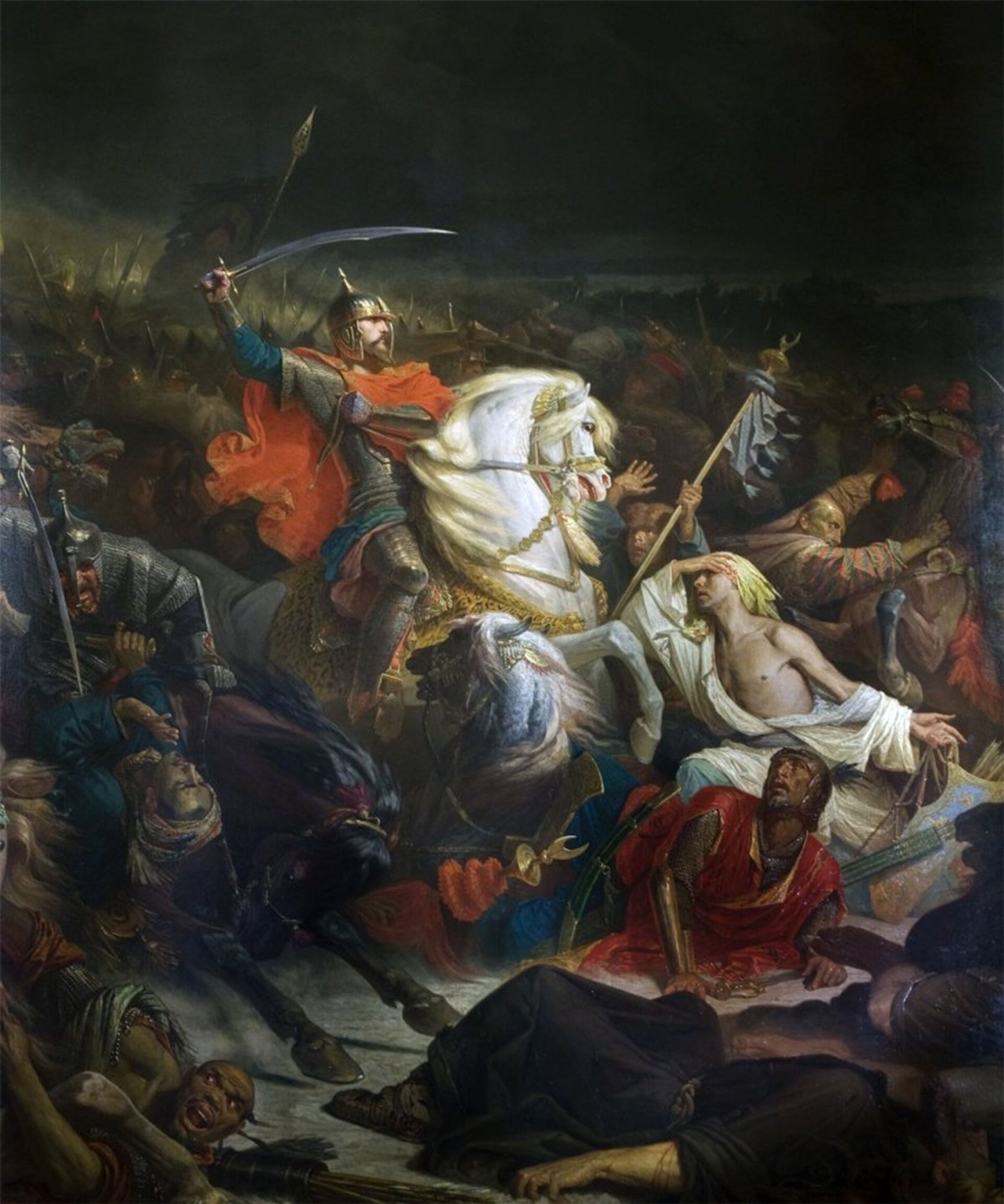
Muscovites Defeat a Golden Horde Army at Kulikovo
Dmitry Donskoy’s victory became a founding legend of Russian independence.
On September 8, 1380, the Grand Prince of Moscow, Dmitry Ivanovich, led an alliance of northern Rus principalities into battle against the military commander Mamai on Kulikovo Field, near the confluence of the Don and Nepryadva rivers. For well over a century, the principalities had been subordinate vassals of the Golden Horde, paying tribute and receiving decrees of legitimacy from its khans. Internal strife had recently splintered the Horde, allowing Mamai, a non-Genghisid warlord ruling its western steppe lands through puppet khans, to assert control. Dmitry challenged this authority by resisting increased tributes and defeating subordinate commanders, prompting Mamai to mount a punitive expedition with prospective support from Lithuanian and Ryazan allies.
Dmitry moved aggressively to meet the threat before Mamai could join forces with his allies. Assembling his contingents at Kolomna in August, Dmitry marched across the Oka River and headed directly toward the steppe borderlands. Upon reaching the Don River on September 6, Dmitry crossed the waterway, positioning his army with its back to the river and deliberately cutting off lines of retreat. Modern historians have sharply reduced the extravagant troop counts found in late medieval tales, which claimed hundreds of thousands of combatants. Demographic realities and mobilization timelines suggest the actual coalition army was much smaller, though historians' estimates of its size still vary widely.

Keep reading in Yester
Coming soon to the App Store
Keep following the story
Sources
Image: Adolphe Yvon