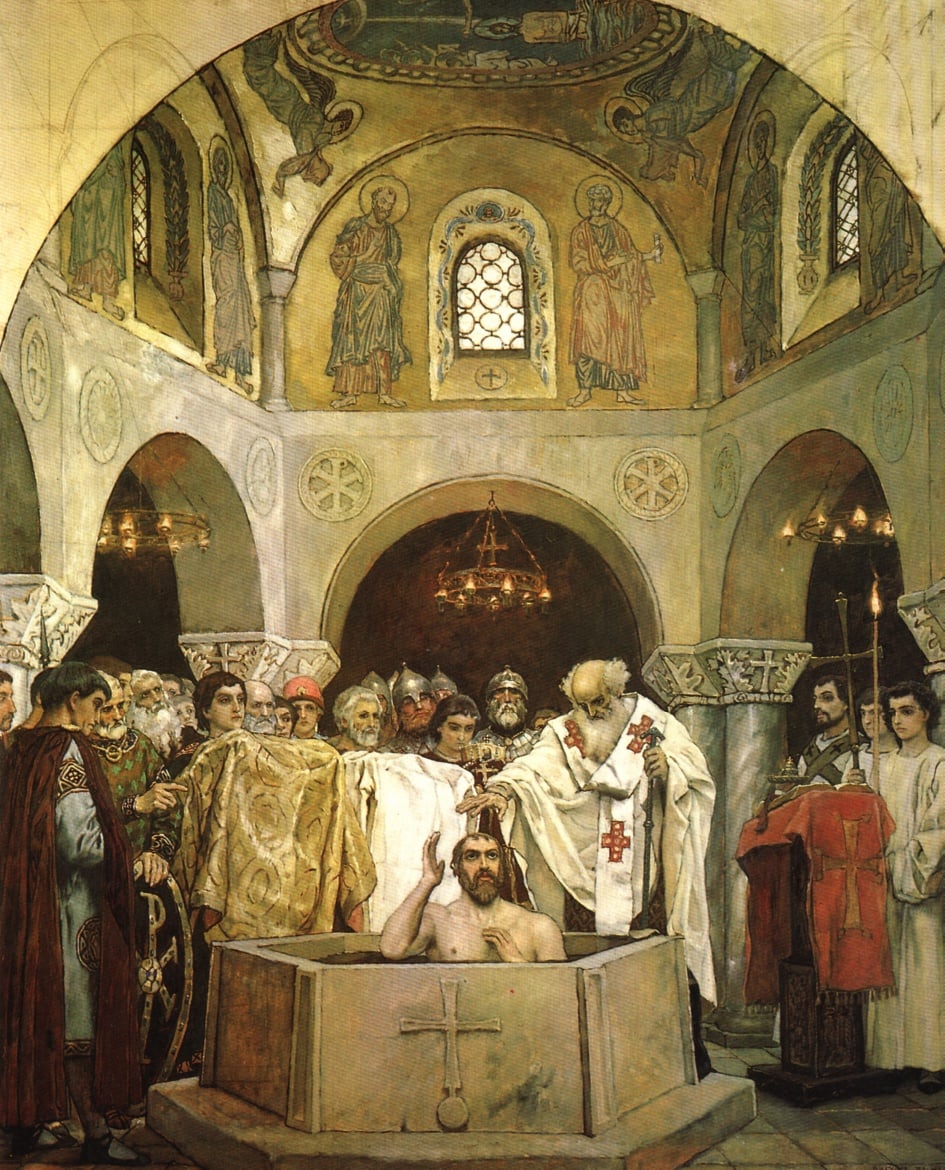
Vladimir of Kyiv Adopts Christianity
A prince’s conversion tied the Rus’ to Byzantium.
In the late tenth century, the ruler of Kyiv oversaw a religious transformation that decisively altered the political and cultural geography of Eastern Europe. Prince Vladimir had initially reinforced traditional paganism after seizing power in 980, ordering the construction of a prominent pantheon of six Slavic deities near his palace. Yet by the end of that decade, dynastic diplomacy and strategic military calculations led him to dismantle those very shrines and bind his territory to Eastern Orthodox Christianity.
The presence of Christianity in the region long preceded Vladimir. Trade and warfare had exposed local elites and merchants to neighboring religious practices, and by 944 the Rus’ treaty with the Byzantine Empire recorded Christian members swearing oaths alongside pagan comrades who invoked Perun. Vladimir’s grandmother Olga had accepted baptism by the mid-tenth century and visited the imperial court in the Byzantine capital, but her son Sviatoslav remained a pagan, reportedly fearing that conversion would cost him the respect of his retinue, leaving pagan traditions firmly entrenched across the realm.

Keep reading in Yester
Coming soon to the App Store
Keep following the story
Sources
Image: Viktor Vasnetsov