Krakatoa’s Eruption Sends Its Effects Around the World
A devastating eruption linked local catastrophe with global observations of atmosphere and sound.
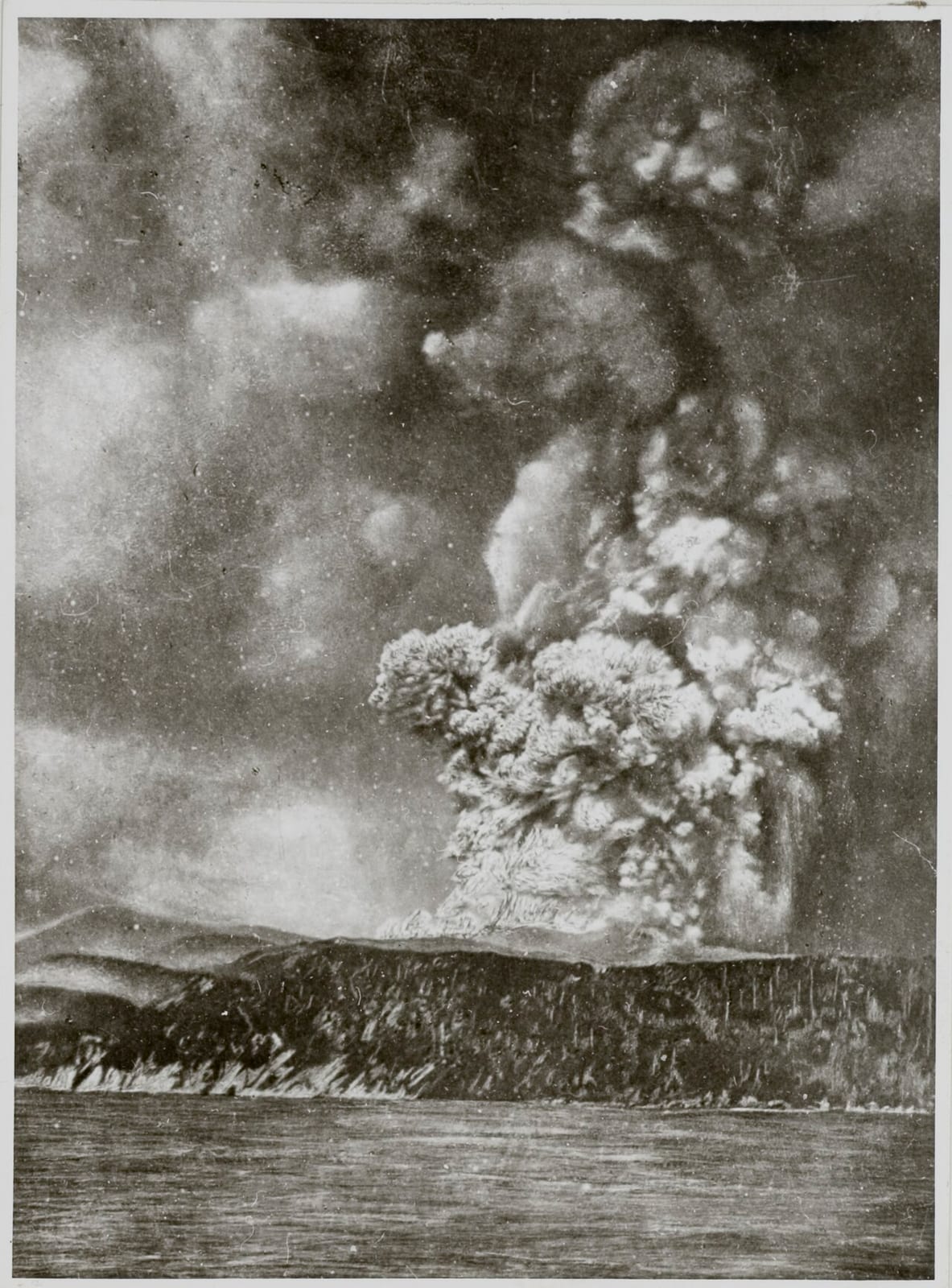
On the morning of 27 August 1883, the volcanic island of Krakatoa in the Sunda Strait reached the violent climax of an eruptive sequence that had begun three months earlier. Activity had commenced in late May with ash columns and venting from the Perboewatan crater, gradually intensifying across multiple vents through June and July. By late August, explosive activity turned continuous. The paroxysm destroyed over seventy percent of the island and surrounding archipelago, leaving a deep submerged caldera where land had previously stood.
The climax produced four enormous explosions, culminating in a blast at 10:02 a.m. that is recorded as one of the most widely heard sounds in recorded history. The detonation carried across thousands of kilometers of ocean, audible in Perth in Western Australia and near Mauritius at Rodrigues Island, where residents mistook the sound for naval artillery. Closer to the source, the acoustic shock ruptured the eardrums of sailors aboard nearby vessels and drove barometric pressure gauges in Batavia completely off their scales. Scientists later found that the atmospheric pressure wave circled the globe more than three times.

Keep reading in Yester
Coming soon to the App Store
Keep following the story
Sources
- Krakatau (Smithsonian Institution, Global Volcanism Program)
- On This Day: Historic Krakatau Eruption of 1883 (NOAA National Centers for Environmental Information)
- Crowdsourcing Krakatoa (Royal Society)
- Volcano Watch: Mixing Magmas at Krakatau (USGS Hawaiian Volcano Observatory)
- 1883 eruption of Krakatoa
Image: Anonymous Unknown author