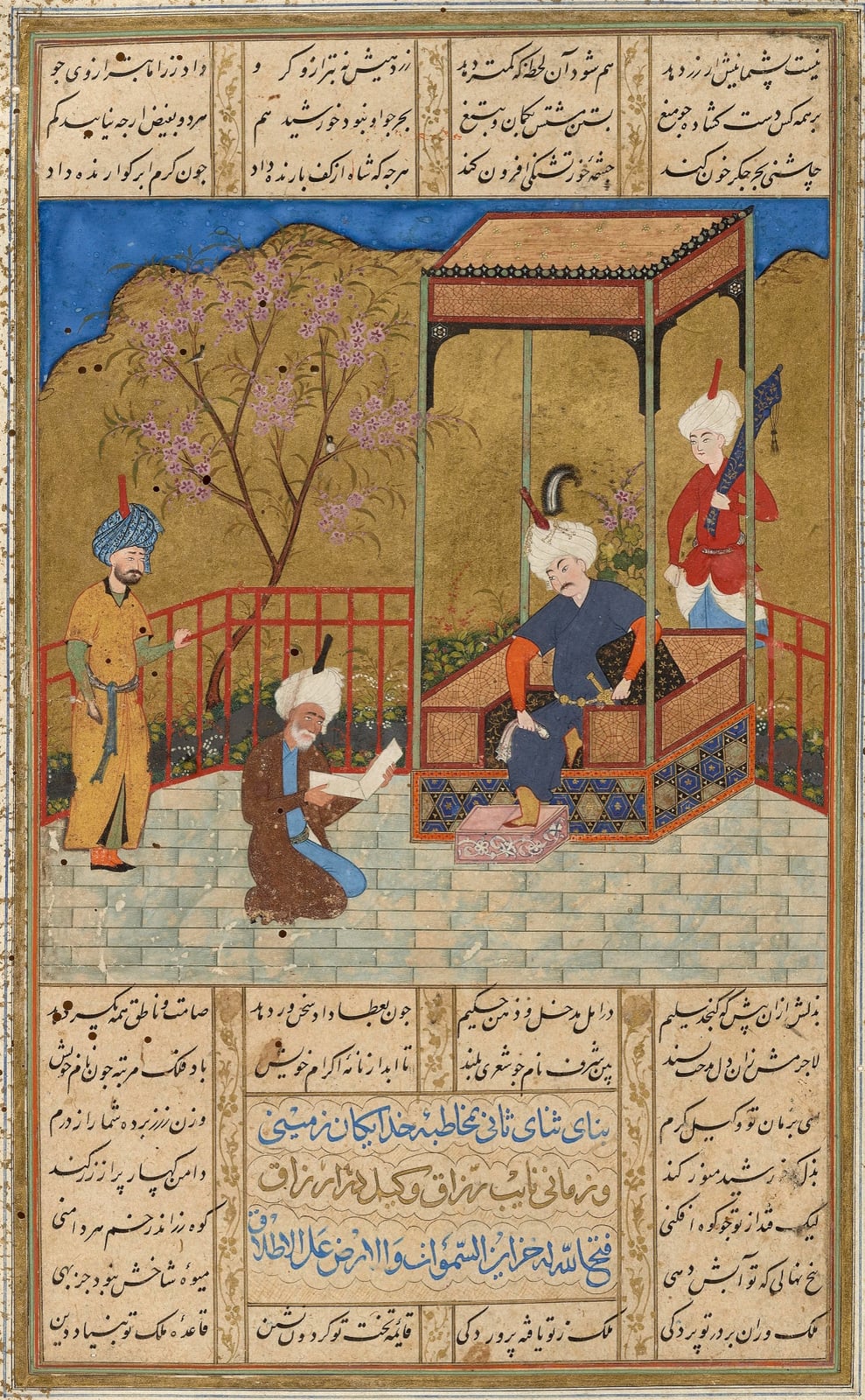
Amir Khusrau Shapes Music and Poetry in Delhi
A poet at the Delhi Sultanate court is linked with qawwali and Hindustani music.
Amir Khusrau was born in 1253 in Patiyali, located in modern Uttar Pradesh, into a family shaped by the turbulent migrations of thirteenth-century Central Asia. His father, Amir Saif ud-Din Mahmud, belonged to the Turkic Lachin clan of Transoxiana and had fled Genghis Khan's campaigns to seek refuge under Sultan Shams al-Din Iltutmish in Delhi. There, Saif ud-Din obtained an official estate and married Bibi Daulat Naz, the daughter of an Indian noble who served as war minister to Sultan Ghiyas ud-Din Balban. Saif ud-Din died while Khusrau was still a young boy, leaving the young boy to be raised by his maternal grandfather while absorbing Sufi practice alongside Arabic, Persian, and Turkic languages.
Khusrau revealed an early aptitude for verse, beginning his studies at the age of nine and later gathering the verses of his youth into his first collection, Tuhfat us-Sighr, completed around 1273. Following his grandfather's death, he entered military service under Malik Chajju, a nephew of Sultan Balban, which quickly brought his compositions before the royal court. By 1276, Balban's second son, Nasir ud-Din Bughra Khan, became his patron. Khusrau accompanied him during his posting to Bengal before joining Balban's eldest son, Khan Muhammad, in the intellectual hub of Multan in 1281. After Khan Muhammad fell in battle against invading Mongols in the mid-1280s, Khusrau served several successive rulers, living through the reigns of several successive sultans of Delhi.

Keep reading in Yester
Coming soon to the App Store
Keep following the story
Sources
Image: unknown painter probably from Herat (see John Seyller: Pearls of the Parrot of India. The Walters Art Museum Khamsa of Amir Khusraw of Delhi. Baltimore 2001, p. 151)