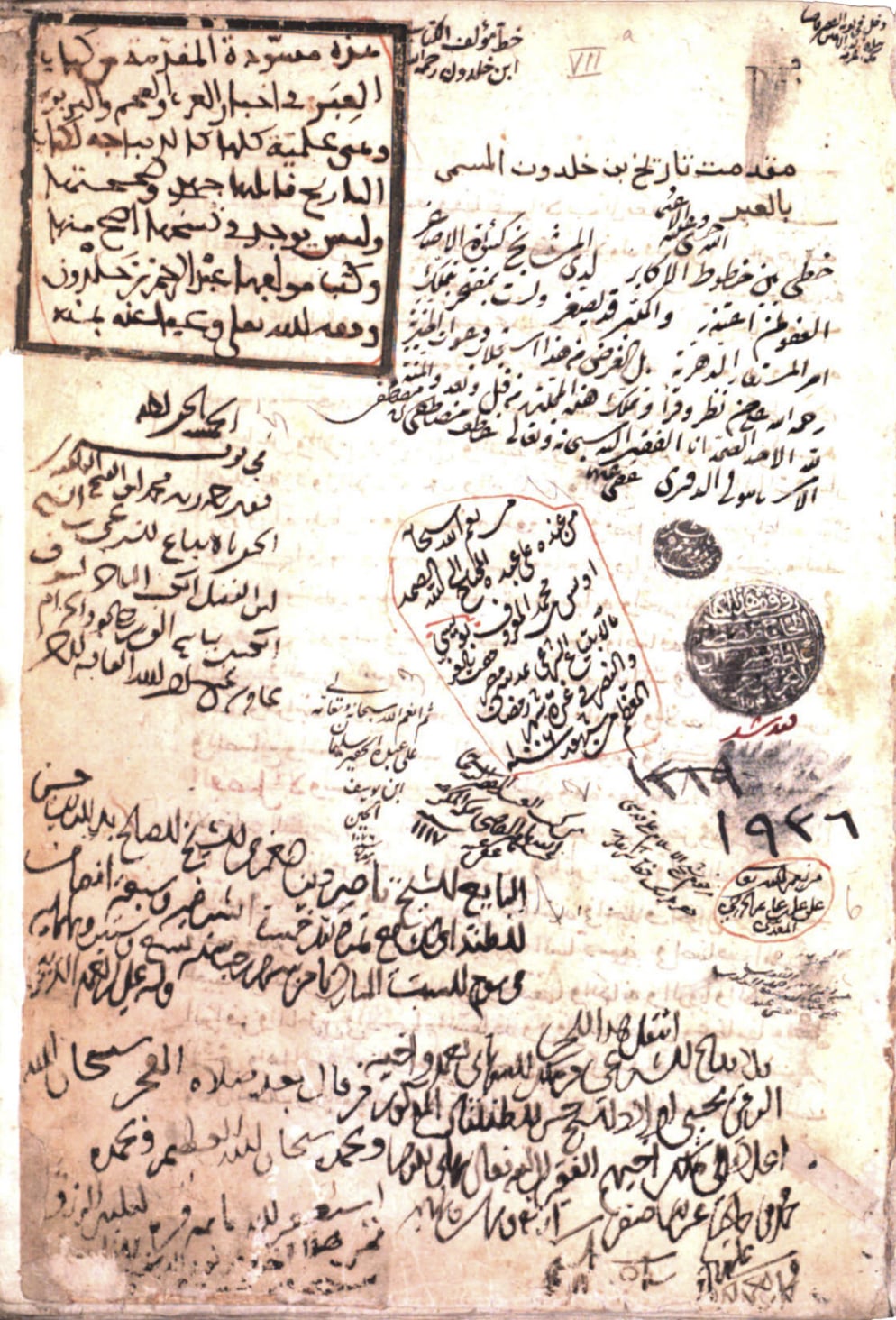
Ibn Khaldun Writes the Muqaddimah
A historian set out a theory of how societies rise and fall.
In 1377, following his withdrawal from political affairs, the North African scholar Ibn Khaldun completed a preliminary draft of the Muqaddimah while living in seclusion at the fortress of Qal'at ibn Salama. He originally designed the treatise as an introduction and first book to a monumental universal history titled Kitab al-Ibar. Over time, however, the introductory text gained recognition as an independent intellectual study. Ibn Khaldun intended it to establish a systematic framework for understanding human society, a subject he designated as a distinct field of inquiry termed ilm al-umran, or the science of civilization.
The Muqaddimah opens with a critique of the methodology used by earlier historians. Ibn Khaldun argued that historical writing regularly suffered from uncritical reliance on sources, partisanship toward particular doctrines, an inclination to flatter rulers, and a tendency to invent or accept exaggerated statistics. To illustrate the logistical flaws in traditional accounts, he questioned reports repeated by historians like al-Masudi concerning ancient armies containing hundreds of thousands of soldiers. Ibn Khaldun observed that such massive formations could neither march, maneuver, nor sustain themselves across the available territory. In his view, chroniclers failed because they lacked knowledge of the fundamental principles governing societal change.

Keep reading in Yester
Coming soon to the App Store
Keep following the story
Sources
- Ibn Khaldun, The Muqaddima, 1377, Michiel Leezenberg, History of Humanities 9:2 (2024) (University of Amsterdam repository)
- Turkish translation of the Muqaddimah in the Ottoman period (Divan: Disiplinlerarasi Calismalar Dergisi)
- The Muqaddimah of Ibn Khaldun, Mohammad Akram Nadwi (Al-Salam Institute)
- Muqaddimah
Image: Ibn Khaldūn