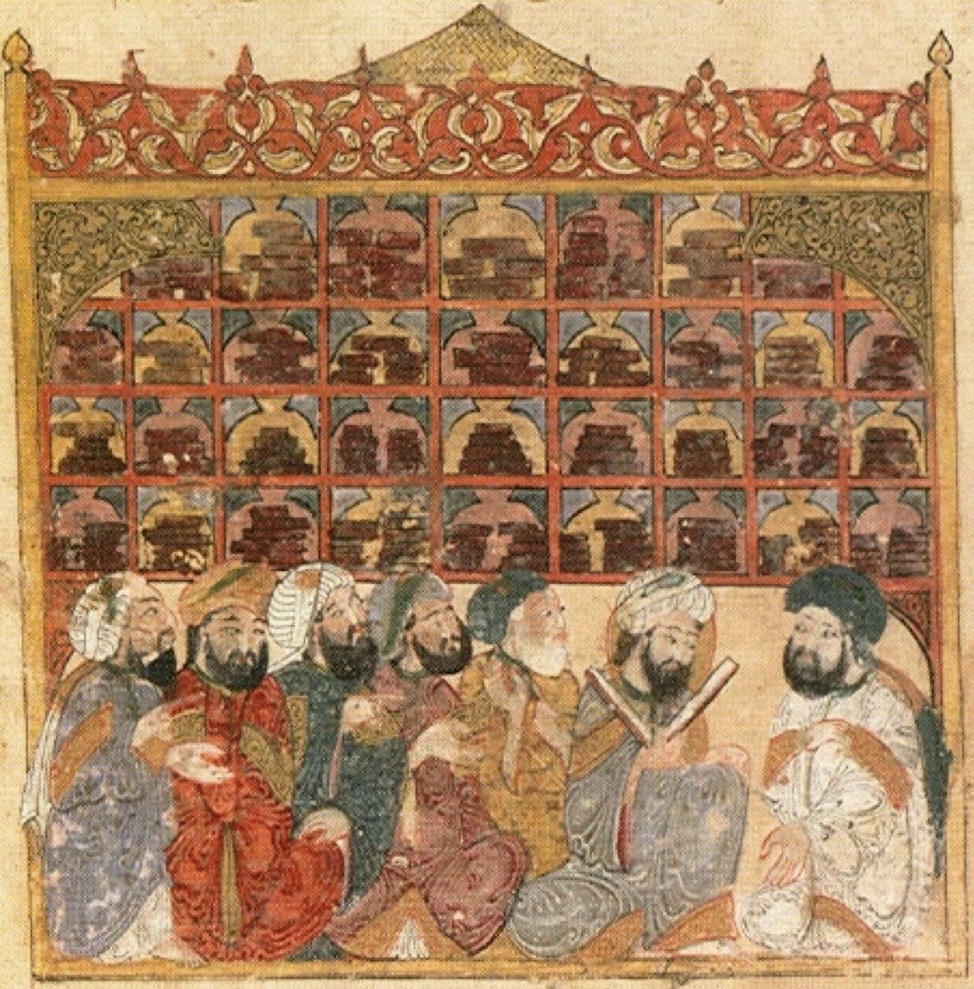
Baghdad’s House of Wisdom Gathers Scholars and Translators
Under the Abbasids, Greek, Persian and Indian learning was translated into Arabic.
During the eighth century, the Abbasid caliphs established Baghdad as their capital and made the city a focal point for scholarship and literature. Drawing on Sasanian imperial traditions of translating foreign texts, the second caliph, al-Mansur, established a royal library to preserve manuscripts and invited delegations from India and neighboring regions to introduce their knowledge of mathematics and astronomy. Under Caliph Harun al-Rashid in the late eighth century, this royal collection expanded as the court accelerated efforts to translate works on medicine, astronomy, and mathematics. Known in Arabic as Bayt al-Hikmah or Khizanat al-Hikma, meaning a storehouse of wisdom, the institution began as a secure repository for rare volumes and poetry.
Imperial patronage reached an apex under Harun al-Rashid's son, Caliph al-Ma'mun, who reigned from 813 to 833. Al-Ma'mun increased state funding for the preservation of manuscripts, transformed the library into a public center of learning, and dispatched expeditions to foreign territories, including Constantinople, to acquire scientific manuscripts. The caliph valued scholarly texts so highly that he occasionally requested important manuscripts, such as Ptolemy's Almagest, as terms of peace or spoils of war following military conflicts with the Byzantine Empire. Scholars affiliated with the court served not merely as archivists, but also as state consultants, physicians, calendar keepers, and architects.

Keep reading in Yester
Coming soon to the App Store
Keep following the story

Sources
Image: Zereshk