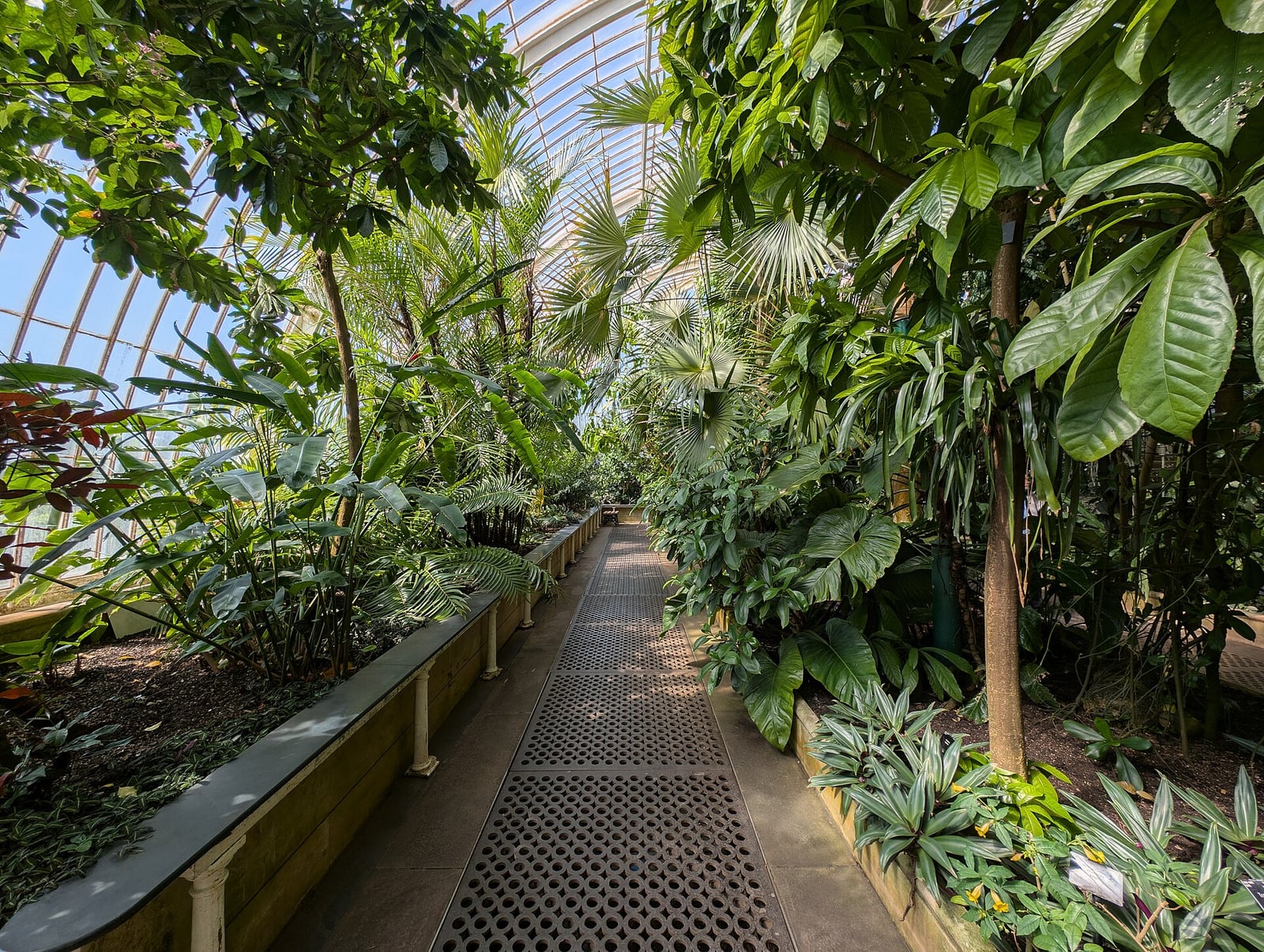
A Garden at Kew Begins to Collect the World’s Plants
A royal garden grew into a center of botany and plant transfer.
The Royal Botanic Gardens, Kew, located at Richmond upon Thames in south-west London, developed into one of the principal centers for botanical research and education in the United Kingdom. Spanning a 132-hectare (about 326-acre) site on which 44 buildings and structures are listed for their historic importance, the institution received designation as a UNESCO World Heritage Site in 2003. Operating as a non-departmental public body sponsored by the Department for Environment, Food and Rural Affairs, Kew combines historic landscape preservation with extensive international scientific activity, employing more than 1,400 staff.
The institutional reach of Kew extends beyond its primary London grounds to several allied properties across England. The organization administers Wakehurst Place, a National Trust property located in Sussex that hosts the Millennium Seed Bank. In 1925, Kew joined with the Forestry Commission to establish the Bedgebury National Pinetum in Kent, an estate devoted to cultivating conifers. A subsequent partnership founded in 1994 between Kew and the Castle Howard Estate established the Castle Howard Arboretum Trust, which oversees the Yorkshire Arboretum.

Keep reading in Yester
Coming soon to the App Store
Keep following the story

Sources
- Royal Botanic Gardens, Kew (UNESCO World Heritage Centre)
- About us (Royal Botanic Gardens, Kew)
- Seed Collection (Royal Botanic Gardens, Kew)
- About Kew's Data Portal (Royal Botanic Gardens, Kew)
- Board of Trustees of the Royal Botanic Gardens Kew (GOV.UK)
- National Heritage Act 1983, Schedule 1 Part IV (legislation.gov.uk)
- Our history at Bedgebury (Forestry England)
- Royal Botanic Gardens, Kew
Image: Andy Li