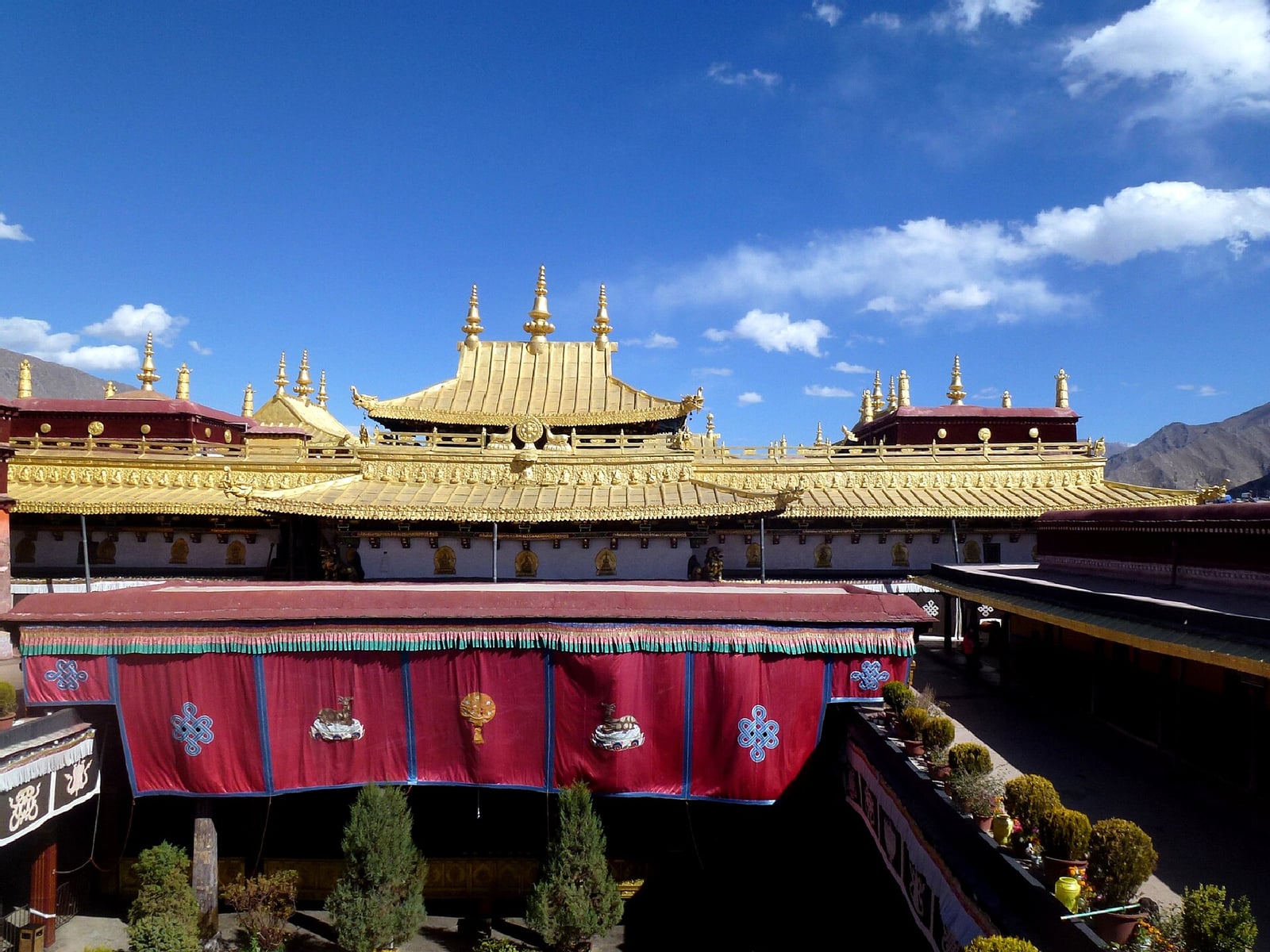
Songtsen Gampo Builds the Jokhang in Lhasa
Tibet’s holiest temple was founded as Buddhism reached the Tibetan Empire.
During the seventh century, King Songtsen Gampo unified the Tibetan Empire and pursued diplomatic alliances with neighboring powers across the Himalayas and eastern Asia. After securing ties with Nepal through his marriage to Princess Bhrikuti, he sought a diplomatic marriage with the Tang court of China. Emperor Taizong initially rejected the proposal, prompting Songtsen Gampo to launch military incursions against Tang-affiliated border regions and the town of Songzhou. Following an exchange that included Tibetan offers of conciliation alongside threats of escalation, Taizong consented in 640, and Princess Wencheng was dispatched to Tibet in 641. Both foreign consorts carried revered Buddhist icons as part of their dowries, establishing the foundational sacred objects around which early imperial religious architecture developed in the capital city of Rasa, which later became known as Lhasa.
Songtsen Gampo initiated a wider program to construct twelve temples across the territory, organized in concentric rings from central Tibet out to the frontiers, with the Jokhang positioned at the symbolic center. Built around 640 or 652 according to varying historical traditions, the structure was originally known as Rasa Trulnang. Nepalese and Indian craftsmen contributed substantially to its earliest construction. Carbon dating of surviving interior elements has confirmed that original seventh-century wooden beams and rafters remain intact, accompanied by Newari door frames, columns, and finials brought from the Kathmandu Valley. The complex was deliberately oriented toward the west, facing Nepal in acknowledgment of Bhrikuti.

Keep reading in Yester
Coming soon to the App Store
Keep following the story
Sources
Image: Hiroki Ogawa