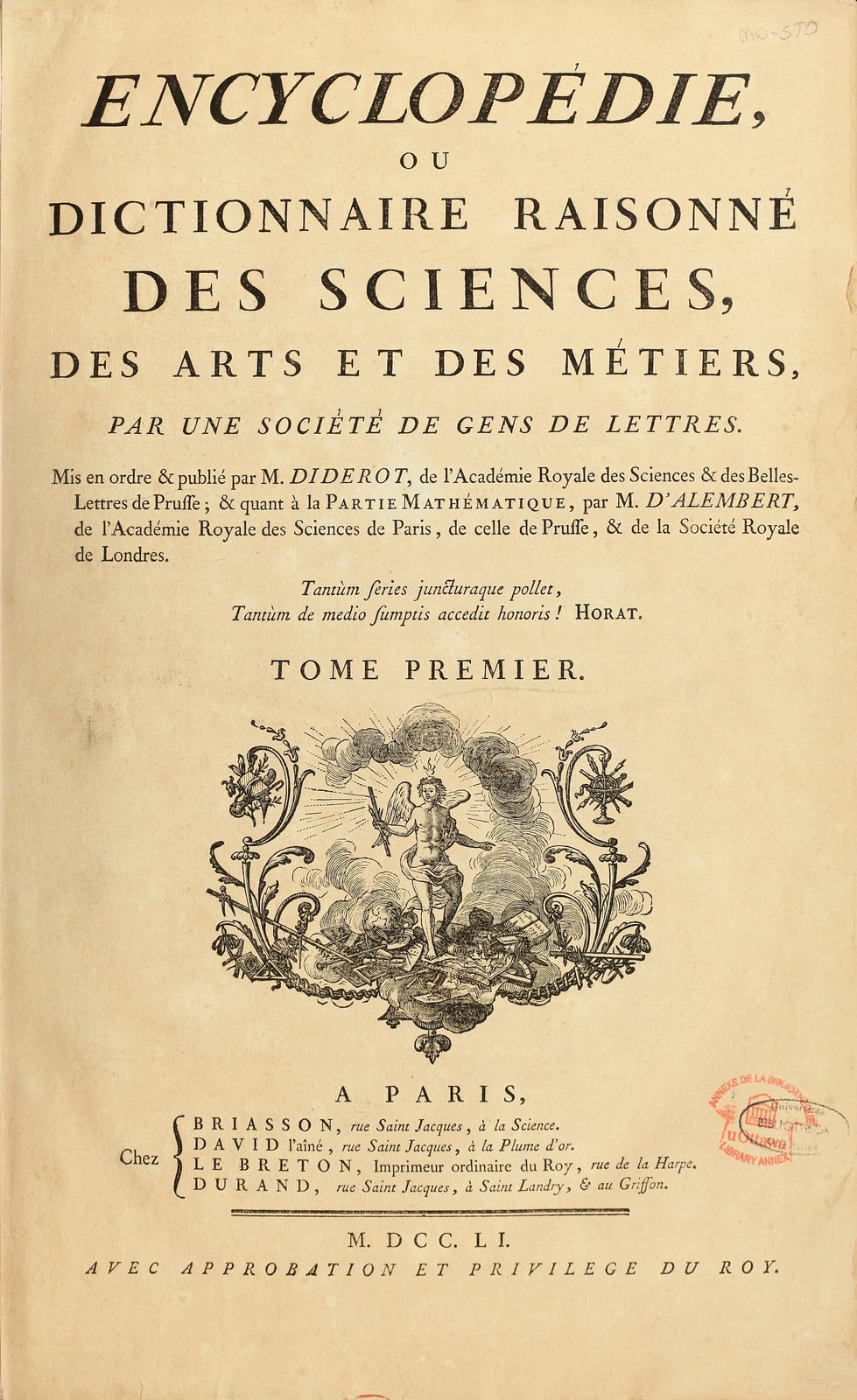
Diderot’s Encyclopédie Begins to Appear
A massive reference work organized knowledge and challenged authorities.
In 1751, the Parisian bookseller André Le Breton and his publishing partners issued the opening volume of the Encyclopédie, ou dictionnaire raisonné des sciences, des arts et des métiers. Edited by Denis Diderot alongside the mathematician Jean le Rond d'Alembert, the project had grown far beyond its modest origins as a French translation of Ephraim Chambers's English Cyclopaedia. Instead of a simple commercial adaptation, the enterprise grew into an original collective compendium that drew articles from more than 140 contributors.
The publication challenged the traditional order of reference literature by grounding its taxonomy of knowledge in human reason rather than religious or civil authority. D'Alembert outlined this framework in the introductory discourse, adapting a classification scheme from Francis Bacon that divided understanding into memory, reason, and imagination. In addition to philosophical inquiry, the work placed extensive value on mechanical crafts and technologies, dedicating long entries and engraved plates to trades like glassmaking and silk-making.

Keep reading in Yester
Coming soon to the App Store
Keep following the story

Sources
- ARTFL Encyclopédie (University of Chicago)
- The Fight for the Encyclopaedia's Publication, by Marie Leca-Tsiomis (Université Paris Nanterre, MOOC 18th century: the Enlightenment's fight)
- Louis de Jaucourt (1704-1779) (Musée protestant)
- La fabuleuse histoire de l'Encyclopédie (Futura Sciences)
- Fauche, Samuel (Historical Dictionary of Switzerland)
- Encyclopédie
Image: Long List of Contributors to the Encyclopédie