Nebuchadnezzar II Builds the Ishtar Gate of Babylon
A gate of blue glazed bricks marked the processional way into the city.
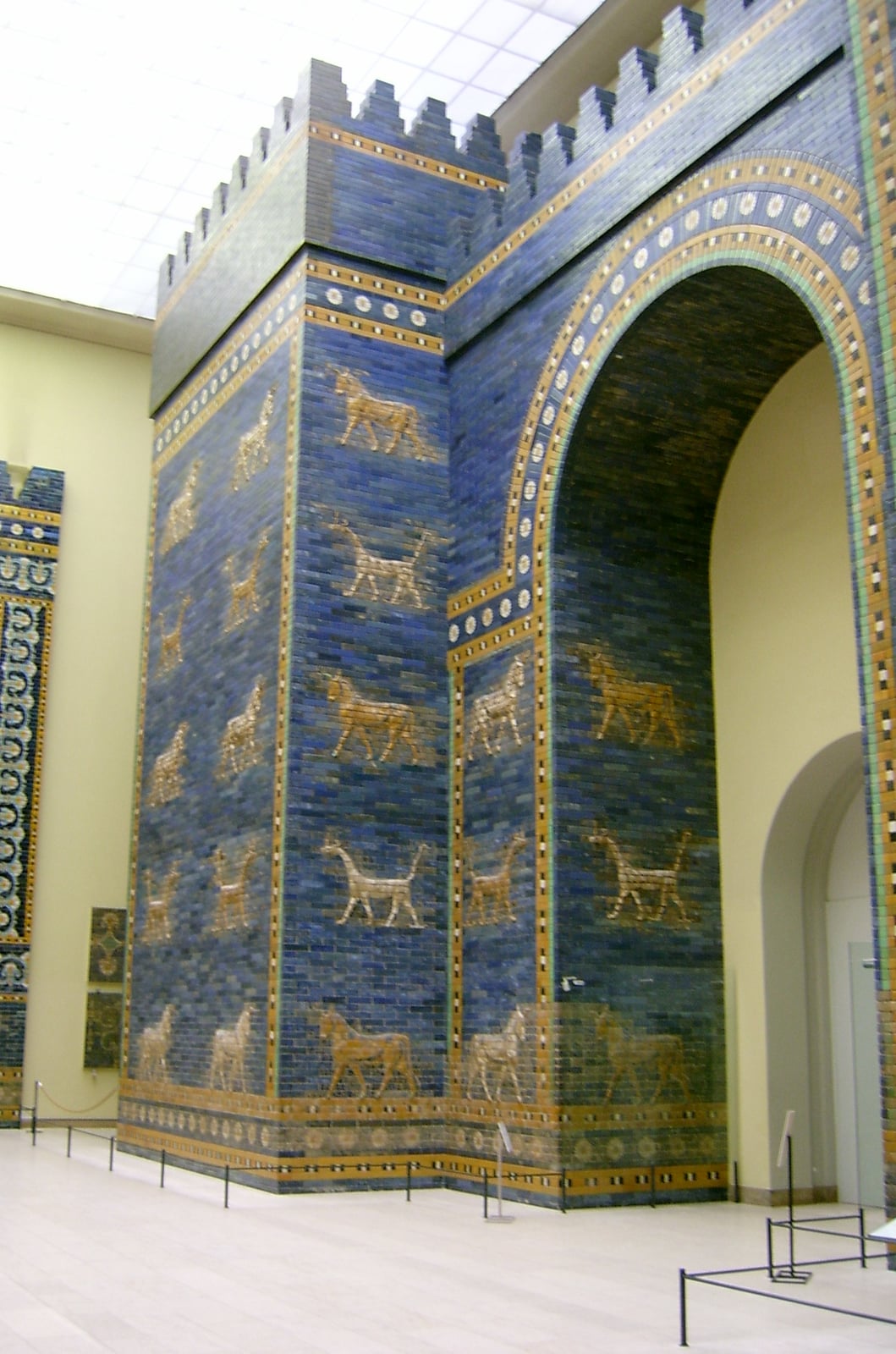
During the height of the Neo-Babylonian Empire, King Nebuchadnezzar II directed the monumental reconstruction of Babylon, placing a fortified entryway on the northern side of the inner city wall. Constructed around the sixth century BCE, this structure served as the eighth gate into the metropolis and was formally dedicated to the goddess Ishtar. The structure rose high above the street, and its molded, unglazed foundations extended deep into the earth. It functioned as an imposing double gate, composed of an external frontal threshold paired with an even larger secondary rear entryway.
Beyond its defensive mass, the gate presented a brilliant facade designed to evoke the appearance of lapis lazuli, a blue stone held in high regard throughout antiquity. Artisans formed individual bricks by pressing fine clay into reusable wooden molds, which were sun-dried, baked into bisque pottery, and painted with mineral glazes containing silica, fluxes, and colorants such as cobalt. When fired at elevated temperatures, the glazes vitrified into a jewel-like exterior. The bricks were then bonded with naturally occurring bitumen, an asphalt substance that sealed the horizontal seams and protected the core architecture.

Keep reading in Yester
Coming soon to the App Store
Keep following the story
Sources
- A Wonder to Behold: Craftsmanship and the Creation of Babylon's Ishtar Gate (Institute for the Study of the Ancient World, NYU)
- From Fragment to Monument: The Ishtar Gate in Berlin (Staatliche Museen zu Berlin)
- The Ishtar Gate of Babylon: One Monument, Multiple Narratives, Helen Gries (The Ancient Near East Today, ASOR)
- Panel with striding lion (The Metropolitan Museum of Art)
- Babylon (UNESCO World Heritage Centre)
- Ishtar Gate, c. 575 BCE (Center for Online Judaic Studies)
- Ishtar Gate
Image: Bontenbal