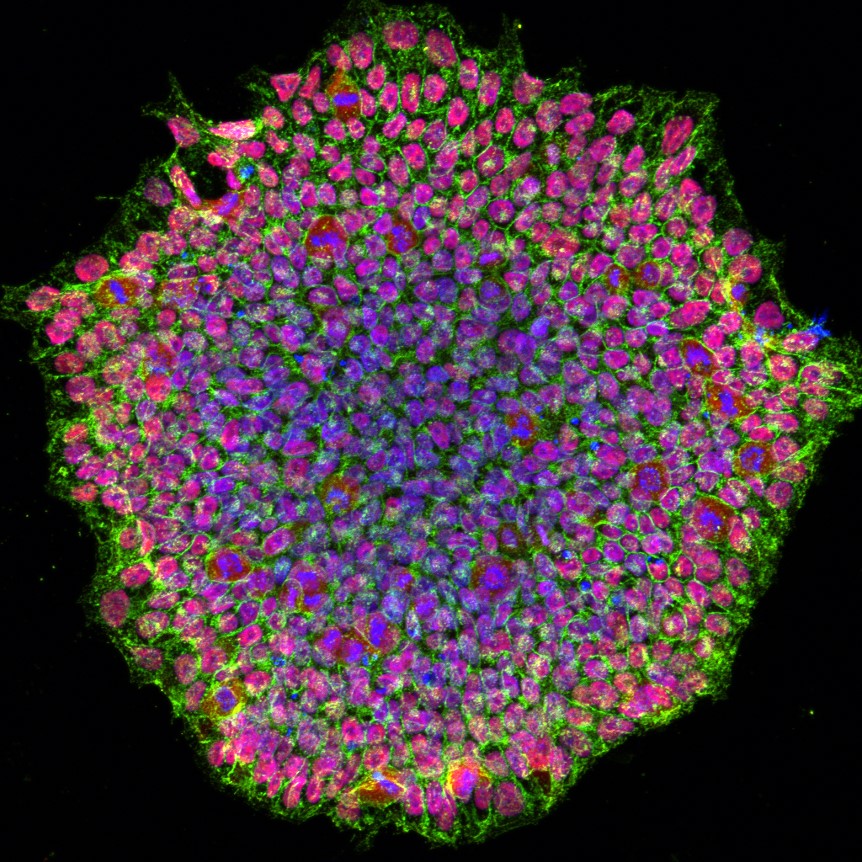
Shinya Yamanaka Reprograms Adult Cells into Stem Cells
Four genes turned mature cells back into cells that could become any tissue.
In 2006, biologists Shinya Yamanaka and Kazutoshi Takahashi at Kyoto University reported that differentiated adult cells could be reset to an embryonic-like state. For decades, developmental biology treated cellular specialization as an irreversible progression: once an embryonic cell matured into a specialized tissue such as a neuron, muscle fiber, or fibroblast, its biological destiny seemed permanently fixed. Yamanaka and Takahashi challenged this view by identifying twenty-four genes strongly expressed in embryonic stem cells, hypothesizing that some combination of these factors held the instructions required to revert mature cells into an unspecialized condition.
To test their hypothesis, the Kyoto researchers introduced the candidate genes into mouse connective tissue cells using retroviruses. They tracked the transformation with an antibiotic-resistance marker linked to the activation of Fbx15, a gene characteristic of embryonic stem cells. When colonies capable of self-renewal emerged under antibiotic selection, the investigators systematically withheld individual genes from the twenty-four candidates to isolate the crucial components. They discovered that four specific transcription factors, Oct4, Sox2, Klf4, and c-Myc, were collectively sufficient to reprogram the adult fibroblasts into pluripotent colonies. Yamanaka named the reprogrammed cells induced pluripotent stem cells, or iPS cells.

Keep reading in Yester
Coming soon to the App Store
Keep following the story
Sources
- The Nobel Prize in Physiology or Medicine 2012, Press release (NobelPrize.org)
- Scientific Background: Mature cells can be reprogrammed to become pluripotent (NobelPrize.org)
- Popular information, Nobel Prize in Physiology or Medicine 2012 (NobelPrize.org)
- Induced Pluripotent Stem Cell Experiments by Kazutoshi Takahashi and Shinya Yamanaka in 2006 and 2007 (Embryo Project Encyclopedia, Arizona State University)
- Generation of germline-competent induced pluripotent stem cells, Okita et al., Nature 2007 (abstract via RePEc)
- Fibroblast-Derived Induced Pluripotent Stem Cells Show No Common Retroviral Vector Insertions (Stem Cells, PMC)
- Induced pluripotent stem cell
Image: NIH Image Gallery from Bethesda, Maryland, USA