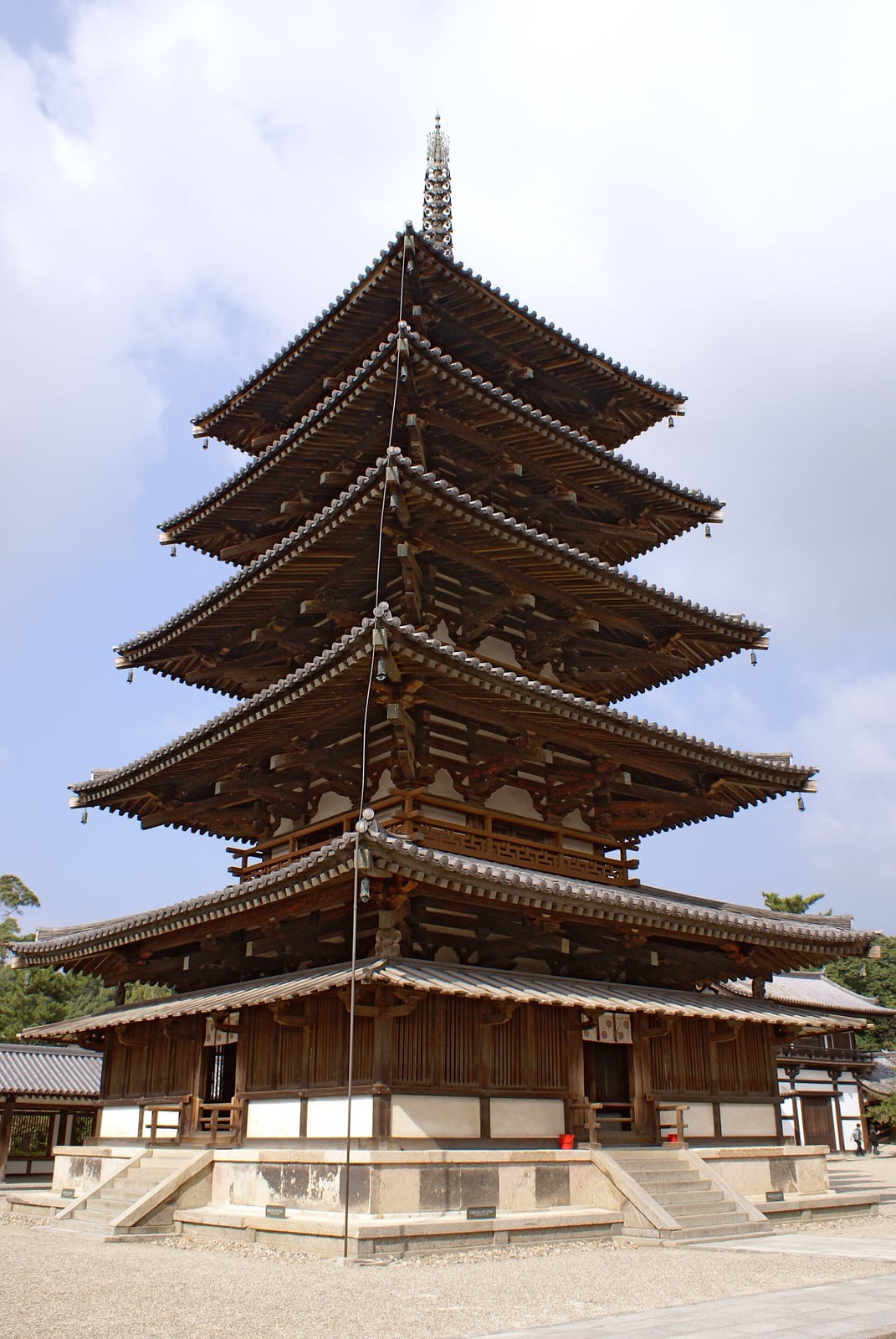
Hōryū-ji Becomes a Center of Early Japanese Buddhism
A temple foundation and later rebuilding left an exceptional architectural legacy.
In the early seventh century, Prince Shotoku commissioned a Buddhist sanctuary in Ikaruga, situated in what is now Nara Prefecture. Originally known as Wakakusadera and believed to have been completed by 607, the complex was established in honour of the prince's father and dedicated to Yakushi Nyorai, the Buddha of healing. Constructed during the period when continental Buddhism was taking firm root in Japan, the foundation served as both a seminary and a monastery under the formal title of Horyu Gakumonji.
Archaeological excavations conducted in 1939 confirmed that the original early seventh-century compound, now termed the Wakakusa-garan by scholars, stood southwest of the prince's palace. According to the ancient chronicle Nihon Shoki, a great fire in 670 left not a single building standing, though some historians have since questioned the account. Following this catastrophe, the temple was reconstructed on an adjacent, slightly reoriented plot to the northwest, an undertaking widely believed to have been finished around 711. Dendrochronological surveys have since revealed that certain timbers, including the central axis pillar of the pagoda, were felled as early as 594, indicating that earlier seasoned materials or parts of older projects were incorporated into the new buildings.

Keep reading in Yester
Coming soon to the App Store
Keep following the story
Sources
- Buddhist Monuments in the Horyu-ji Area (UNESCO World Heritage Centre)
- Introduction: A Brief History of Horyuji (Horyuji Temple, official site)
- Five-storied Pagoda (Horyuji Temple, official site)
- Main Hall (Kondo) and Shaka Triad (Horyuji Temple, official site)
- Hall of Dreams (Yumedono) (Horyuji Temple, official site)
- The Gallery of Horyuji Treasures (Tokyo National Museum)
- Fire Prevention Day for Cultural Properties (Agency for Cultural Affairs, Government of Japan)
- Hōryū-ji
Image: 663highland