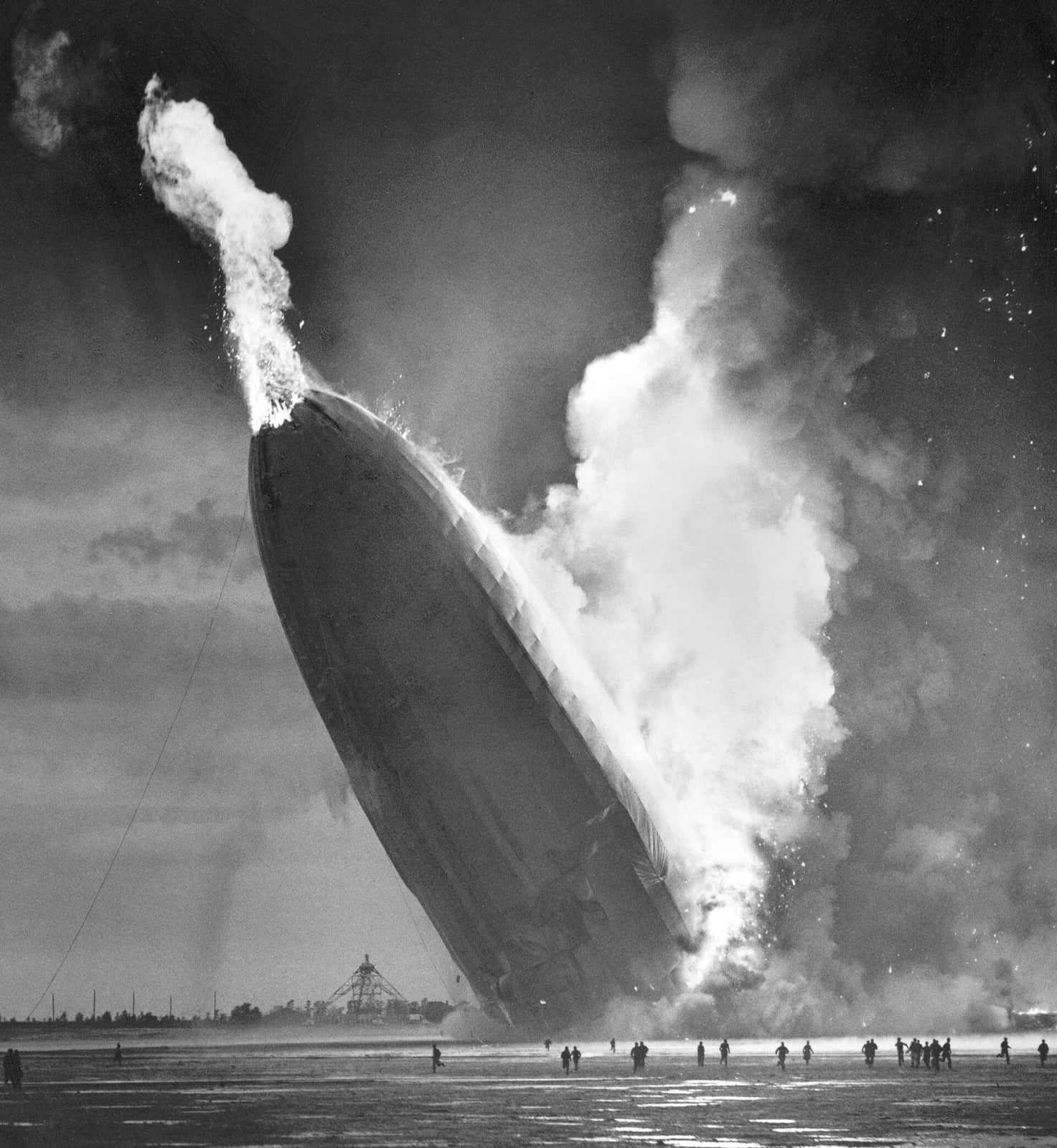
The Hindenburg Burns at Lakehurst
A filmed disaster ended the age of passenger airships.
On the evening of May 6, 1937, the German rigid airship LZ 129 Hindenburg arrived at Naval Air Station Lakehurst in New Jersey at the end of its first passenger flight of the year to the United States. Running behind schedule after its flight from Frankfurt, the hydrogen-filled dirigible hovered several hundred feet above the field during its mooring approach. As the crew dropped lines to the ground handlers below, a sudden fire erupted near the stern and swept through the vessel in less than a minute, bringing the flaming framework down before a gathering of journalists, spectators, and newsreel crews.
The landing had been delayed for most of the day. The airship had been due in the early afternoon, but persistent rainstorms held it off until the weather improved. Around 7:00 p.m., the Hindenburg began its final approach for a high landing, known as a flying moor, in which the ship dropped its ropes from altitude and was then winched down to the mooring mast. As it approached the mast, the airship made a sharp turn to face into the shifting wind, and its engines were run astern to slow it. The mooring lines had been dropped, and one was attached to a ground winch, when fire broke out at about 7:25 p.m.

Keep reading in Yester
Coming soon to the App Store
Keep following the story

Sources
- Hindenburg (Encyclopaedia Britannica)
- Lakehurst marks 75th anniversary of Hindenburg crash (NAVAIR, U.S. Navy)
- Fire of the Zeppelin LZ 129 Hindenburg, HIAD incident database (Clean Hydrogen Partnership, European Union)
- Oh, the Humanity: Herbert Morrison was the voice of the Hindenburg crash (Goldenseal, West Virginia Department of Arts, Culture and History)
- 80th Anniversary for Airship Disaster Immortalized by Chicago Reporter's Recording (Illinois Public Media)
- Hindenburg disaster
Image: Murray Becker / Associated Press