Hertz Makes Electromagnetic Waves Measurable
Laboratory experiments gave physical evidence for waves predicted by Maxwell’s theory.
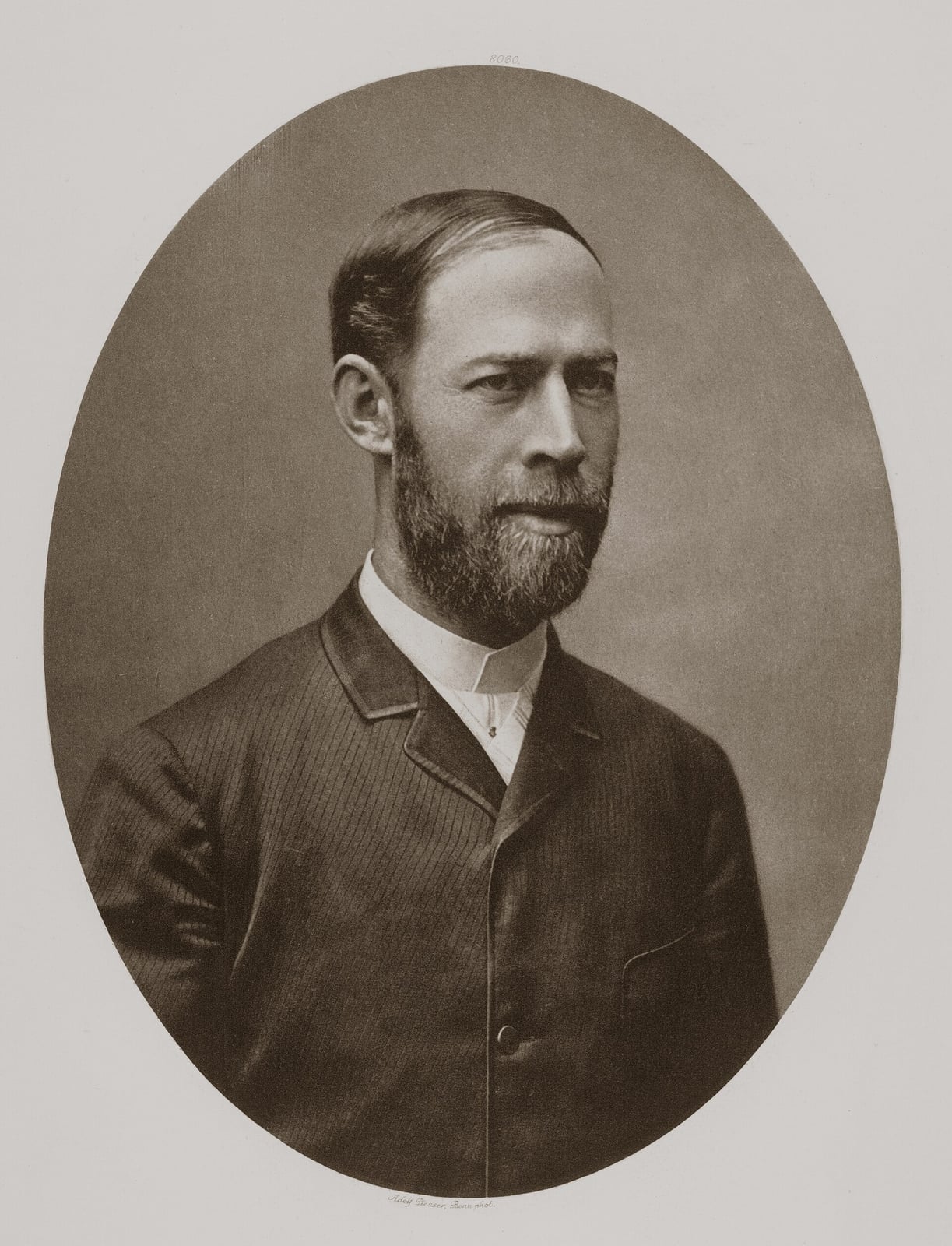
In the autumn of 1886 at the Technische Hochschule in Karlsruhe, Heinrich Hertz noticed that discharging a Leyden jar through a Riess spiral produced an unexpected spark across a second, disconnected spiral. The unintended spark provided Hertz with an experimental path toward testing the theoretical framework developed by Scottish physicist James Clerk Maxwell two decades earlier. Maxwell had calculated that coupled electric and magnetic fields propagated through space as transverse waves traveling at the speed of light, yet his equations lacked empirical verification beyond visible radiation.
Hertz had considered testing Maxwell’s theory years earlier in Berlin under Hermann von Helmholtz. In 1879, Helmholtz had established a Prussian Academy of Sciences prize for empirical verification of electromagnetic action across polarizable insulators. Hertz had initially deemed an experimental apparatus unfeasible, turning instead to electromagnetic induction for his doctoral thesis. After securing his professorship in Karlsruhe, the observation involving the coupled spirals led him to build a practical transmitter and receiver.

Keep reading in Yester
Coming soon to the App Store
Keep following the story
Sources
- Heinrich Rudolf Hertz (MacTutor History of Mathematics, University of St Andrews)
- Milestones: First Generation and Experimental Proof of Electromagnetic Waves, 1886-1888 (IEEE, Engineering and Technology History Wiki)
- Hertz: 125 Years "Propagation of Electric Action" (Karlsruhe Institute of Technology)
- Heinrich Hertz (National High Magnetic Field Laboratory, Magnet Academy)
- Hertz's photoelectric effect (Institute of Physics, IOPSpark)
- Heinrich Hertz
Image: Robert Krewaldt, Kaiserplatz 16, Bonn