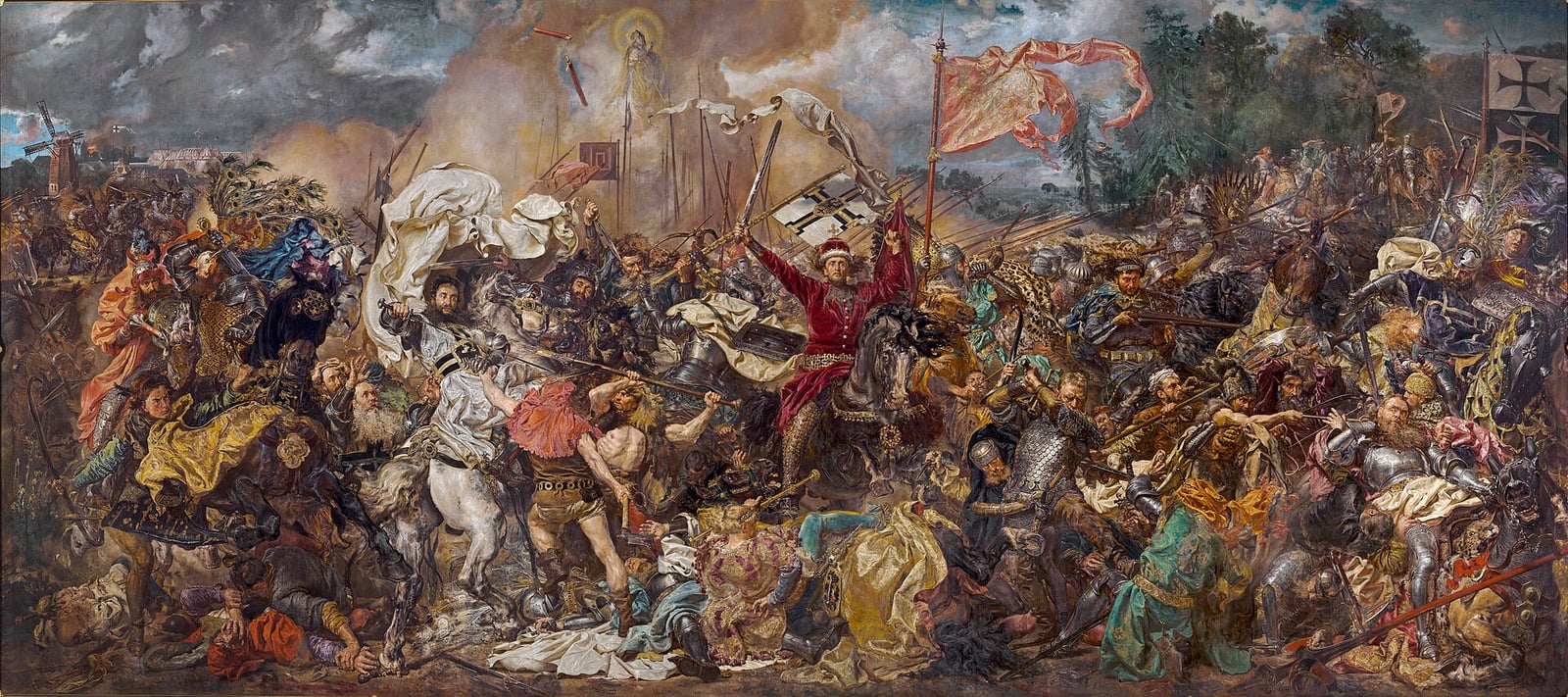
Poland and Lithuania Crush the Teutonic Knights
One of medieval Europe’s largest battles broke the power of a crusading order.
On 15 July 1410, the armies of the Kingdom of Poland and the Grand Duchy of Lithuania confronted the Teutonic Order on the fields between the Prussian settlements of Grunwald, Tannenberg, and Ludwigsdorf. The military monastic order had dominated the south Baltic coast for nearly two centuries, initially subduing native pagan tribes before launching persistent raids into Lithuanian territory. Lithuania's official adoption of Christianity following the personal union established between Grand Duke Jogaila and the Polish Crown in 1385 eliminated the religious premise of these Baltic crusades. Unresolved territorial friction over border regions such as Samogitia, coupled with economic competition for vital river trade routes, erupted into formal warfare in 1409.
King Władysław II Jagiełło of Poland and Grand Duke Vytautas of Lithuania devised a strategy to combine their forces into a single massive host. In late June 1410, they coordinated a difficult river crossing over a pontoon bridge at Czerwińsk, catching the Teutonic leadership unprepared for a direct offensive aimed at their capital of Marienburg. The Grand Master of the Teutonic Order, Ulrich von Jungingen, shifted his army to block the allied approach. When Jagiełło chose to bypass heavily fortified river crossings along the Drewenz River, both forces shadowed one another until they drew into combat formations across an open plain on the morning of 15 July.

Keep reading in Yester
Coming soon to the App Store
Keep following the story

Sources
Image: Jan Matejko