Prague Installs Its Astronomical Clock
The oldest astronomical clock still working shows the sun, moon and zodiac.
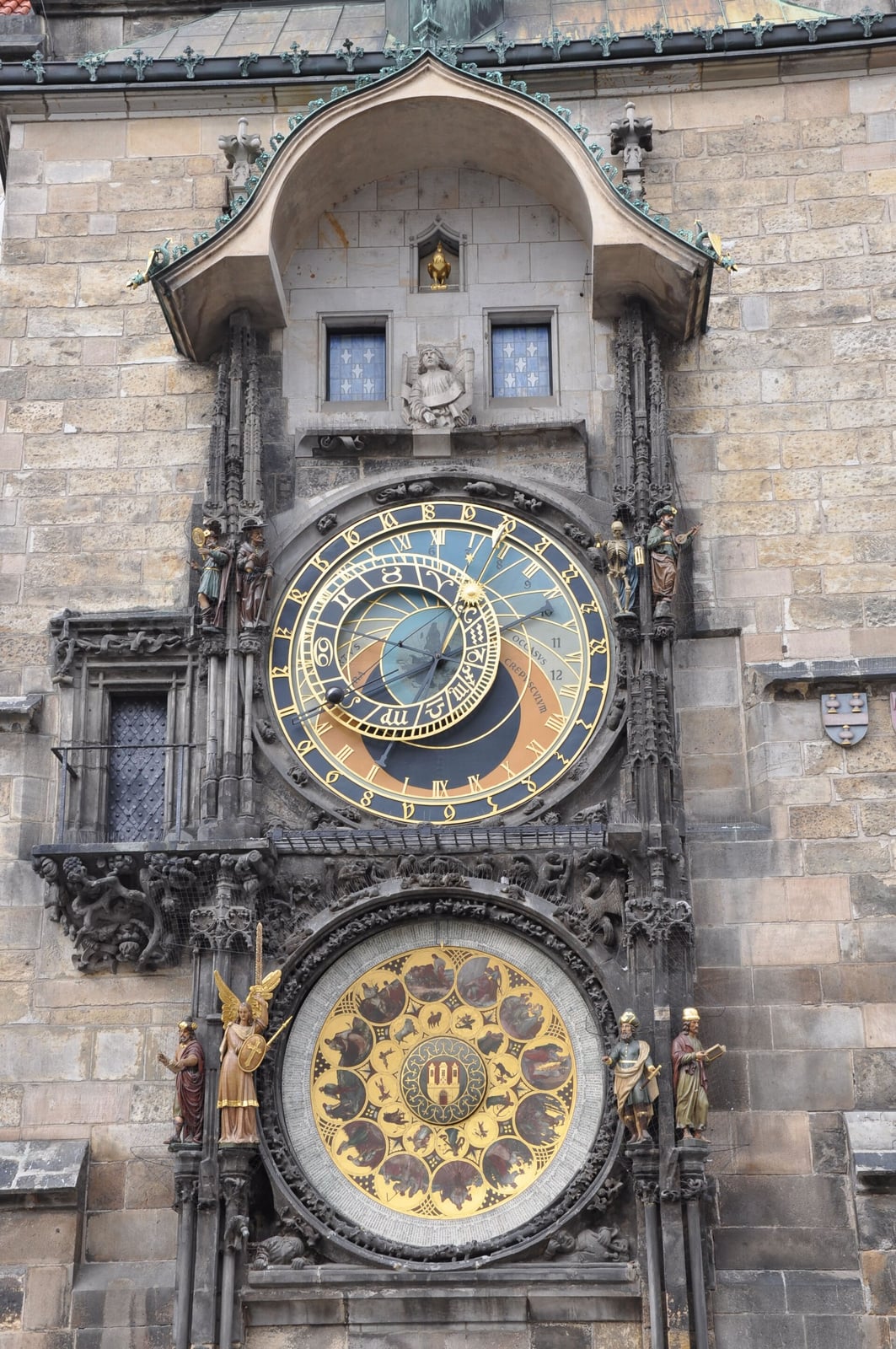
On 9 October 1410, city records documented the earliest known mention of the astronomical clock mounted on the southern wall of the Old Town Hall in Prague. The initial mechanism was the joint achievement of the horologist Mikuláš of Kadaň and Jan Šindel, an astronomer and mathematics professor at Charles University. Together they constructed a mechanical clock and an astronomical dial that served as a mechanical astrolabe, mapping the cosmos from an Earth-centred perspective. While later folk tales attributed the original construction to a clockmaster named Jan Růže, also called Hanuš, modern historical research confirmed that this claim was a mistaken reading of fifteenth-century records.
The central astronomical dial operates against a painted stationary backdrop representing the Earth and the local sky. Golden Roman numerals trace a standard twenty-four-hour day in local time, while curved golden lines mark twelve unequal daytime hours that shift in length according to the seasons. Concentric components track multiple celestial phenomena simultaneously. A movable ring displays the signs of the zodiac along the ecliptic plane using a stereographic projection, while an outer ring of Schwabacher numerals rotates through the year to measure Old Czech time, in which the twenty-fourth hour aligns with the setting of the sun.

Keep reading in Yester
Coming soon to the App Store
Keep following the story

Sources
Image: Jorge Láscar from Australia