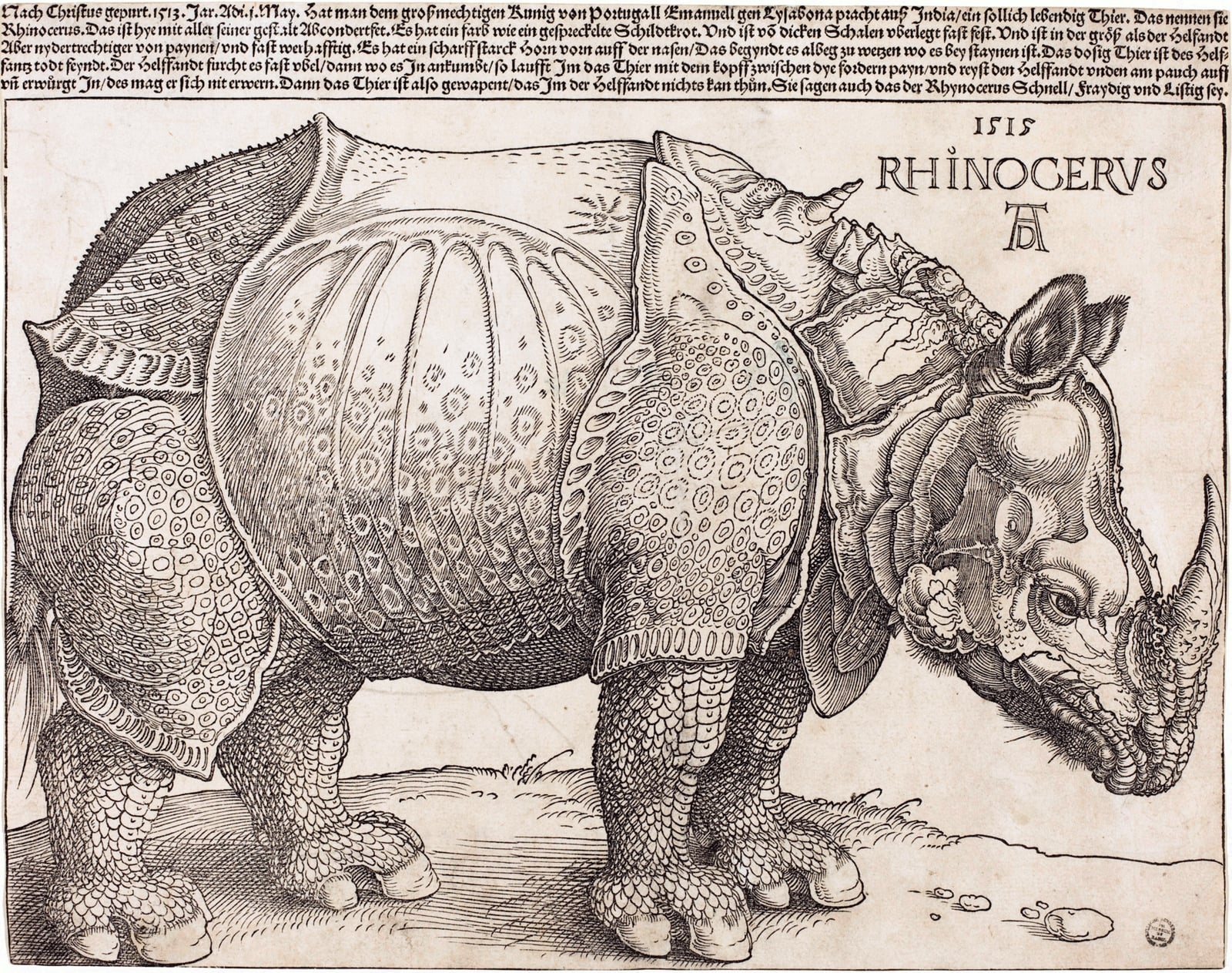
Dürer’s Rhinoceros Travels Through Print
An image made without seeing the animal shaped its European representation.
On 20 May 1515, a living Indian rhinoceros reached Lisbon after a four-month sea voyage from Goa. The animal had been offered to Afonso de Albuquerque, the Portuguese governor of India, by Sultan Muzaffar Shah II of Cambay as part of a diplomatic exchange. Albuquerque forwarded the beast and its Indian keeper to King Manuel I of Portugal. The creature was the first living rhinoceros observed in Europe since the Roman era, prompting intense curiosity. Scholars examined it, King Manuel tested ancient accounts by staging an abortive fight between the beast and a young elephant, and written accounts quickly circulated among merchants and humanists across the continent.
Among those tracking the news was the German printmaker Albrecht Durer, who was living in Nuremberg. Durer never saw the rhinoceros himself. Instead, he worked from a written description and a preliminary sketch sent from Lisbon by an unknown author. Working from these second-hand materials, he produced a pen and ink drawing and then translated the design into a reversed woodcut block. The resulting composition, printed in 1515, carried an inscription drawing heavily on Pliny the Elder, asserting that the image was an accurate likeness of the exotic beast.

Keep reading in Yester
Coming soon to the App Store
Keep following the story
Sources
- Rhinocerus (Rhinoceros), woodcut by Albrecht Dürer, 1515, museum number 1895,0122.714 (British Museum)
- Early depictions of the first Lisbon rhinoceros in the 16th century, Rookmaaker, Monson and Billia, Pachyderm 65 (IUCN SSC African Rhino Specialist Group journal)
- Hans Burgkmair print, 1515 (Rhino Resource Center)
- Pisa 1602 cathedral door (Rhino Resource Center)
- Panel (Central door), Pisa, Cattedrale di Santa Maria Assunta (Animals and Plants database, Università degli Studi di Milano)
- Jovius rhino emblem: rhino emblem of Alessandro de Medici (Rhino Resource Center)
- Scientist of the Day: Jean-Baptiste Oudry (Linda Hall Library)
- Dürer's Rhinoceros
Image: Albrecht Dürer