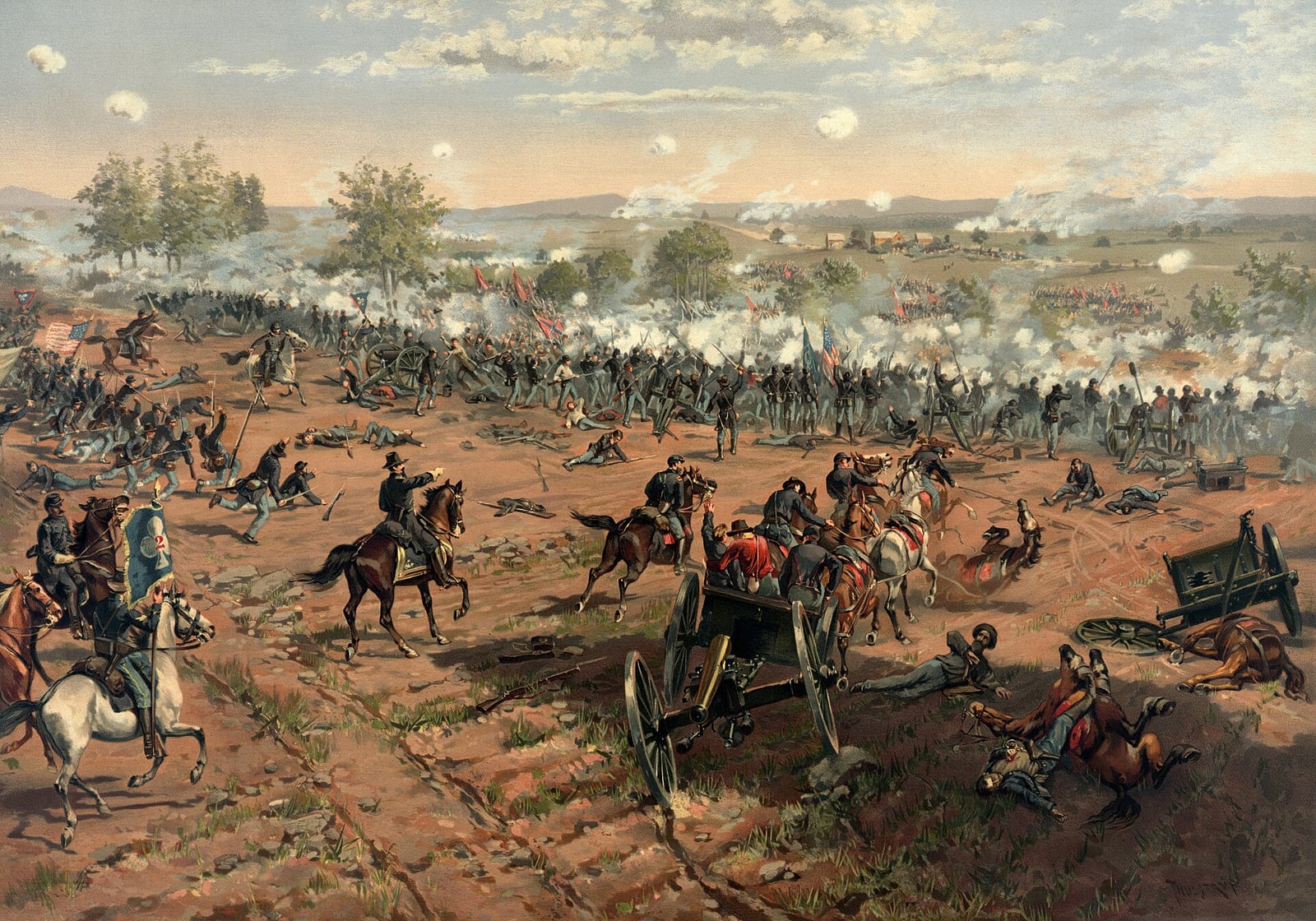
Union Forces Win at Gettysburg
Three days of fighting turned back Lee’s invasion of the North.
In June 1863, Confederate General Robert E. Lee marched the 75,000-man Army of Northern Virginia into Pennsylvania, undertaking his second offensive into Northern territory. After securing a major victory at Chancellorsville in May, Lee sought to transfer the strain of war away from Virginia, gather northern supplies, and bolster peace sentiment across the North. Pursuing him, the Union Army of the Potomac, numbering more than 90,000 soldiers, underwent a sudden change in leadership on June 28 when Major General George Gordon Meade replaced Joseph Hooker. While Lee sought to assemble his scattered divisions near Cashtown, reconnaissance led by Confederate units toward the crossroads town of Gettysburg precipitated an unanticipated clash.
The engagement began on the morning of July 1 along ridges west of Gettysburg, where a Union cavalry division under Brigadier General John Buford established defensive lines to delay advancing Confederate infantry. Buford sought to hold the approaches until federal infantry could arrive and occupy the commanding ridges south of the town. Reinforcements from the Union I and XI Corps soon entered the fray, during which Union corps commander Major General John F. Reynolds was killed. As Confederate corps under Lieutenant Generals A. P. Hill and Richard S. Ewell assaulted from the west and north, the federal lines buckled. Retreating Union troops fell back through Gettysburg to establish positions on Cemetery Hill and adjacent elevations.

Keep reading in Yester
Coming soon to the App Store
Keep following the story
Sources
Image: Thure de Thulstrup / Adam Cuerden