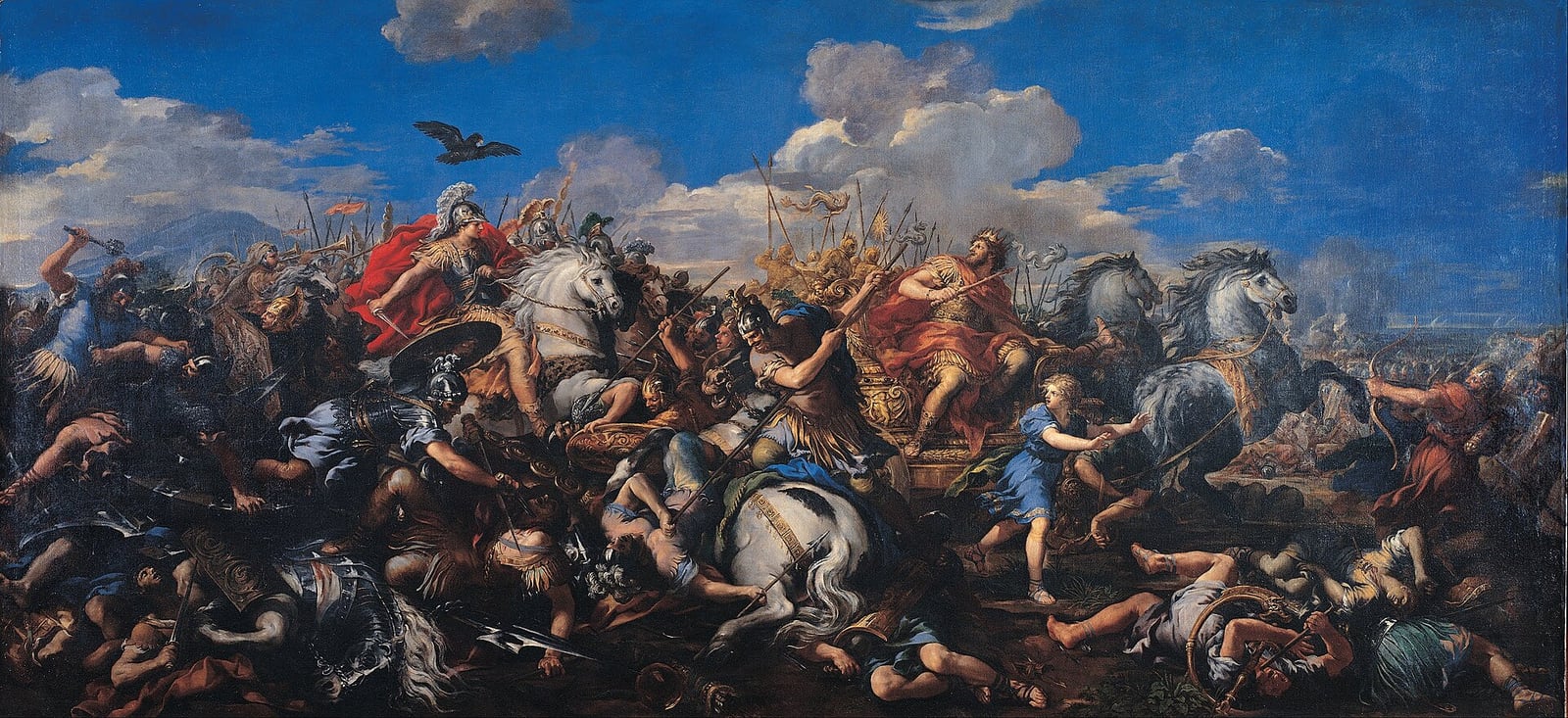
Alexander Defeats Darius at Gaugamela
A battle on the plains of northern Iraq sealed the fall of the Persian Empire.
On October 1, 331 BC, the army of Alexander the Great confronted the forces of King Darius III on the plains of northern Mesopotamia. Following his previous victory at Issus and subsequent campaigns through the Levant and Egypt, Alexander advanced into the heart of the Achaemenid Empire. Rather than moving directly down the Euphrates toward Babylon, he chose a northern route, crossing the Tigris into territory north of Arbela. Darius had assembled an imperial host drawn from his eastern satrapies, choosing a broad field near the village of Gaugamela to maximize his advantage in cavalry and scythed chariots.
Ancient accounts of the Persian force are widely considered inflated by modern historians. Arrian credited Darius with a million infantry and 40,000 cavalry, while Diodorus Siculus gave 800,000 infantry and 200,000 cavalry, figures that modern scholars regard as unworkable exaggerations designed to magnify the Macedonian achievement. Modern estimates are far lower, though they vary widely, and the historian Ernst Badian judged all the ancient figures worthless. In contrast, historians generally accept that Alexander commanded roughly 47,000 men, comprising 40,000 infantry and 7,000 mounted troops.

Keep reading in Yester
Coming soon to the App Store
Keep following the story
Sources
- Gaugamela, by Ernst Badian (Encyclopaedia Iranica)
- Gaugamela (331 BCE) (Livius.org)
- Arrian, Anabasis of Alexander: The Battle of Gaugamela (Book III, 7-16), trans. E. J. Chinnock (Iran Chamber Society)
- Diodorus Siculus, Library of History, Book XVII, 40-63 (LacusCurtius, University of Chicago)
- Arrian on the death of Darius III (Livius.org)
- Darius III Codomannus (Livius.org)
- Battle of Gaugamela
Image: Pietro da Cortona