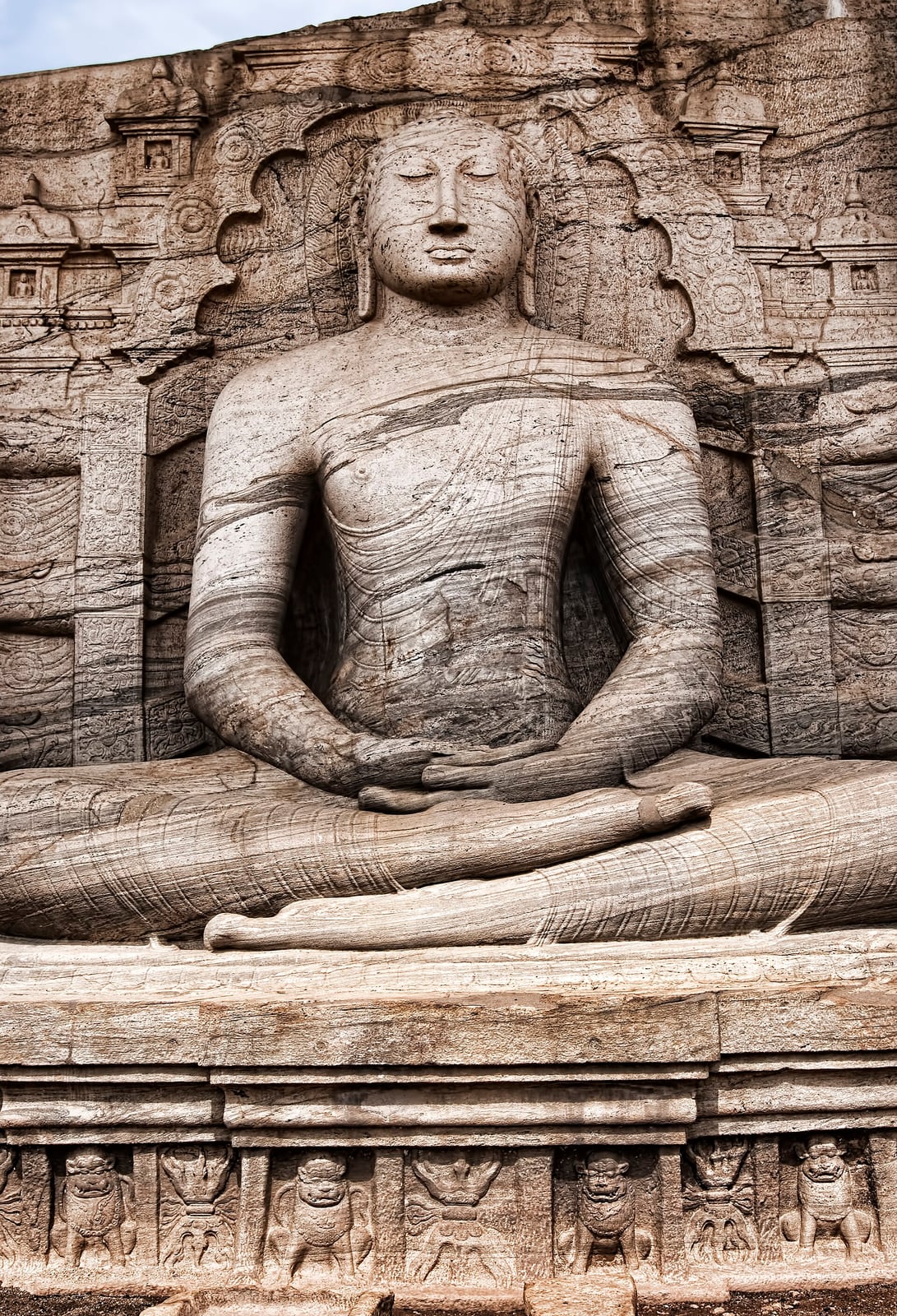
Sculptors Carve the Buddhas of Gal Vihara
Four great images were cut from a single granite face.
During the twelfth century, the royal capital of Polonnaruwa became the focal point of an ambitious religious building program under King Parakramabahu I, who ruled from 1153 to 1186. As recorded in the medieval chronicle Culavamsa, the monarch commissioned numerous shrines throughout the island, among which the rock monastery known originally as the Uttararama held a distinguished place. In modern times called the Gal Vihara, the complex was carved directly from an expansive outcrop of granite gneiss. Workers cut back into the natural slope of the rock, clearing space to carve four relief figures into it.
The statues display stylistic shifts that differentiate them from earlier sculptures of the Anuradhapura era. Master sculptors shaped broader foreheads on the subjects and defined the folds of monastic drapery with sets of parallel incised lines, reflecting an aesthetic lineage linked to the Amaravati tradition of mainland India, rather than the single-line grooves seen in older island monuments. The scale of each carving was adapted directly to the height of the stone face at that specific point, maximizing the available stone surface. Traces of ancient plaster and brick foundations demonstrate that these figures were not originally exposed open-air monuments, but stood enclosed within separate brick image houses with painted murals, and archaeologist Senarath Paranavithana suggested the rock images were initially gilded in gold.

Keep reading in Yester
Coming soon to the App Store
Keep following the story
Sources
Image: Philip Nalangan