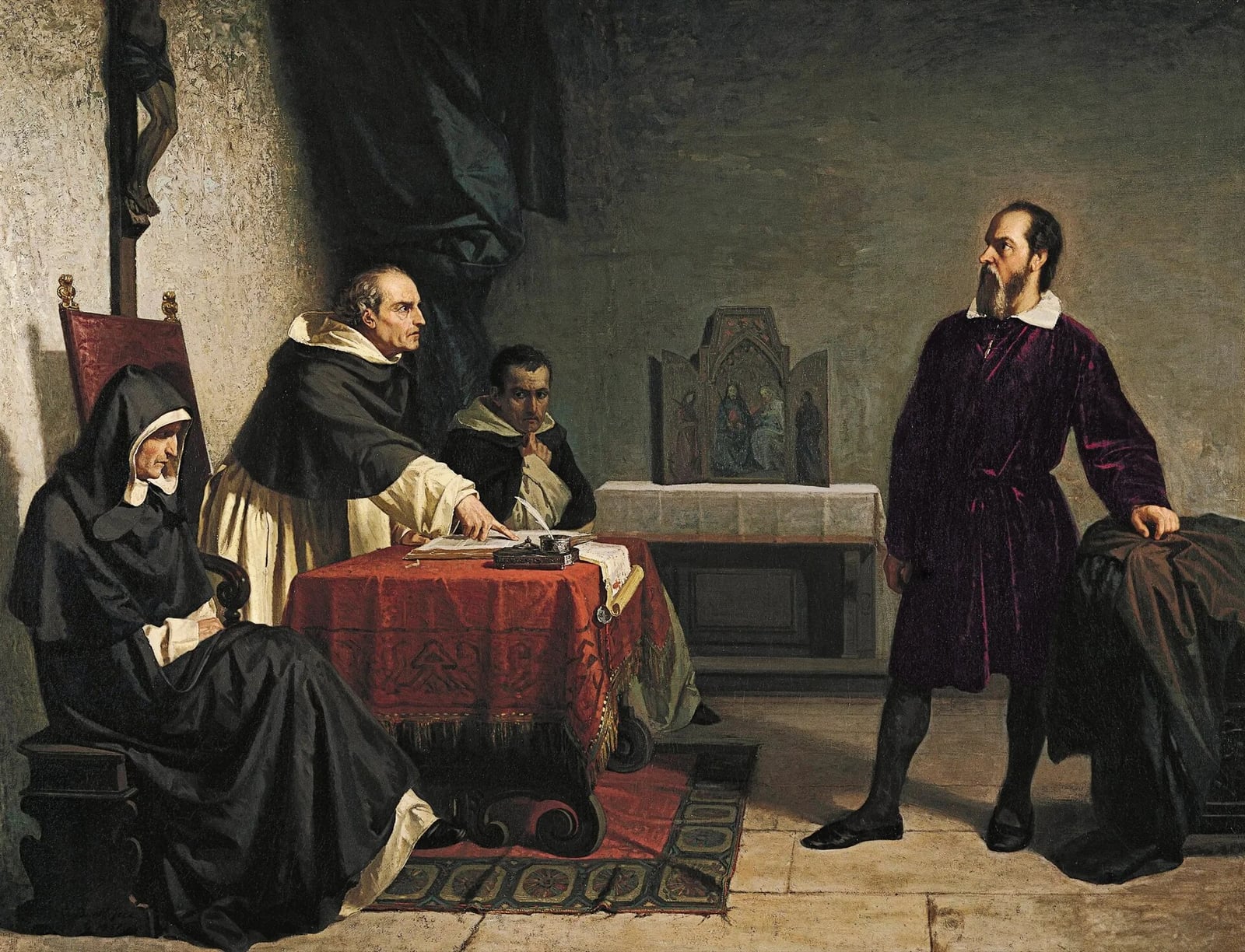
Galileo Is Tried by the Inquisition
The astronomer was forced to recant and spent his last years under house arrest.
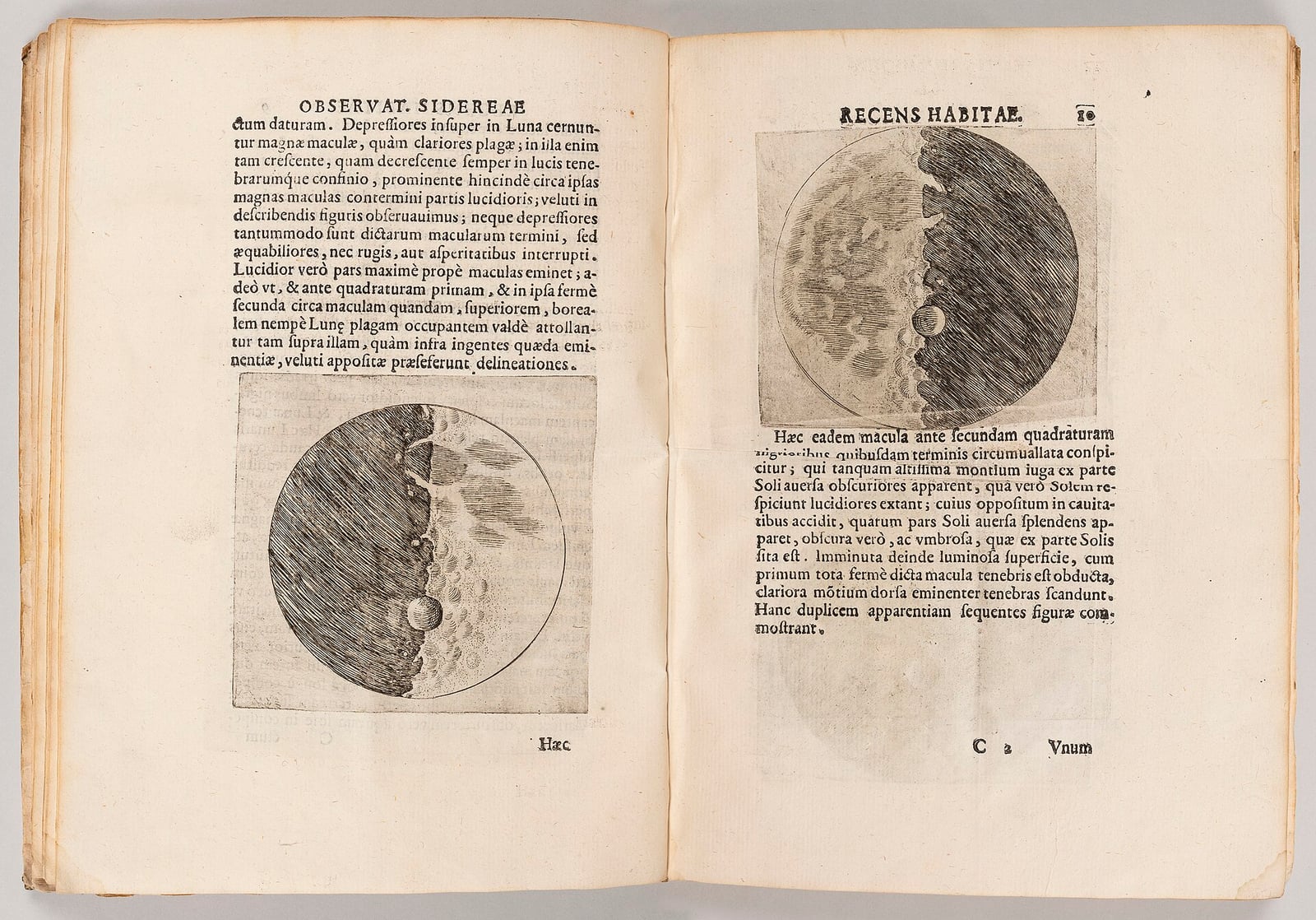
In the spring of 1633, the Italian astronomer Galileo Galilei faced interrogation before the Roman Inquisition. Two decades earlier, the Catholic Church had scrutinized his work after he turned an improved telescope toward the heavens, publishing observations of Jupiter's satellites, the rugged lunar surface, and the phases of Venus in his 1610 treatise Sidereus Nuncius. These findings challenged traditional Aristotelian and Ptolemaic cosmology, which placed a motionless Earth at the center of the universe, and instead provided compelling empirical backing for the heliocentric theory formulated by Nicolaus Copernicus.
The conflict deepened as theologians argued that a moving Earth contradicted a literal reading of biblical scripture. In 1615, Dominican critics forwarded Galileo's private letters on scriptural interpretation to Rome, prompting formal theological review. Cardinal Robert Bellarmine took the position that heliocentrism could be treated as a useful mathematical model for calculations, but asserting it as physical truth required conclusive proof and threatened accepted doctrine. In February 1616, Inquisition qualifiers formally assessed the claims, judging a stationary Sun heretical and an orbiting Earth erroneous. Galileo was ordered to abandon Copernicanism and avoid defending or teaching it, while Copernicus's De revolutionibus was placed on the Index of Prohibited Books pending corrections.

Keep reading in Yester
Coming soon to the App Store
Keep following the story
Sources
Image: Cristiano Banti