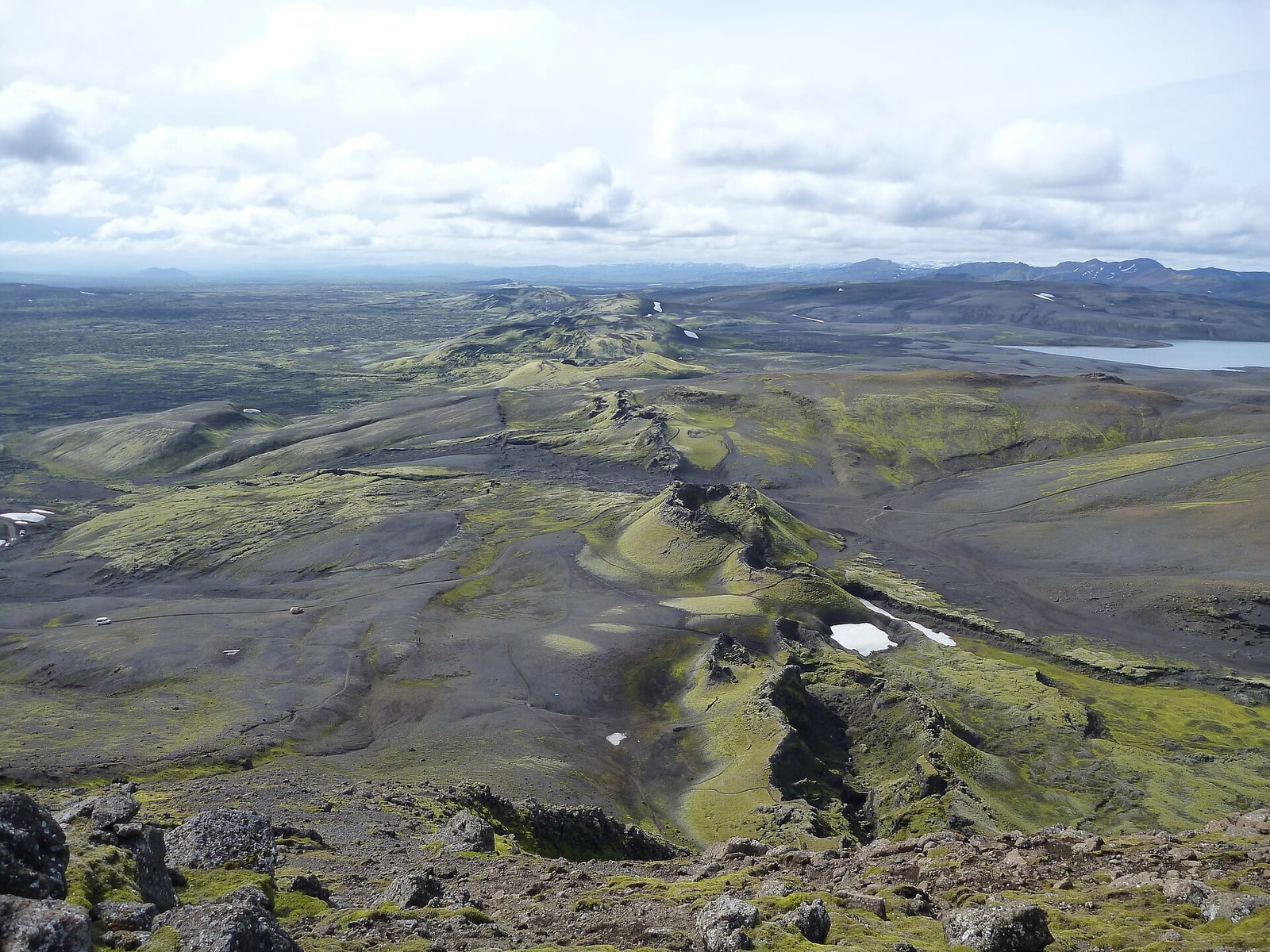
The Laki Eruption Poisons Iceland
Months of lava and gas caused famine in Iceland and a haze across Europe.
On 8 June 1783, a volcanic fissure system about twenty-seven kilometers long tore open in southern Iceland between the glaciers of Mýrdalsjökull and Vatnajökull. Part of the volcanic system centered on Grímsvötn, the Lakagígar fissure opened as a long row of craters. Groundwaters interacting with rising basalt magma initially provoked violent phreatomagmatic explosions. Over the ensuing days, the activity transitioned toward fire-fountaining and enormous lava effusions. The eruption continued for eight months until February 1784, pouring out nearly fifteen cubic kilometers of basalt lava alongside eruption plumes laden with toxic gases that rose more than ten kilometers into the atmosphere.
The environmental destruction across Iceland was catastrophic, an era remembered locally as the Móðuharðindin, or mist hardships. The eruption released an estimated eight million tonnes of fluorine compounds and one hundred and twenty million tonnes of sulfur dioxide. As grazing lands were blanketed by volcanic fallout, domestic animals ingested toxic fluoride deposits settled on the grass. The resulting skeletal and dental fluorosis decimated the rural economy, killing an estimated eighty percent of Iceland's sheep, around 40 to 50 percent of its cattle, and half of its horses. With herds ruined and pastures withered, acute famine swept the island, leading to the deaths of about one-fifth of the human population, roughly nine thousand people.

Keep reading in Yester
Coming soon to the App Store
Keep following the story
Sources
- Grímsvötn (Smithsonian Institution Global Volcanism Program)
- Fire, Fog, Frost, Famine - French Revolution? The Lakagígar eruption in Iceland, 1783-1784 [Part 1] (European Geosciences Union GMPV blog)
- Volcanic eruptions in Iceland shrunk Nile River, study shows (ScienceDaily / Rutgers University)
- Mortality in England during the 1783-4 Laki Craters eruption (Witham and Oppenheimer, Bulletin of Volcanology)
- Laki
Image: Anne Schöpa