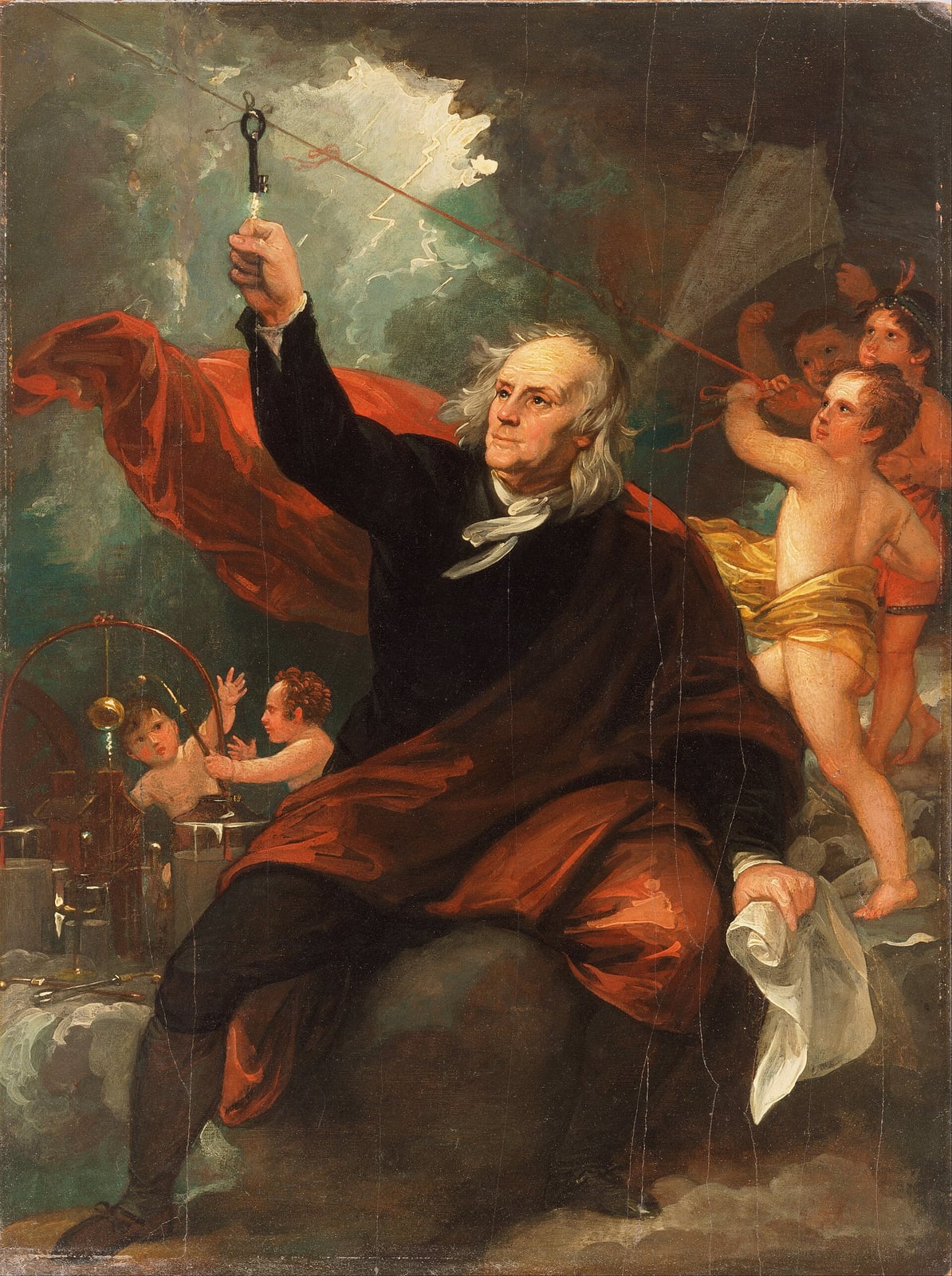
Franklin Proposes Drawing Electricity from the Sky
Experiments with lightning connected a spectacular natural force to laboratory electricity.
During the middle of the eighteenth century, natural philosophers across Europe and North America sought to establish whether atmospheric thunder and lightning were identical to the static charges produced in laboratory devices. Benjamin Franklin of Philadelphia was among those who suspected that lightning was a giant electric spark. In March 1750 he described the idea of a lightning rod in a letter to his friend Peter Collinson, and that July he set out an experiment to catch an electrical charge from the sky.
Franklin initially suggested erecting pointed metal rods on high structures to draw electricity into a Leyden jar, an early device used to store electrical charge. Because the Philadelphia spire he hoped to use was not yet built, Franklin could not immediately execute this specific setup. European researchers acted quickly on his printed suggestions; in May 1752, Thomas-Francois Dalibard carried out an experiment using a tall iron rod in northern France. Dalibard successfully extracted electrical sparks from passing clouds, confirming that overhead weather carried an electrical charge. These outdoor investigations carried severe hazards, as demonstrated in 1753 when Georg Wilhelm Richmann was killed by a glowing ball of charge during an attempt to repeat a similar rod experiment.

Keep reading in Yester
Coming soon to the App Store
Keep following the story
Sources
Image: Benjamin West