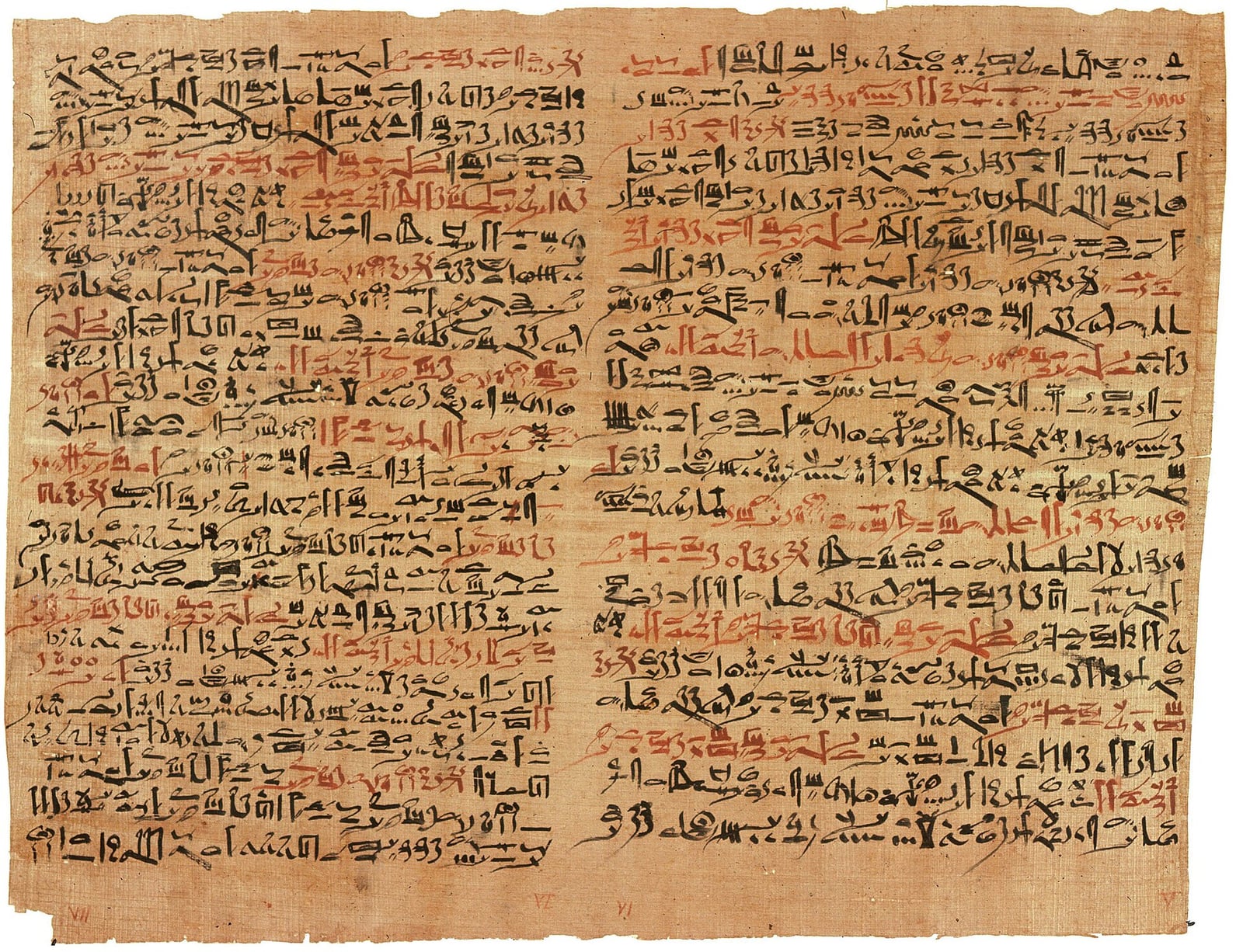
An Egyptian Papyrus Describes How to Treat Wounds
A surgical text listed injuries case by case, from head to spine.
In 1862, the American collector Edwin Smith acquired a substantial Egyptian scroll in Luxor from a local dealer named Mustafa Agha. Dating to Dynasties 16 and 17 during the Second Intermediate Period, around 1600 BCE, the manuscript was probably preserved in a tomb in the Theban necropolis. Unlike typical surviving medical scrolls from the Nile Valley that relied primarily on incantations, this text presented an empirical and systematic approach to bodily injury. Physical analysis shows that the scroll originally measured 4.68 meters in length, written right to left in black and red ink. It was composed primarily by a single scribe using hieratic script, with minor contributions by a second hand, before halting abruptly mid-line.
Scholars believe the manuscript is an incomplete copy of a considerably older treatise, based on its archaic grammatical forms, vocabulary, and interpretive glosses; estimates of the original's age range from the Old Kingdom to a few centuries before the copy. The original composition has sometimes been attributed by modern commentators, including the Egyptologist James Henry Breasted, to the Old Kingdom architect and physician Imhotep, though the identification is speculative and specialists consider it highly unlikely. Instead of cataloging individual patient histories, the surviving text functions as an organized manual of typical injuries. Because the conditions treated focus heavily on fractures, lacerations, dislocations, and physical trauma, historians frequently interpret the document as a practical reference for military surgery.

Keep reading in Yester
Coming soon to the App Store
Keep following the story

Sources
- Papyrus Edwin Smith (Science in Ancient Egypt, Saxon Academy of Sciences in Leipzig)
- The Edwin Smith papyrus: a clinical reappraisal of the oldest known document on spinal injuries (European Spine Journal, via PubMed Central)
- The Edwin Smith Surgical Papyrus (Neuroscience for Kids, University of Washington)
- Edwin Smith Papyrus
Image: Jeff Dahl