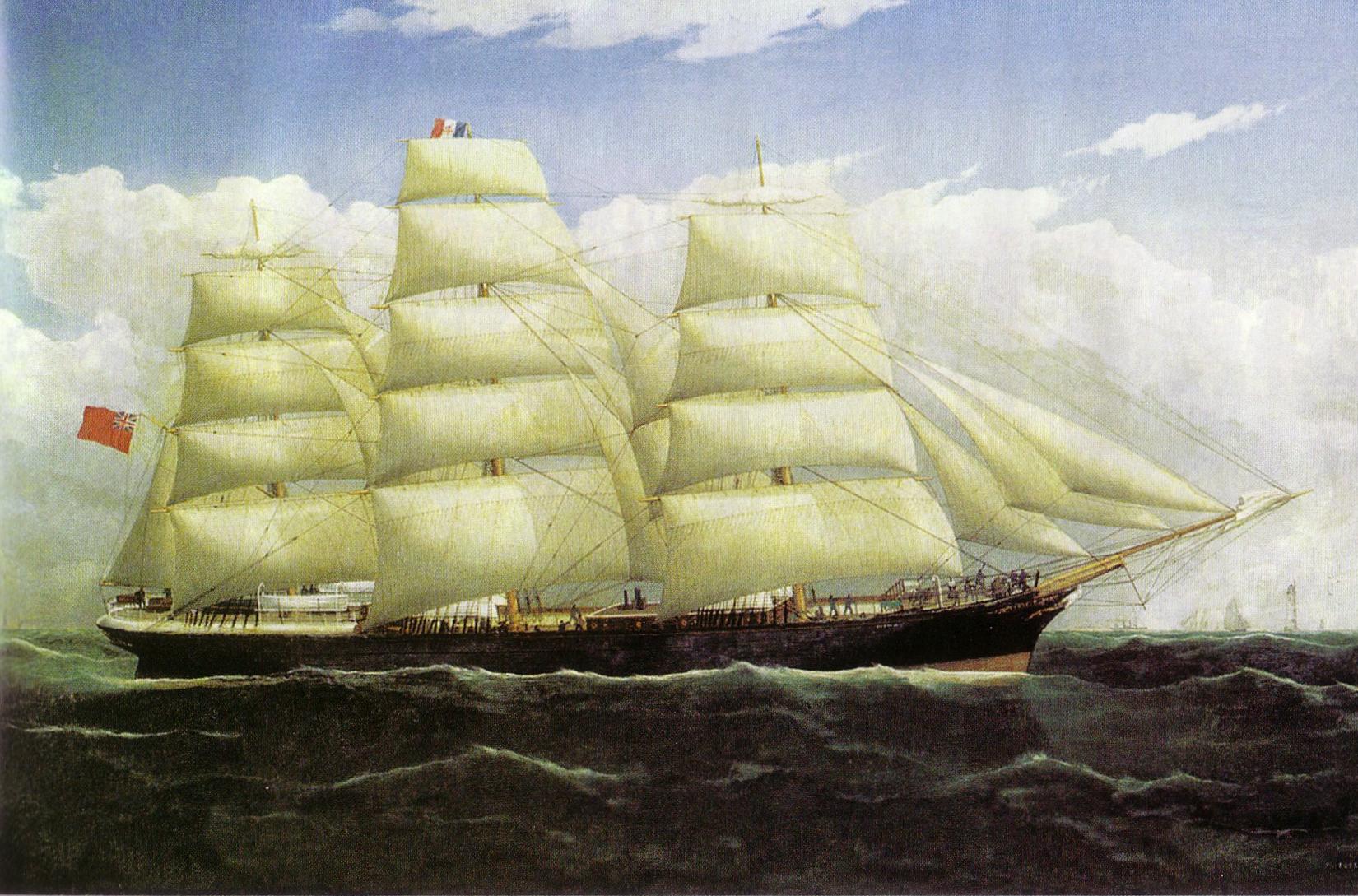
A Refrigerated Ship Carries Frozen Meat from New Zealand
A sailing ship with a freezer changed farming on the far side of the world.
In 1874, the shipbuilders Robert Duncan and Company completed the iron sailing vessel Dunedin at Port Glasgow in Scotland. Built for the Albion Line at an initial cost of 23,750 pounds sterling, the 1,320-ton craft was designed as an Auckland-class emigrant carrier capable of transporting 400 passengers. Under Captain John Whitson, the ship established a reliable record along the emigrant route to New Zealand, completing passages out of London in under 100 days. While the ship continued to carry travellers throughout its working life, an economic dilemma facing New Zealand pastoralists soon transformed its primary purpose.
During the late nineteenth century, urban population expansion in the United Kingdom produced a sharp rise in domestic meat prices. Pastoralists in Australia and New Zealand maintained vast herds, but shipping live animals across the equator was prohibitively expensive, and local attempts to can meat found little enthusiasm among British consumers. Early experiments had demonstrated the promise of mechanical chilling: shipments of beef crossed the North Atlantic in 1876, French vessels transported Argentine mutton in 1877, and the steamer Strathleven brought a modest 40 tons of Australian frozen meat to London in 1879. Seeking a broader market for southern flocks, William Soltau Davidson of the New Zealand and Australian Land Company sent agent Thomas Brydone to examine British compression systems.

Keep reading in Yester
Coming soon to the App Store
Keep following the story

Sources
- First and Famous: Dunedin (Lloyd's Register Foundation Heritage and Education Centre)
- How the SS Dunedin Revolutionised the Global Food Market (History Hit)
- How New Zealand lamb conquered Britain (Daily Post)
- Otago ships on stamps (Otago Daily Times)
- Brave visionaries behind Lamb Day (Farmers Weekly NZ)
- Dunedin (1874 ship)
Image: Frederick Tudgay