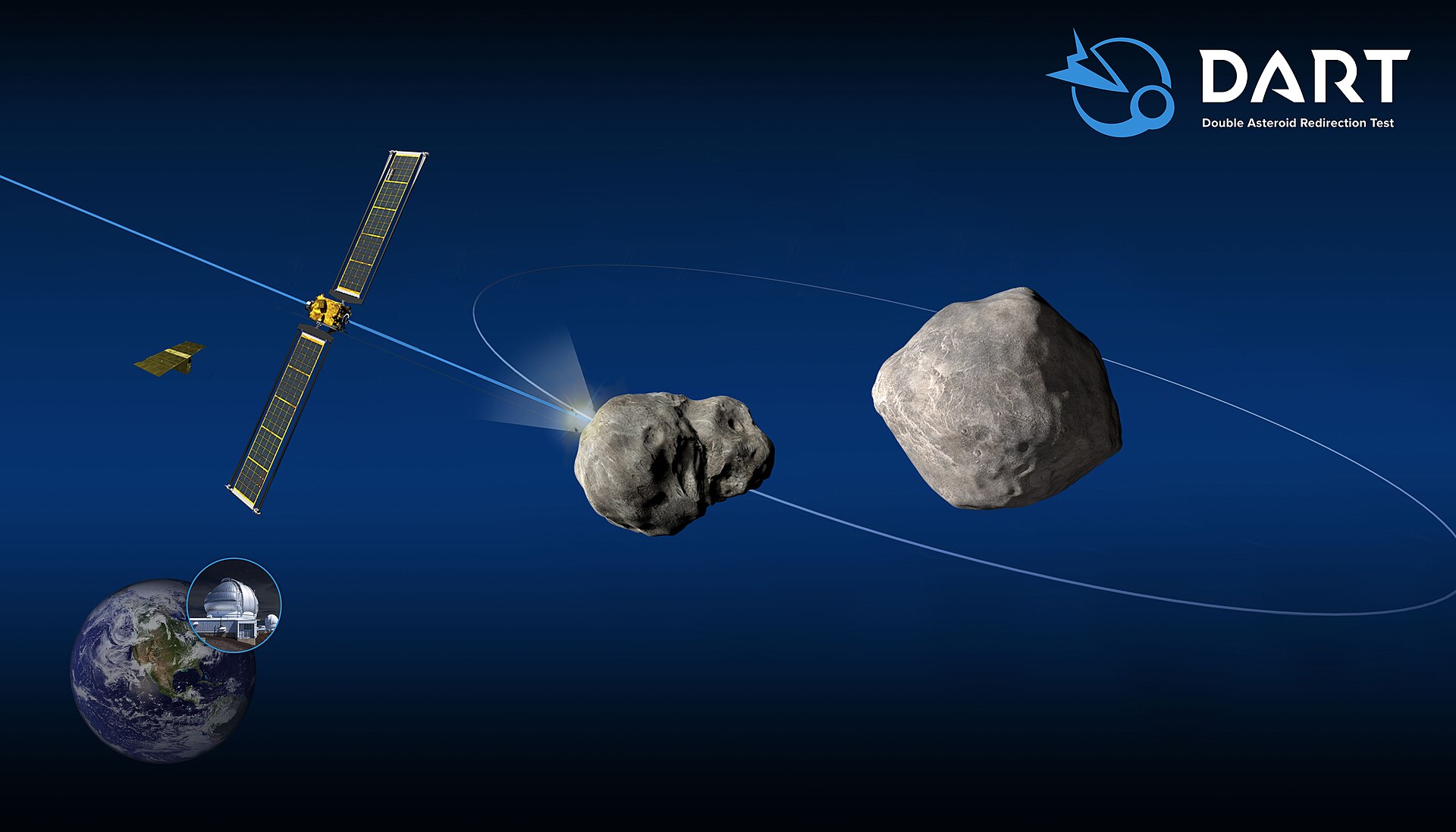
NASA’s DART Spacecraft Nudges an Asteroid
A deliberate collision showed that an asteroid’s orbit can be changed.
On 26 September 2022, a robotic American spacecraft slammed deliberately into a small celestial body millions of miles from Earth. The Double Asteroid Redirection Test, managed by NASA and the Johns Hopkins University Applied Physics Laboratory, sought to evaluate kinetic impact as a viable method of planetary defense against potential near-Earth hazards. Rather than attempting an interception of a genuine threat, planners selected the binary asteroid pair consisting of the larger Didymos and its orbiting moonlet, Dimorphos, a target system that posed no danger to Earth.
DART's journey began on 24 November 2021, when a SpaceX Falcon 9 rocket lifted off from Vandenberg Space Force Base in California. The rocket placed the spacecraft directly on an Earth escape trajectory, leaving DART to perform only a few trajectory-correction burns with simple chemical thrusters during a transit of more than ten months.

Keep reading in Yester
Coming soon to the App Store
Keep following the story

Sources
- Double Asteroid Redirection Test (DART) (NASA Science)
- NASA Confirms DART Mission Impact Changed Asteroid's Motion in Space (NASA)
- NASA's DART Data Validates Kinetic Impact as Planetary Defense Method (NASA)
- NASA's DART Mission Changed Orbit of Asteroid Didymos Around Sun (NASA)
- DART (Johns Hopkins University Applied Physics Laboratory)
- Double Asteroid Redirection Test
Image: Credits: NASA/Johns Hopkins Applied Physics Lab