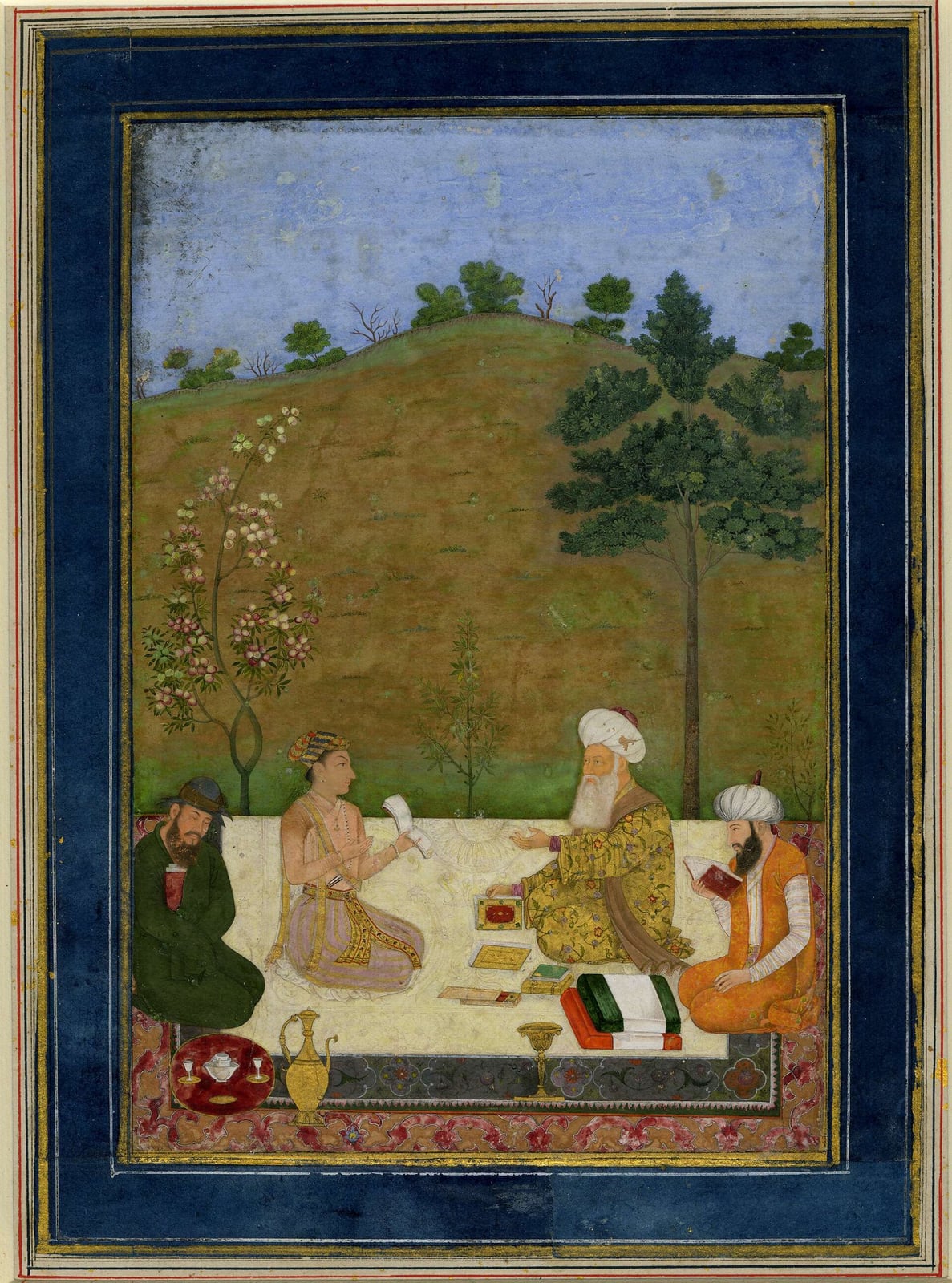
Dara Shikoh Translates the Upanishads into Persian
The heir to the Mughal throne sought common ground between Hindu and Sufi thought.
In 1657, Prince Dara Shikoh, the eldest son and designated heir of the Mughal emperor Shah Jahan, completed, with the help of Hindu pandits, a translation of some fifty Upanishads from Sanskrit into Persian. Titled Sirr-i-Akbar, or The Greatest Mystery, the ambitious rendering was undertaken to make ancient Vedantic texts accessible to Muslim scholars. In his introduction, the prince advanced the hypothesis that the Upanishads represented the hidden book mentioned in the Quran as the Kitab al-maknun. This translation formed the culmination of his sustained efforts to establish a shared metaphysical dialogue between Islamic Sufism and Hindu philosophical thought.
Born in Ajmer in 1615, Dara Shikoh received a rigorous imperial education that included the study of the Quran, history, calligraphy, and Persian poetry. Persian was his language of writing, he conversed with Hindu scholars in Hindi, and he studied Sanskrit, though how well he could read it is debated. His scholarly interests increasingly drew him toward cross-faith spiritual speculation. Earlier in the 1650s, he had authored Majma-ul-Bahrain, translated as The Confluence of the Two Seas, a treatise explicitly arguing for theological and metaphysical affinities between Sufic thought and Vedanta philosophy. He had also commissioned earlier translations of Sanskrit texts, including the Yoga Vasistha, into Persian.

Keep reading in Yester
Coming soon to the App Store
Keep following the story
Sources
Image: Dál Chard