A New Dynasty Takes Root at Copán
Inscriptions and archaeology trace the development of a Maya royal center.
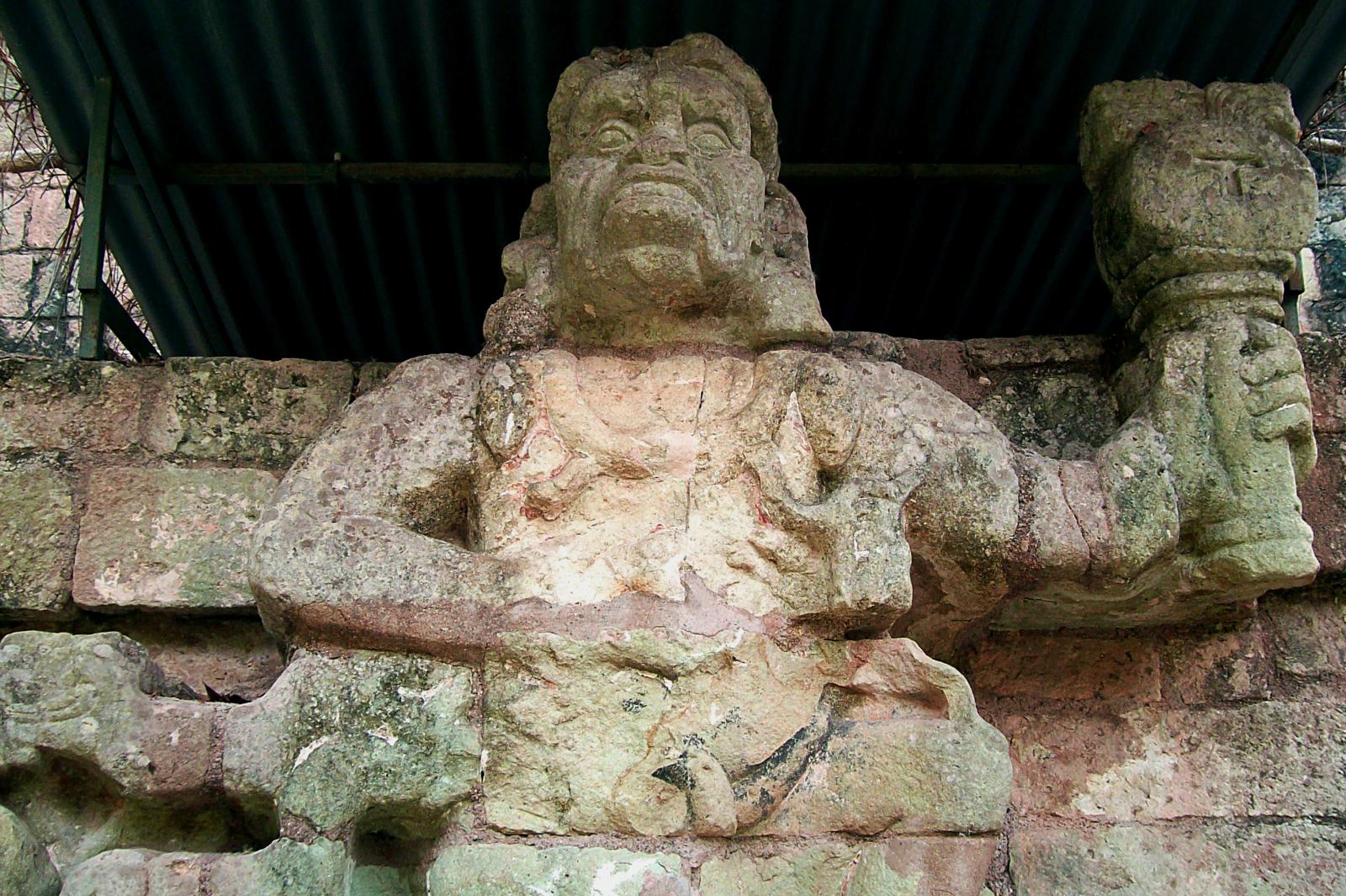
In AD 426, a foreign warrior known in later inscriptions as K'uk' Mo' Ajaw was inaugurated as a king and took the royal name K'inich Yax K'uk' Mo'; early in 427 he arrived in the fertile Copán River valley of western Honduras. Inscriptions retrospectively record that he received a royal scepter and assumed the title of Lord of the West, a designation previously linked to the central Mexican metropolis of Teotihuacan. Hieroglyphic records at Copán suggest the intervention was organized from Tikal, where an individual named K'uk' Mo' had been recorded two decades prior. Indirect archaeological evidence, including depictions on later monuments showing him with Teotihuacano warrior emblems and a war shield, points to an armed takeover, while skeletal evidence suggests he legitimized his position by taking a local noblewoman as his queen.
The founding ruler established an urban plan that linked his new kingdom to the dominant powers of Mesoamerica. K'inich Yax K'uk' Mo' initiated structures in the central precinct that incorporated talud-tablero architecture associated with Teotihuacan as well as the apron moldings and inset corners typical of the Petén lowlands. Following his death between AD 435 and 437, his son and successor K'inich Popol Hol redesigned the site core. He oversaw the construction of the city's first formal ballcourt, adorned with carved stone scarlet macaws, and placed successive monumental platforms directly over his father's vaulted tomb, setting a pattern of layered rebuilding that continued for generations.

Keep reading in Yester
Coming soon to the App Store
Keep following the story
Sources
- Copan Altar Q, Robert Sharer, Expedition Magazine 54(1), 2012 (Penn Museum)
- Finding the Founder: Old Notes on the Identification of K'inich Yax K'uk' Mo' of Copan, David Stuart (Maya Decipherment, University of Texas at Austin)
- Maya Site of Copan (UNESCO World Heritage Centre)
- Hieroglyphic Stairway at Copan (Getty Conservation Institute)
- Copan (World History Encyclopedia)
- Ek'nab: Lago Negro / Quirigua history (Prensa Libre)
- Copán
Image: Adalberto Hernandez Vega from Copan Ruinas, Honduras