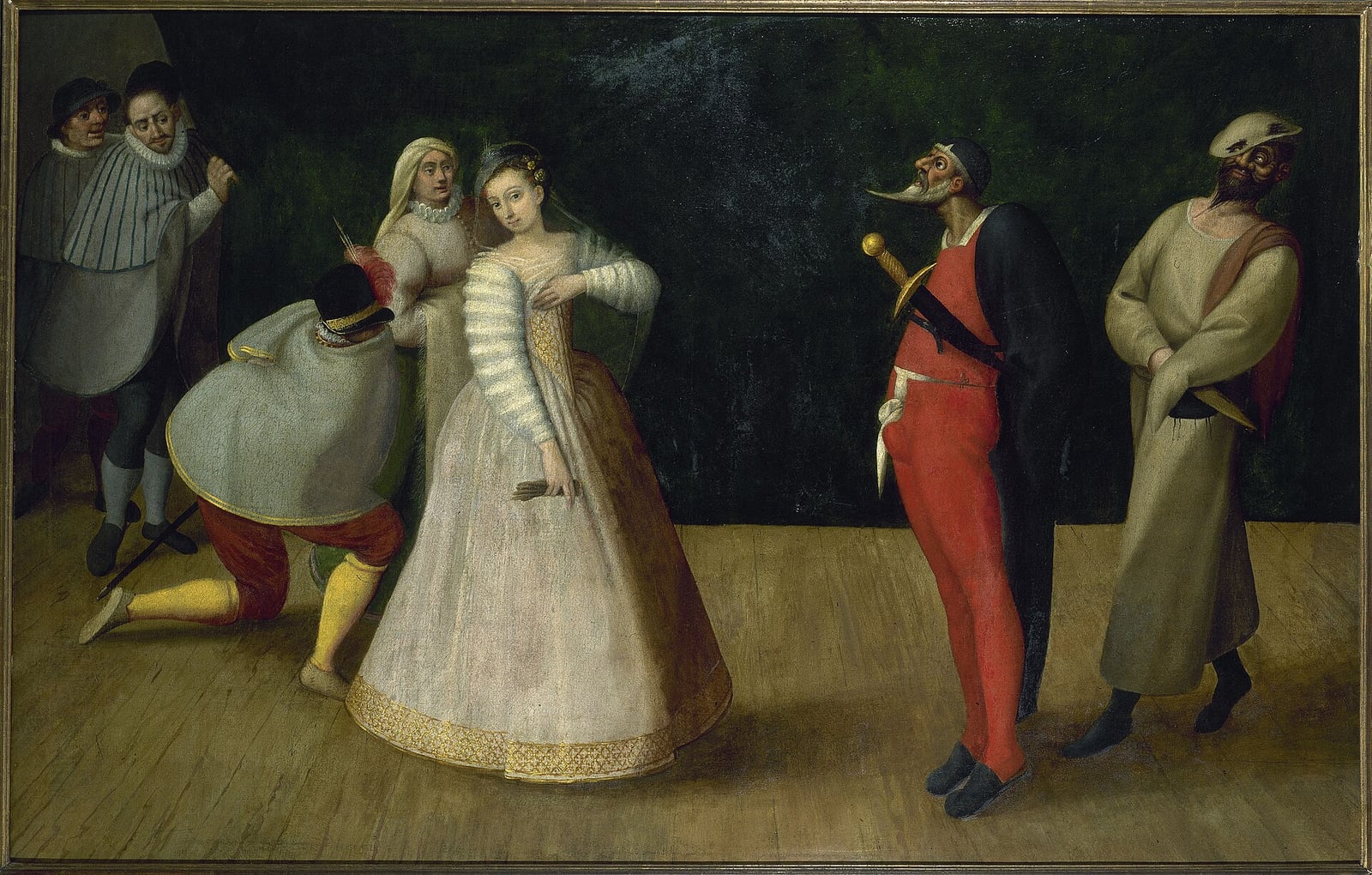
Actors in Padua Sign a Contract to Form a Troupe
The first known professional company helped launch the commedia dell’arte.
During the sixteenth century, Italian theatrical entertainment underwent a structural transformation as performers organized into professional, traveling companies. While formal similarities have led some scholars to seek roots in early Roman Atellan farces, Plautine comedies, or medieval jongleurs, historians cannot establish certain genealogical links to antiquity. Instead, documentation reveals that by the 1550s and 1560s, specialized ensembles were coalescing in northern and central Italy. Moving between courts, civic halls, and outdoor platforms erected in public squares, these troupes established a distinct craft based on improvisation, standard masks, and collaborative business partnerships.
The earliest written evidence for such a company comes from Padua. In 1545 eight men there signed a contract agreeing to travel together and earn money by performing comedies, and reference works describe the group as the first documented troupe of actors for hire. The model spread quickly. By the 1560s performers were setting up stages in city squares and collecting money from audiences, companies had begun to include women, and by the early 1570s several troupes were touring abroad. Prominent companies such as the Gelosi, the Desiosi, the Confidenti and the Uniti formed, merged and re-formed over the following decades.

Keep reading in Yester
Coming soon to the App Store
Keep following the story
Sources
- Commedia dell'arte, by Louise George Clubb, Europe 1450 to 1789: Encyclopedia of the Early Modern World, and Commedia dell'Arte, Renaissance: An Encyclopedia for Students (Encyclopedia.com)
- Commedia dell'arte, by Silvio D'Amico, Enciclopedia Italiana 1931 (Treccani)
- Commedia dell'arte (Treccani)
- Commedia dell'arte