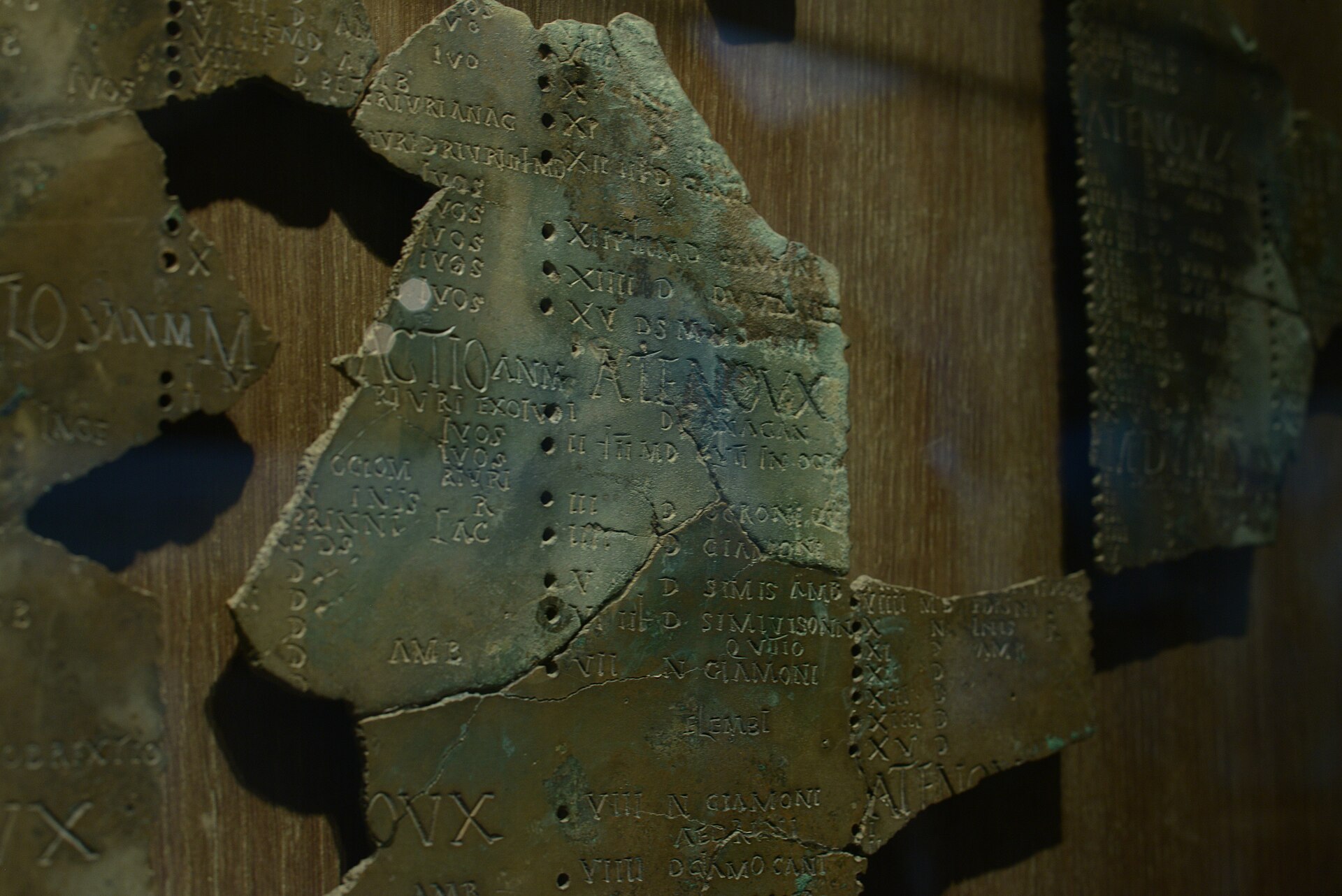
Gauls Engrave a Lunar Calendar in Bronze
The Coligny tablet tracks five years of months and days in the Gaulish language.
In 1897, agricultural workers in the French commune of Coligny, near Lyon, unearthed scores of bronze fragments alongside pieces of a life-size statue of a nude male figure bearing a spear. When assembled, these metal pieces revealed a monumental plaque well over a metre wide. Engraved using the Latin alphabet and Roman numerals, the inscription preserved an elaborate lunisolar calendar written in the Gaulish language. Surviving at roughly 40 percent of its original size, the plaque is now housed at the Gallo-Roman Museum of Lyon-Fourvière, offering direct evidence for how Celtic communities organised time under Roman rule.
Although lettering styles and the accompanying statue suggest the tablet was produced late in the second century CE, copyists' errors across the surface indicate that the inscription was transcribed from a considerably older template. Eight smaller bronze fragments discovered at a double shrine in Villards-d'Héria carry an almost identical calendar system, though they lack the small peg holes present on the Coligny tablet that allowed a user to track elapsed days. Together, these artifacts document an indigenous tradition of timekeeping that reconciled solar cycles with regular observations of lunar phases.

Keep reading in Yester
Coming soon to the App Store
Keep following the story
Sources
Image: Ruthven