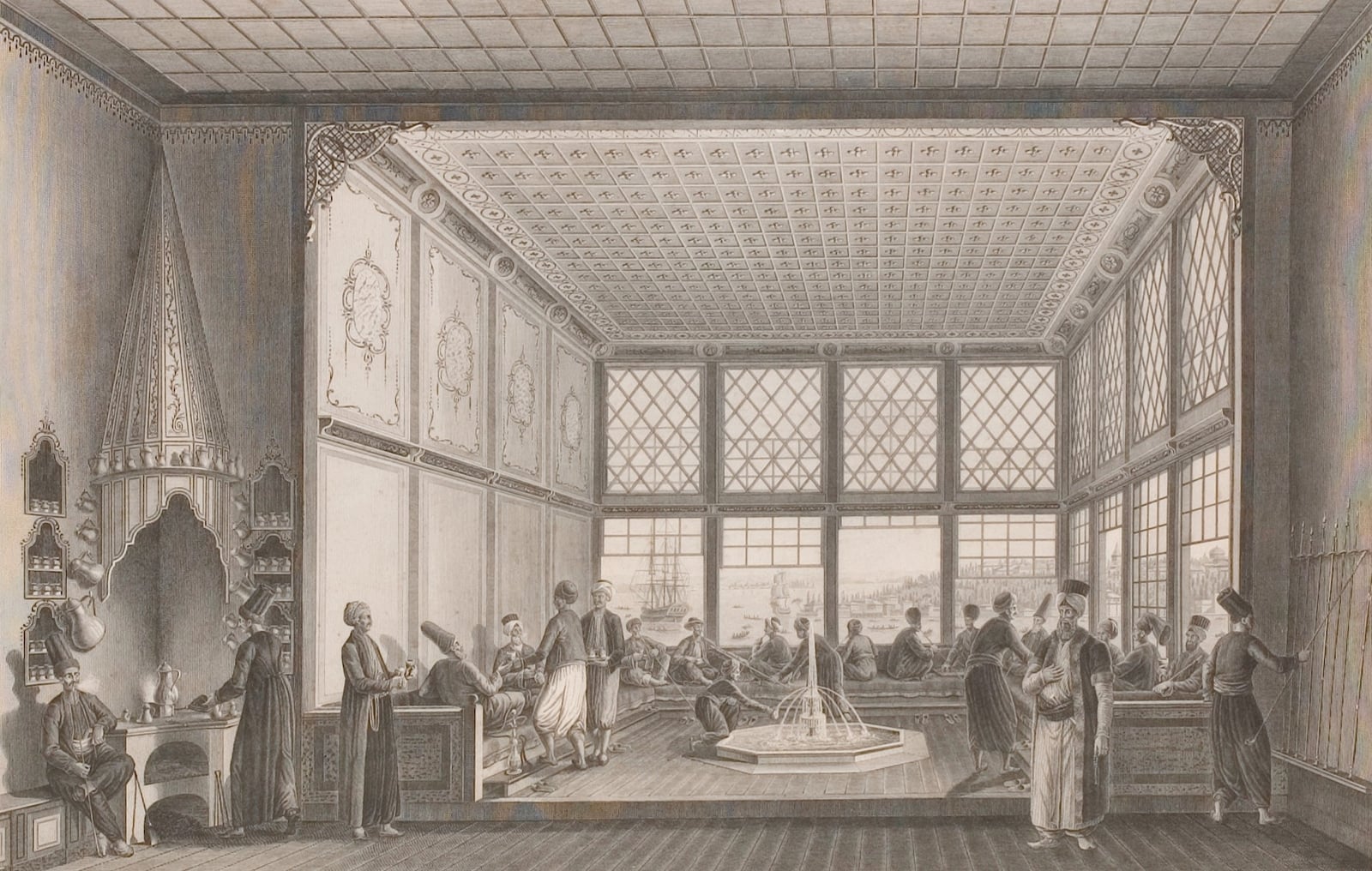
Coffeehouses Open in Istanbul
A new kind of gathering place spread from the Ottoman capital.
In the middle of the sixteenth century, an unfamiliar establishment emerged in the bustling mercantile district of Tahtakale in Istanbul. According to seventeenth-century Ottoman historian Ibrahim Pecevi, public coffeehouses were nonexistent across Ottoman territories until roughly the Islamic year 962, corresponding to 1555. That year, two Arab entrepreneurs, Hakam of Aleppo and Shams of Damascus, arrived in the imperial capital. Each opened a large venue dedicated to preparing and selling coffee, introducing urban residents to a communal institution centered around the consumed brew.
The drink itself had developed earlier in Yemen, where Sufi communities used qahwa to remain awake during night rituals of prayer and contemplation. Cultivated beans were traded through the Red Sea port of Mokha, establishing supply routes that carried the roasted, ground product northward. Early public meeting halls serving coffee emerged across Arab urban centers, including Damascus, Mecca, and Cairo, before reaching the Anatolian heart of the empire. Although authorities in Mecca banned coffee in 1511 over concerns about the conduct of those who gathered to drink it, and later Ottoman orders also tried to close coffeehouses, public devotion to the beverage consistently undermined such restrictions.

Keep reading in Yester
Coming soon to the App Store
Keep following the story

Sources
- Hakem (Halebli), Istanbul Encyclopedia of Resad Ekrem Kocu (SALT Research)
- Coffee Lesson Student Handouts (University of Arizona, Center for Middle Eastern Studies)
- Brewing Controversy: How Coffee Sparked Fierce Debate in the 16th Century (Medievalists.net, on a study in Darah: Journal of Arabian Peninsula Studies)
- 4 times drinking coffee was illegal, or even punishable by death (Popular Science)
- Our history (Lloyd's)
- Coffeehouse
Image: Antoine-Ignace Melling (Life time: 19th Century)