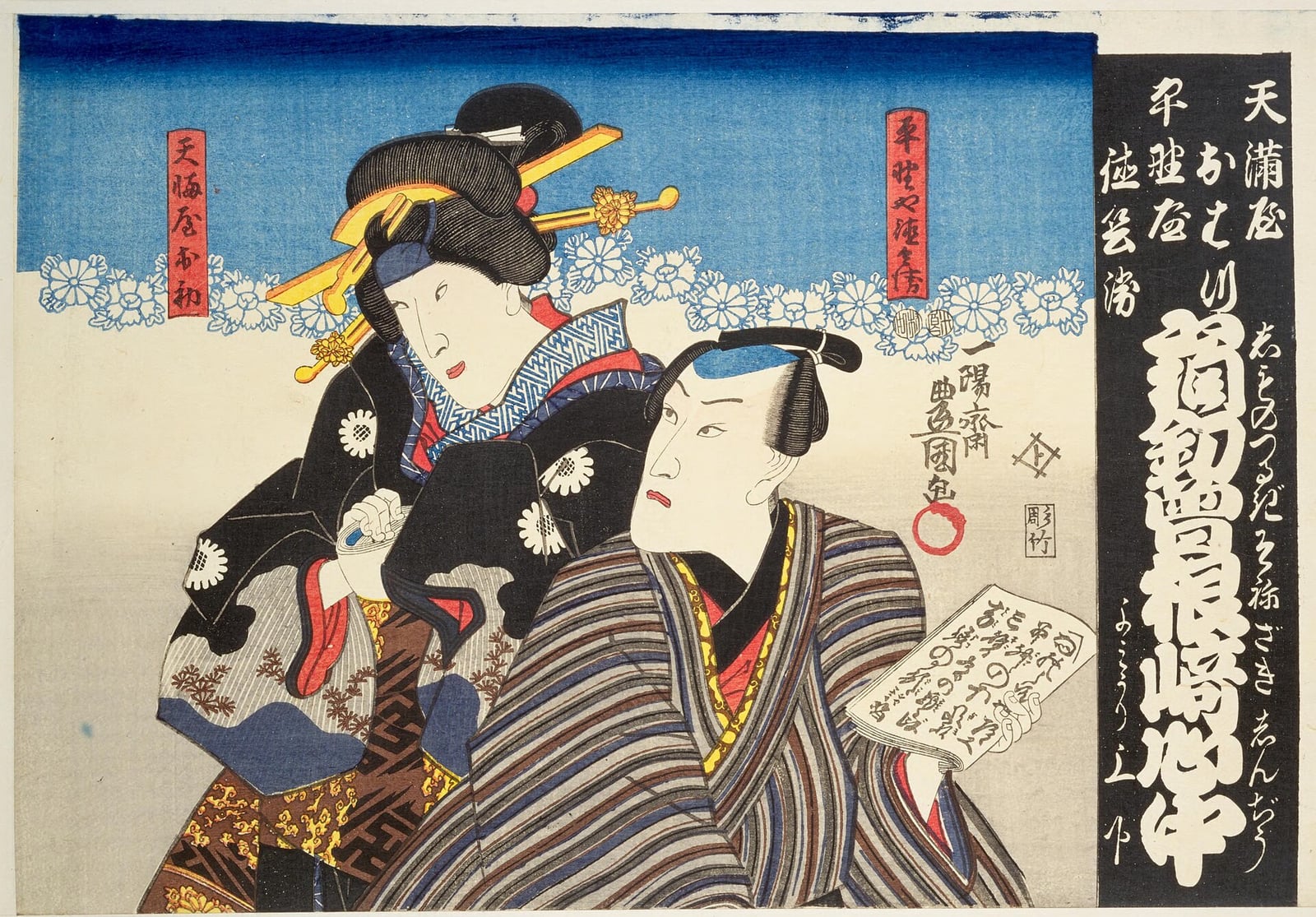
Chikamatsu’s Love Suicides at Sonezaki Opens in Osaka
A puppet play about ordinary townspeople drew huge crowds.
In 1703, the Takemoto Theater in Osaka staged The Love Suicides at Sonezaki, an original puppet play written by Chikamatsu Monzaemon. The production proved to be an immediate popular success, reviving the struggling commercial fortunes of the theater. Unlike the grand martial chronicles that had long dominated the genre of joruri, later known as bunraku, this work placed the personal dilemmas of everyday urban commoners at the very center of the stage. Its premiere marked the emergence of the sewamono, or domestic tragedy, as a major force in Japanese drama.
Born Sugimori Nobumori into a samurai family, Chikamatsu spent his youth navigating rapid social displacement. His birthplace is disputed, with Echizen Province offering the most widespread traditional claim alongside other possibilities such as Nagato Province. After his father gave up his samurai service in Echizen sometime between 1664 and 1670, the family relocated to Kyoto. Chikamatsu worked there for several years as an obscure page for a noble household, published a haiku in 1671, and was subsequently recorded at the Gonsho-ji temple in Omi Province, which is widely cited as the probable source of his professional pen name.

Keep reading in Yester
Coming soon to the App Store
Keep following the story
Sources
Image: Utagawa Kunisada