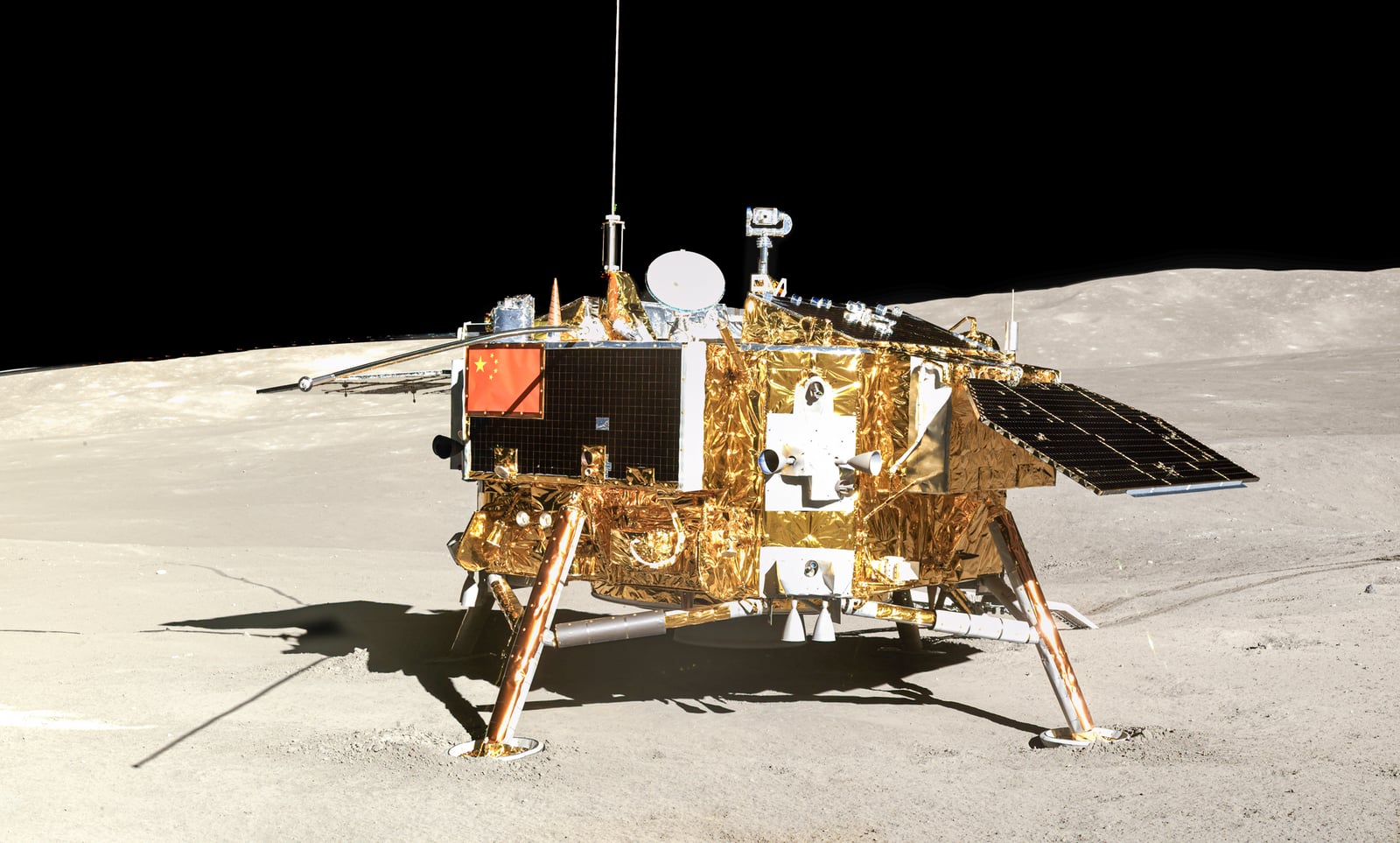
Chang’e 4 Lands on the Far Side of the Moon
No spacecraft had touched the hemisphere hidden from Earth until a Chinese lander set down there.
On 3 January 2019, a robotic probe touched down inside Von Karman crater on the far side of the Moon, completing the first soft landing on the hemisphere that faces permanently away from Earth. Named Chang'e 4 after the Chinese Moon goddess, the spacecraft touched down at 02:26 UTC within the enormous South Pole-Aitken basin. Because direct radio transmissions to Earth are physically blocked by the body of the Moon, the craft depended on an orbital communications relay that Chinese engineers had positioned months earlier.
The mission was developed as part of the Chinese Lunar Exploration Program, and was the final planned mission of the programme's second phase. Chang'e 4 was originally assembled as a backup duplicate for the Chang'e 3 mission, which landed on the lunar nearside in 2013. When that preceding mission succeeded, project engineers reassigned the spare hardware to tackle the untried challenge of reaching the far side, modifying its instruments and redesigning its trajectory. The modified spacecraft finally launched aboard a Long March 3B rocket on 7 December 2018.

Keep reading in Yester
Coming soon to the App Store
Keep following the story
Sources
- Chinese rover begins exploring far side of the moon (Spaceflight Now)
- Chang'e-4 and Yutu-2: China's mission to the Moon's farside (The Planetary Society)
- Cotton Seed Sprouts In China's Lunar Lander (NPR)
- First seeds to germinate on the Moon (Guinness World Records)
- China's Farside Moon Rover Breaks Lunar Longevity Record (Live Science)
- China's Chang'e-4 scientists win 2020 IAF World Space Award (CGTN)
- Chang'e 4
Image: CSNA/Siyu Zhang/ Kevin M. Gill