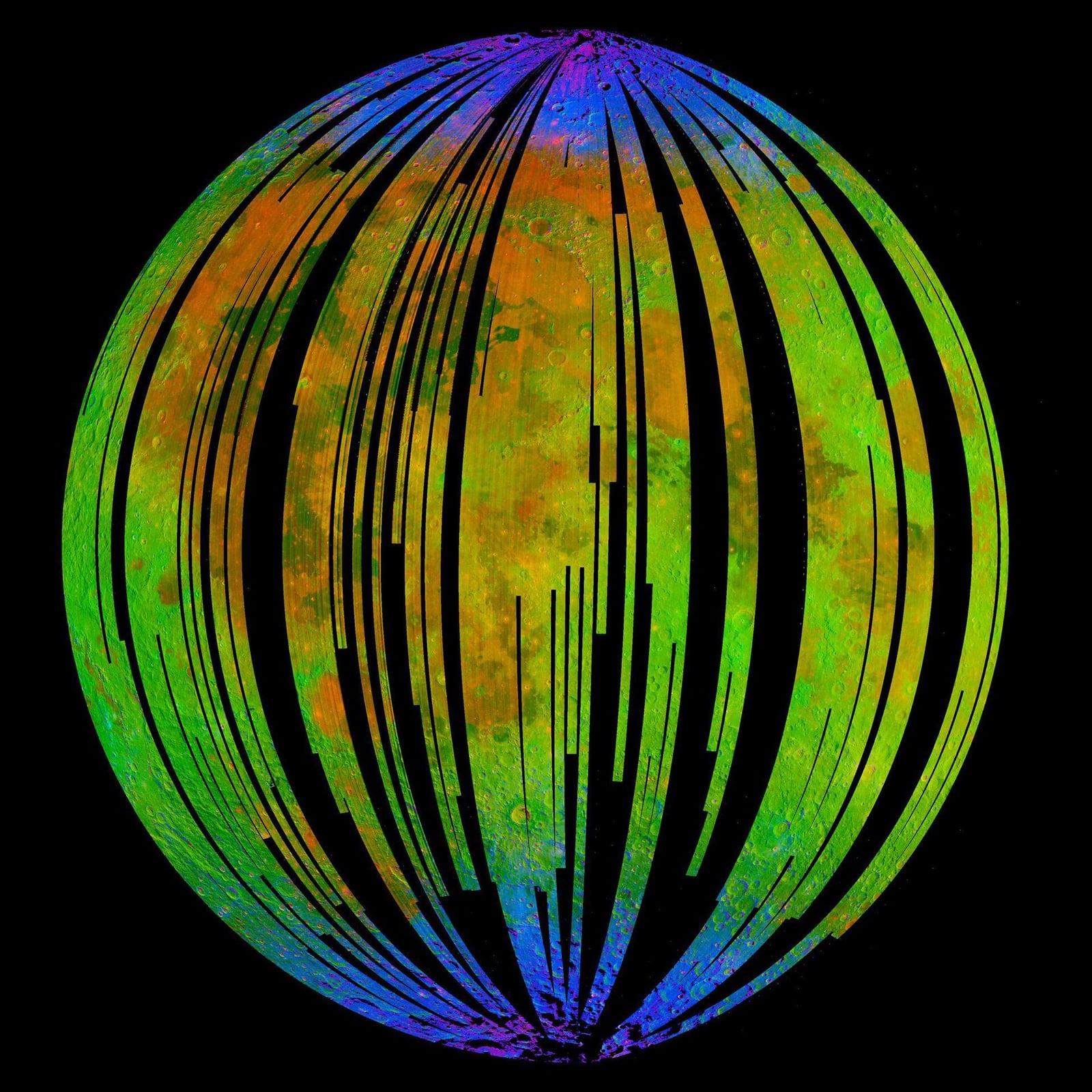
Chandrayaan-1 Helps Find Water on the Moon
India’s first lunar mission carried an instrument that detected water molecules.
On 22 October 2008, the Indian Space Research Organisation launched Chandrayaan-1 aboard a Polar Satellite Launch Vehicle from the Satish Dhawan Space Centre in Sriharikota. The mission represented India's first deep-space venture beyond Earth orbit, culminating years of planning that began within the national scientific community in 1999 and received formal government approval in late 2003. Built at an estimated cost of 386 crore rupees, the cuboid spacecraft was equipped to carry out comprehensive mineralogical, chemical, and topographical mapping of the lunar surface.
Rather than following a direct path, Chandrayaan-1 used a sequence of five engine firings over 13 days to progressively elongate its elliptical orbit around Earth. On 8 November 2008, the spacecraft fired its primary liquid engine while passing near the Moon, decelerating sufficiently to enter lunar orbit. Subsequent engine adjustments brought the craft into its operational circular polar orbit at an altitude of 100 kilometres above the surface. India thereby joined the Soviet Union, the United States, the European Space Agency, Japan and China in sending a spacecraft to the moon.

Keep reading in Yester
Coming soon to the App Store
Keep following the story
Sources
- Chandrayaan-1 (Indian Space Research Organisation)
- Chandrayaan-1 / Moon Impact Probe (NASA Science)
- Chandrayaan-1 begins Moon observations (Astronomy, ISRO update)
- India's first lunar probe lands, sends back images (Vatican Radio archive)
- India Puts Probe on Moon (VOA, via GlobalSecurity.org)
- New NASA Radar Technique Finds Lost Lunar Spacecraft (NASA JPL)
- Chandrayaan's first sensor failed much earlier (The Hindu)
- Chandrayaan-1
Image: ISRO/NASA/JPL-Caltech/Brown Univ./USGS